Introduction
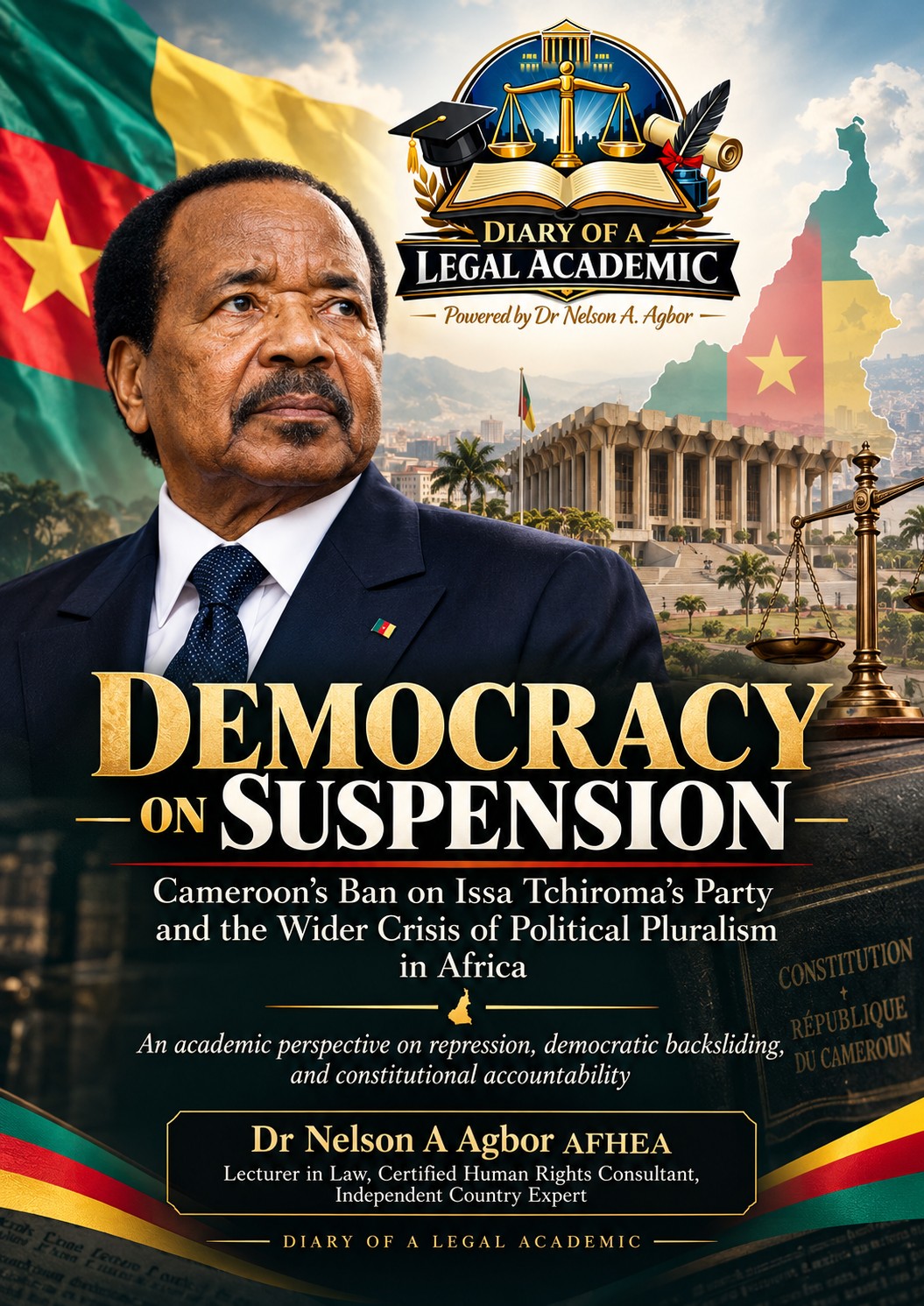
Democracy is measured not only by regular elections; it also depends on how far political institutions guarantee meaningful competition, constitutional accountability, and equal participation. Cameroon’s Minister of Territorial Administration, Paul Atanga Nji, took the most extraordinary step of suspending the Front pour le Salut National du Cameroun (FSNC) led by opposition politician Issa Tchiroma Bakary. This raises fundamental questions about one or more of these democratic principles. On 27 October 2026, the Minister issued Order 000163/A/MINAT, stopping all FSNC activities in the territory for three months. Allegations of incitement to insurrection against the government, threats to national unity, political violence, and serious disturbances of public order are linked to the October 2025 presidential election. These serious allegations require investigation. Nonetheless, their seriousness does not eliminate the standards of legality, procedural fairness and proportionality. The timing deserves particular attention. What logic justifies imposing the maximum statutory suspension almost a year after the disputed presidential election, just as Cameroon prepares for legislative and municipal elections expected in early 2027? The Minister says the investigations and proceedings justified the delay, citing a conviction by the Yaoundé Military Tribunal on 8 October 2026. But the suspension’s proximity to the next election cycle raises reasonable doubt about its effects. A measure that lapses around 27 January 2027 may deprive an opposition party of vital months for mobilisation, candidate selection, and grassroots politics. Reportedly, the FSNC says it has already withdrawn from future elections. The suspension nonetheless limits its broader political engagement. The democratic implications therefore go beyond whether its candidates planned to contest the next elections.
When administrative power constrains political competition
Whether a government has the legal right to regulate parties is not the issue per se. Is the authority exercised lawfully, and if so, with respect to the constitution or the law? Article 17 of Cameroon’s Law No. 90/056 of 19 December 1990 provides that the Minister of Territorial Administration may suspend a political party for three months on the grounds that it has been responsible for serious public disorder. The provision also acknowledges judicial review. However, mere statutory authorisation does not validate every administrative restriction. It must show that the requisite legal conditions are satisfied, that the party concerned is responsible for the alleged conduct and that the restriction is proportionate. Individuals’ criminal culpability should not automatically entail a political group’s collective culpability. Similarly, a party leader’s residence overseas does not, without identifying a breached statutory obligation, constitute misconduct requiring suspension. In Democracy Without Rights? Agbor develops that argument, which explains this distinction. The democratic constitutionalism espoused in Cameroon and Central Africa (2026) requires more than formally established institutions. It depends on whether those institutions are genuinely constraining the exercise of political authority.
A warning to Cameroon’s wider opposition community
The suspension has implications beyond the FSNC. In his 29 October interview, Minister Atanga Nji warned that political parties deemed non-compliant would face the rigour of the law. The message is clearly deterrent, but what does this mean for actual political opposition? When they believe administrative suspension is a possible response, political organisations may hesitate to organise demonstrations, challenge electoral administration, or coordinate opposition activities. In March 2024, the same ministry declared two opposition coalitions illegal, raising Human Rights Watch’s concerns about restrictions on political association ahead of the 2025 presidential election. In his paper, Cameroon in Context: Rethinking Democracy in Central and West Africa, the author offers an important analytical perspective. He analyses how formal multiparty systems can co-exist with entrenched executive dominance, neo-patrimonial power relations, and constrained democratic competition. Political pluralism may be constitutionally accepted but administratively constrained. Opposition parties may exist legally, but in practice they may not be allowed to challenge the government.
Justice, procedural fairness and democratic accountability
Administrative law guarantees must protect citizens against arbitrary government action, not merely against the instruments that implement executive decisions. In Jurisdiction, Power and the Denial of Justice, the author demonstrates how Cameroon’s procedural and jurisdictional arrangements limit access to effective judicial remedies, particularly in politically sensitive cases. That analysis applies to this situation. Political parties’ ability to challenge suspension decisions before administrative jurisdictions does not guarantee effective justice. When proceedings take longer than the three-month sanction, a favourable judgment may come after the most significant restriction has already taken effect.
To ensure meaningful judicial protection, the situation must be examined independently and promptly. Furthermore, where available under the law, an effective interim remedy must be provided. International commitments support these principles. Articles 21, 22, and 25 of the ICCPR protect the rights to peaceful assembly, association, and participation in political life. The African Charter on Human and Peoples’ Rights provides protections corresponding to Articles 10, 11, and 13. In addition, Cameroon ratified the African Charter on Democracy, Elections and Governance, which recognises pluralism and the rights of duly constituted opposition parties. A few days before suspending the FSNC, the UN Human Rights Committee questioned Cameroon about restrictions on civic space, vague legal criteria for suspending associations, and military trials of civilians. This contrast highlights the persistent tensions between global human rights obligations and local official conduct.
Cameroon within Africa’s wider democratic difficulties
Cameroon’s experience reflects a wider continental concern: the restriction of political competition through administrative and legal procedures. Mali’s military authorities dissolved political parties in May 2025. After the military dissolved political parties, UN experts warned that this would erode political freedoms in Mali. In Tanzania, the electoral commission has barred the main opposition party, CHADEMA, from all elections and by-elections until 2030 after a spat over an electoral code of conduct. Likewise, Guinea’s officials dismantled 40 political parties in March 2026 for failing to abide by regulations. Opposition organisations subsequently disputed the decision that preceded the legislative elections. The constitutional settings, statutory justifications and severity of these cases differ. However, they show how regulatory powers can significantly affect political participation. Evaluations of democratic backsliding show that democracies may weaken not only by exploiting constitutional loopholes but also through executive aggrandisement and electoral manipulation. The developments discussed also connect with Levitsky and Way’s (2002) review of competitive authoritarianism, in which multiparty elections occur alongside institutional practices that disadvantage political opponents.
Reclaiming constitutional democracy
Cameroon’s challenge is to harmonise legitimate public-order functions with the efficient safeguarding of constitutional freedoms. Four protections are very critical. Restrictions on political parties should be based on clear evidence of organisational responsibility, not general allegations against individual supporters. Moreover, the sanctions must serve a necessary and proportionate end, with proper consideration of less restrictive alternatives. Judicial review must also be prompt and effective enough to ensure that temporary sanctions do not disable political participation before a court can assess their legality. Furthermore, electoral institutions and administrative authorities should apply legal requirements consistently to parties in government and opposition. As part of electoral governance, the African Union and regional bodies should consider restrictions on political participation, not just assess polling-day activities. In his article, Jurisdiction, Power and the Denial of Justice: The Impact of Jurisdictional Incompetence on Fair Trial Rights in Cameroon, Agbor demonstrates that political power depends on control over legal institutions. Formal legal protections do not guarantee substantive rights when independent oversight poorly constrains administrative discretion.
Conclusion
The suspension of the FSNC raises a question beyond Issa Tchiroma Bakary and the controversial October 2025 presidential election: is democracy meaningful if the institutions responsible for protecting political participation also have broad powers to suppress it? Governments can codify laws to maintain public order. Nonetheless, lawful regulation must be distinguished from excessive restrictions on political association. Cameroonian Parliament: Legislative sessions following the presidential elections should conclude with the introduction of a new electoral code that includes provisions to regulate unfair practices by political players. For democracy to function properly, opposition parties alone are not enough. Indeed, opposition parties must operate within an institutional legal order that protects and remedies disagreement and subjects governing power to the rule of law.