
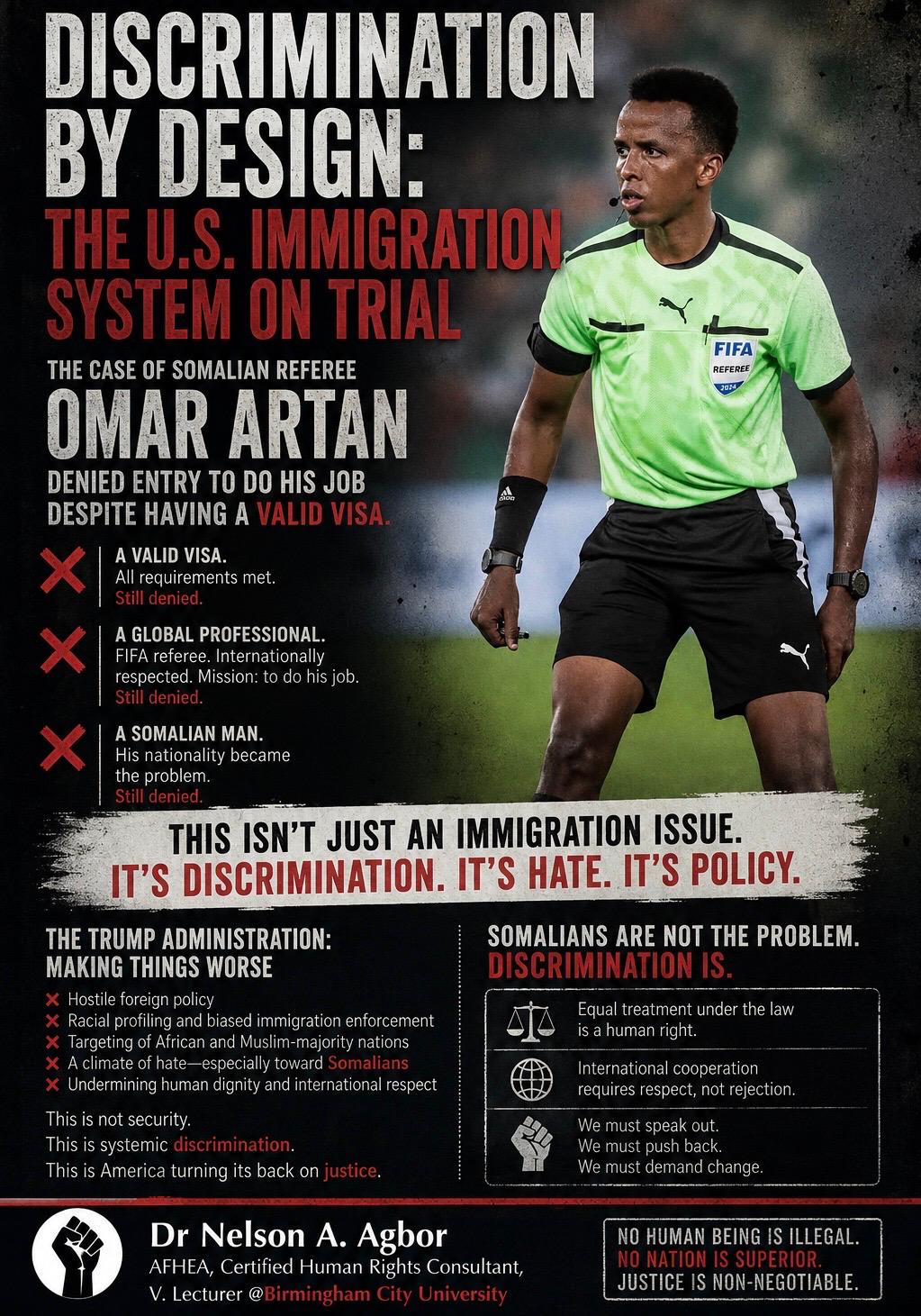
The reported denial of entry to Somali refugee Omar Artan, despite his possession of a valid U.S. visa, raises profound questions about fairness, equality, and discrimination within the US immigration system. US immigration law grants broad discretionary powers to border officials. Yet the exercise of such discretion often produces outcomes that appear inconsistent with the principles of due process and equal treatment. When a professional invited to perform legitimate employment-related duties is prevented from entering the country despite meeting formal visa requirements, concerns naturally arise about the extent to which nationality, ethnicity, or geopolitical considerations influence immigration decision-making.
The U.S. immigration system has long been criticised for operating under a framework that combines legal formalism with extensive executive discretion. While visas are generally understood as authorisation to seek entry into the United States, admission ultimately remains subject to the judgment of border authorities. This arrangement creates a significant gap between legal entitlement and practical reality. For individuals from countries that have historically been subjected to heightened scrutiny, such as Somalia, the uncertainty generated by this discretionary system can amount to a structural barrier that disproportionately affects certain national groups.
The experiences of Somali nationals under U.S. immigration policy must be understood within a broader historical context. Since the collapse of the Somali state in the early 1990s and the subsequent rise in security concerns in the Horn of Africa, Somali migrants and travellers have frequently faced heightened suspicion. Although national security remains a legitimate governmental objective, critics argue that security-based narratives have often contributed to the stereotyping of Somali individuals as potential risks rather than as ordinary travellers, professionals, students, or family members seeking lawful entry.
The reported treatment of Omar Artan illustrates the practical consequences of these broader patterns. If an individual with a valid visa travelling for a legitimate professional purpose can still be denied entry, questions arise about the transparency and accountability of immigration enforcement. Such outcomes not only affect the individual concerned but also undermine the confidence of international organisations, employers, and professional communities that rely on predictable and impartial immigration procedures. The resulting uncertainty can discourage international cooperation and limit opportunities for global professional engagement.
The administration of President Donald Trump intensified debates about the relationship between immigration policy and national identity. Policies associated with the Trump era, including travel restrictions affecting several predominantly Muslim countries, drew widespread criticism from scholars, human rights organisations, and civil society groups. Although supporters defended these measures as necessary security precautions, opponents argued that they institutionalised discrimination by disproportionately targeting people by nationality and religion. Somalia’s inclusion in restrictive immigration measures reinforced perceptions among many observers that Somali nationals were being subjected to exceptional scrutiny.
Beyond immigration, critics contend that the Trump administration’s foreign policy contributed to a deterioration in America’s global image as a defender of openness and multiculturalism. Restrictive immigration policies were often interpreted abroad as signals of exclusion rather than engagement. For communities with strong transnational ties, including the Somali diaspora, such policies fostered a sense of alienation and insecurity. The symbolic impact of these measures extended beyond legal consequences, shaping public perceptions of who is welcomed and who is viewed with suspicion in the United States.
The case of Omar Artan also highlights the intersection of race, nationality, and institutional power. Contemporary scholarship on migration increasingly emphasises that immigration systems do not operate in a social vacuum. Rather, they reflect broader political narratives about belonging, security, and national identity. Somali travellers often occupy a particularly vulnerable position within these narratives because they are racialised as African, identified as Muslim, and associated with a country frequently portrayed through the lens of conflict and instability. These overlapping factors can contribute to discriminatory outcomes even when formal legal rules appear neutral.neutral.
From a human rights perspective, excluding qualified professionals through opaque decision-making processes raises concerns about equality and procedural fairness. International norms emphasise that state discretion over borders should be exercised in a manner consistent with non-discrimination and respect for human dignity. While states retain sovereign authority to control admission, the legitimacy of immigration enforcement depends on transparent criteria and consistent application. When individuals perceive that nationality or ethnicity plays an undue role in decision-making, trust in governmental institutions is weakened.
The broader implications extend beyond any single case. Immigration systems function not only as mechanisms of border control but also as instruments that communicate national values. Decisions affecting travellers from historically marginalised countries can either reinforce or challenge perceptions of exclusion. Ensuring that visa holders are treated according to clear, objective standards is therefore essential to maintaining the credibility of immigration institutions. Failure to do so risks perpetuating patterns of inequality that disproportionately burden already vulnerable populations.
In conclusion, the reported denial of entry to Somali refugee Omar Artan despite his valid visa serves as a significant case study in ongoing debates about discrimination within the U.S. immigration system. Whether viewed through the lens of legal discretion, racialised security narratives, or the legacy of restrictive immigration policies, the incident illustrates the challenges faced by Somali nationals seeking equal treatment. It further underscores criticisms that Trump-era immigration policies intensified existing inequalities and contributed to perceptions of exclusion. A fair and effective immigration system must balance legitimate security concerns with transparency, accountability, and an unwavering commitment to the principle that individuals should be judged by objective criteria rather than by nationality, ethnicity, or origin.
Dr Nelson A. Agbor AFHEA
Certified Human Rights Consultant
V. Lecturer @Birmingham City University.




