
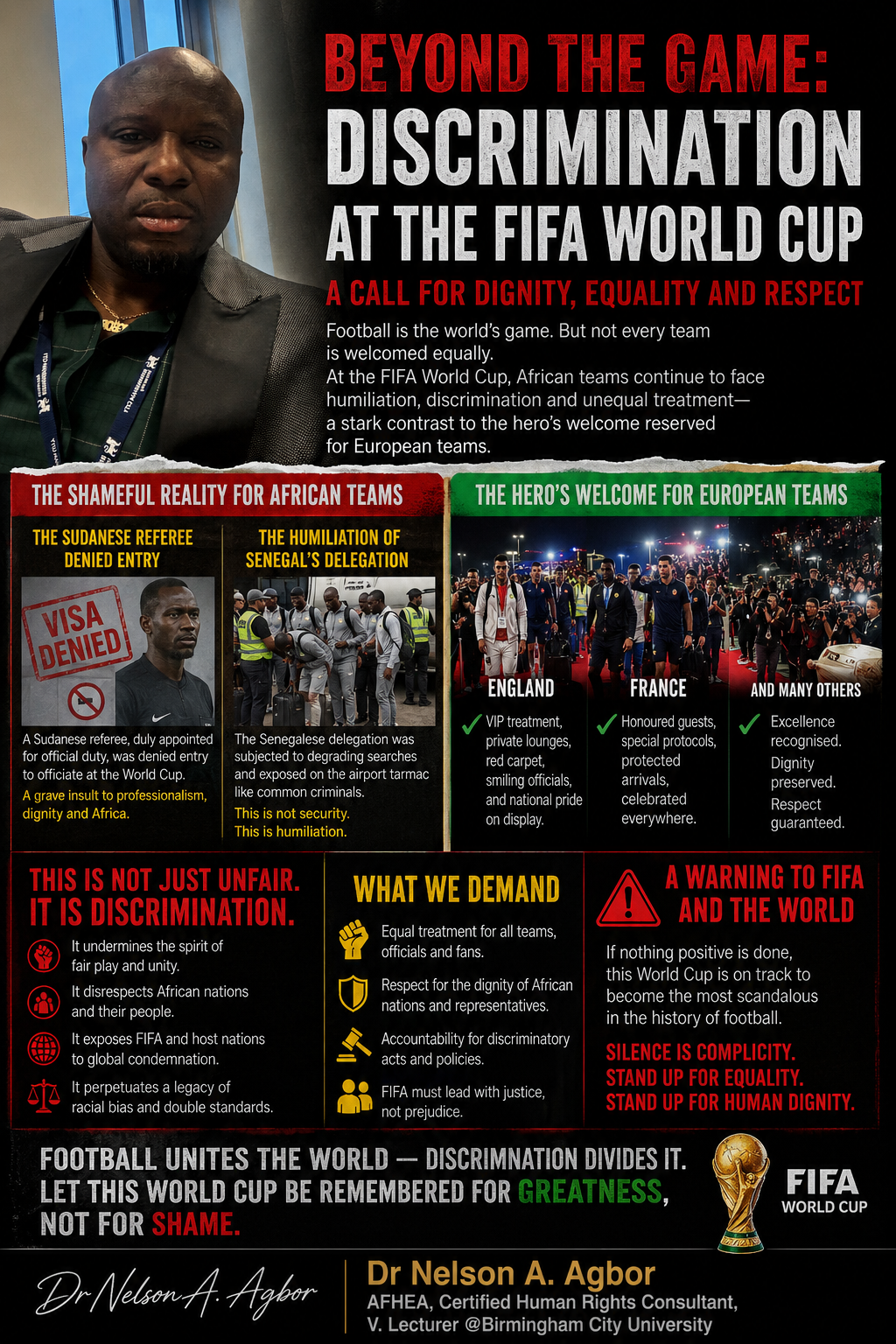
The 2026 FIFA World Cup was envisioned as a celebration of global unity, diversity, and the universal appeal of football. Yet before a ball has been kicked in earnest, troubling controversies have emerged that risk overshadowing the tournament’s sporting achievements. The treatment of certain African participants and delegations has raised serious concerns about unequal treatment, selective scrutiny, and the persistence of discriminatory attitudes within the structures of international sport. These incidents have prompted difficult questions about whether all nations are truly welcomed equally to football’s premier global event.
Football has long been promoted as a force capable of transcending political, racial, and cultural divisions. FIFA frequently emphasises inclusivity, respect, and equal opportunity as the game’s foundational principles. However, these principles lose credibility when participants’ lived experiences across different regions of the world appear markedly unequal. The contrast between the reception afforded to several African representatives and that enjoyed by teams from powerful European football nations has created an uncomfortable perception of double standards that FIFA and tournament organisers cannot afford to ignore.
One of the most disturbing controversies concerns Somali referee Omar Abdulkadir Artan, who was selected to officiate at the 2026 FIFA World Cup. Artan, one of Africa’s most respected match officials and the Confederation of African Football’s 2025 Referee of the Year, was denied entry to the United States despite holding the necessary travel documents and FIFA accreditation. His exclusion prevented him from participating in what would have been a historic milestone for both his career and Somali football. The incident drew widespread criticism, as it appeared to undermine FIFA’s commitment to equal participation regardless of nationality.
The symbolism of this decision extends far beyond a single individual. Artan represented not merely himself but an entire continent whose footballing contributions have enriched the World Cup for decades. When an elite African official is denied the opportunity to perform on the world’s biggest sporting stage, questions naturally arise about fairness, transparency, and the extent to which geopolitical considerations are allowed to interfere with international sport. Such actions risk conveying that some participants are viewed with suspicion simply because of their national origin.
Equally troubling were the widely circulated images and videos of the Senegalese delegation. Team members were subjected to extensive security checks on an airport tarmac, including luggage inspections and screening that many observers considered needlessly public and humiliating. The images quickly spread across social media, sparking outrage among football supporters, journalists, and commentators, who questioned why invited World Cup participants were treated as if it were more a criminal investigation than an athletic competition.
Regardless of the explanations officials later offer, perception matters enormously in international events. The public spectacle of athletes being searched in full view of cameras and bystanders carries powerful symbolic weight. For many observers, the incident reinforced longstanding concerns that African teams often face levels of scrutiny and suspicion not routinely directed at delegations from wealthier or more politically influential regions. The resulting damage to trust cannot be dismissed by procedural justifications alone.
The contrast with the treatment often afforded to leading European teams is striking. National teams such as England and France are routinely welcomed as celebrated sporting ambassadors, their arrival generating media excitement, ceremonial receptions, and extensive hospitality. Their presence is often framed as an asset to the tournament and to host communities. While such treatment is understandable given their footballing stature, it becomes problematic when other nations encounter barriers, suspicion, and humiliation rather than respect and dignity.
From a sociological perspective, these incidents illuminate broader inequalities that continue to shape international sport. Global football operates within a hierarchy in which some nations enjoy greater political influence, economic leverage, and institutional protection than others. Consequently, African participants may be subjected to forms of scrutiny that are rarely applied with equal intensity to representatives of more powerful footballing nations. Such disparities undermine the ideal of football as a genuinely universal game governed by common standards. by common standards.
FIFA cannot remain a passive observer in these circumstances. Although immigration and security policies formally fall within the authority of host governments, FIFA has significant influence and moral responsibility. The organisation must actively advocate for the consistent treatment of all accredited participants, establish transparent protocols for resolving disputes, and ensure that no delegation or official is subjected to degrading or discriminatory treatment. Failure to act decisively risks eroding confidence in FIFA’s commitment to equality and inclusion.
If meaningful corrective measures are not implemented immediately, the 2026 FIFA World Cup risks being remembered not only for its football but also for controversy, exclusion, and allegations of unequal treatment. The denial of entry to an elite African referee and the public humiliation of the Senegalese delegation have already cast a shadow over the tournament’s reputation. FIFA, host authorities, and the international football community must recognise the seriousness of these concerns and respond urgently. A World Cup that claims to unite humanity cannot tolerate practices that appear to divide participants by nationality, geography, or perceived status. Unless fairness, dignity, and equal treatment are visibly restored, this tournament may ultimately be remembered as one of the most scandal-ridden in modern history.
Dr Nelson A. Agbor AFHEA
Certified Human Rights Consultant
V. Lecturer @Birmingham City University.




