
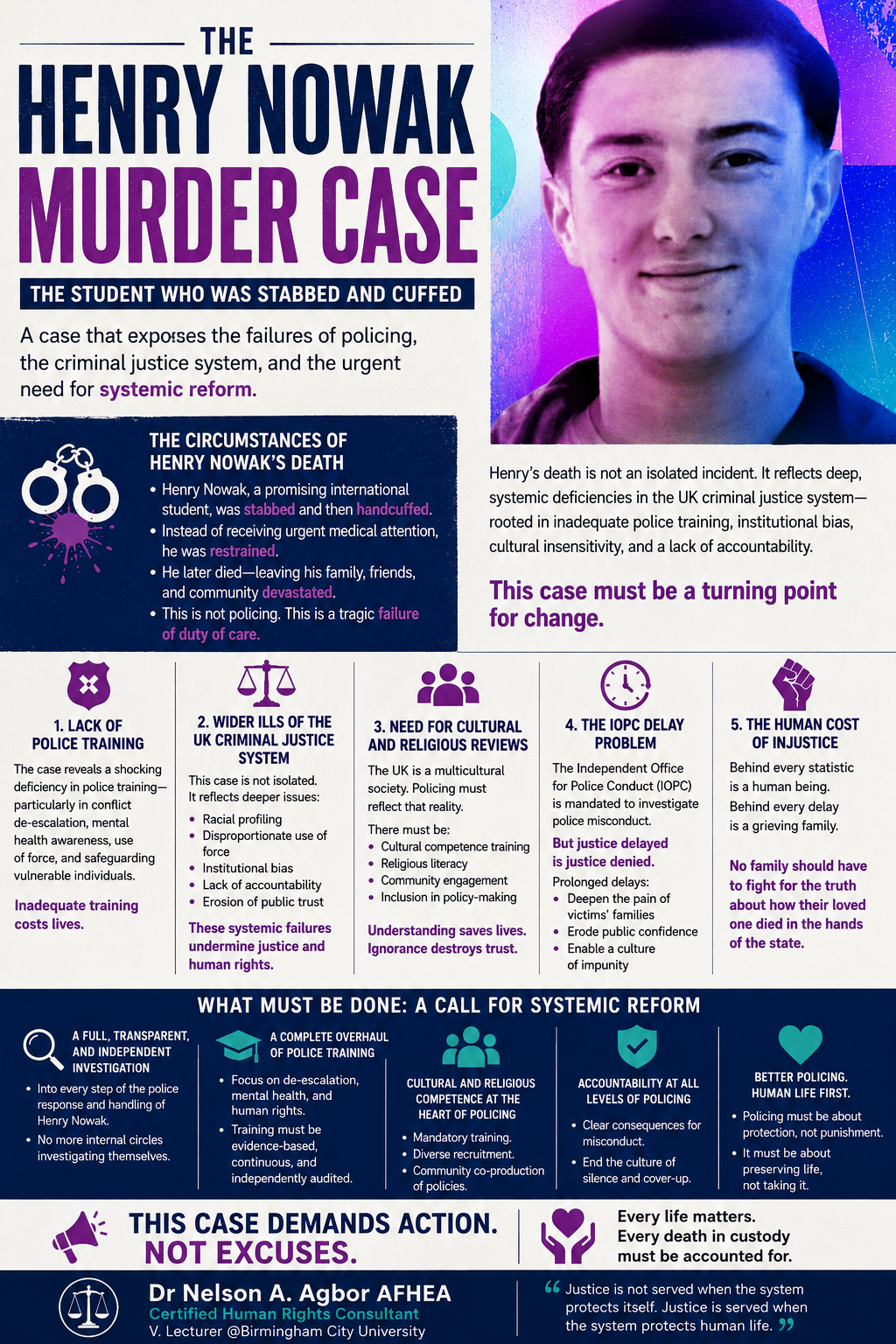
The murder of Henry Nowak has rapidly emerged as one of the most troubling criminal justice cases in contemporary Britain. The case concerns the death of Henry Nowak, an 18-year-old University of Southampton student who was fatally stabbed in Southampton in December 2025. Evidence presented in subsequent criminal proceedings established that Nowak was stabbed multiple times by Vickrum Digwa, who was later convicted of murder and sentenced to life imprisonment. Particularly disturbing was the revelation that when police officers arrived at the scene, Nowak was handcuffed and treated as a suspect despite repeatedly stating that he had been stabbed and needed assistance. The circumstances of his death have generated widespread public concern because they raise profound questions about police decision-making, operational competence, accountability, and the criminal justice system’s ability to place the preservation of human life above competing considerations.
The facts of the case reveal a tragic sequence of events. Court proceedings heard that Digwa falsely alleged that Nowak had racially abused and assaulted him. Officers initially accepted this account and handcuffed Nowak, who was suffering from serious internal injuries. Body-worn video footage subsequently released to the public showed Nowak repeatedly informing officers that he had been stabbed and was struggling to breathe. Despite these pleas, officers initially failed to recognise the severity of his condition. Only later did they recognise that he was critically injured. By then, the window for a more immediate medical response had closed. Although questions remain about whether emergency intervention could ultimately have saved him, the images of a dying teenager in handcuffs have become emblematic of a profound institutional failure.
From a policing perspective, the case raises serious concerns about training, situational assessment, and victim identification. Police officers are routinely required to make rapid decisions in complex and uncertain circumstances. However, professional policing standards require officers to reassess situations as new information emerges. The failure to prioritise medical assessment when an individual repeatedly claimed to have been stabbed suggests deficiencies in training, supervision, operational judgement, or a combination of all three. The core lesson from the case is not simply that an error occurred; rather, it is that systems intended to protect life failed to function as they should when confronted with a vulnerable and critically injured young man.
The case also invites examination of wider cultural dynamics within policing. Critics have argued that allegations of racism appear to have been given immediate credibility, while visible signs of medical distress received insufficient attention. Whether or not this interpretation aligns with the findings of official investigations, the perception itself is damaging to public confidence. Effective policing requires impartiality, objectivity, and evidence-based decision-making. Officers must neither discount allegations of discrimination nor allow such allegations to eclipse their primary duty to protect life and assess risk. The Nowak case demonstrates the dangers that arise when assumptions appear to replace careful investigation and critical assessment.
A further issue concerns the need for reviews of cultural and religious policies. Public debate following the case has focused on the use of a large bladed weapon carried under the claimed justification of religious observance. Importantly, many Sikh organisations have emphasised that the offender’s actions should not be conflated with Sikhism itself and that the weapon used exceeded what many regard as the customary religious kirpan. Nevertheless, the case has prompted legitimate questions about the scope, regulation, and oversight of religious exemptions for bladed articles. A mature legal system should be able to conduct evidence-based reviews of such exemptions without stigmatising religious communities. The objective must be to ensure that public safety and religious liberty coexist within a coherent and transparent regulatory framework.
The conduct of the criminal justice system after a tragedy is nearly as important as its conduct before one. In this context, attention has turned to the Independent Office for Police Conduct (IOPC), which is investigating the actions of the officers involved. While independent oversight is essential in a democratic society, public confidence is often undermined by the length of time such investigations can take. Families who have lost loved ones frequently describe prolonged investigations as an additional burden that delays closure, accountability, and institutional learning. In cases involving death following police contact, delays can deepen public mistrust and intensify the suffering of grieving relatives. The pursuit of thoroughness should not become an excuse for unnecessary delay.
The Nowak family’s experience illustrates a broader challenge facing police accountability mechanisms across the United Kingdom. Families affected by controversial deaths often endure years of uncertainty while awaiting investigative conclusions, disciplinary decisions, and possible legal proceedings. Such delays undermine the deterrent effect of oversight mechanisms and weaken public faith in accountability structures. A modern accountability system should be independent, transparent, adequately resourced, and capable of delivering timely outcomes. Justice delayed is not merely justice denied; it is also an obstacle to institutional reform and public trust.
Beyond questions of individual responsibility, the case exposes structural weaknesses in the broader criminal justice system. These include inconsistent police training, variable standards for frontline decision-making, difficulties in identifying victims and offenders during rapidly evolving incidents, and weak accountability processes. The fact that a mortally wounded university student could be handcuffed while pleading for help has shocked many observers, as it appears inconsistent with the fundamental principles of public service policing. Such an outcome suggests the need for comprehensive reviews of training curricula, particularly regarding trauma recognition, medical emergencies, communication, unconscious bias, and dynamic risk assessment.
Meaningful reform should therefore include mandatory training that reinforces the primacy of preserving life. Officers responding to violent incidents should receive enhanced instruction in recognising concealed injuries, identifying signs of internal bleeding, and distinguishing between competing accounts in highly charged encounters. Training should also emphasise that victim status cannot be determined solely by verbal allegations at the scene. Instead, officers must be equipped to systematically gather information, challenge assumptions, and maintain a constant focus on immediate welfare considerations. Such reforms would not eliminate human error, but they could reduce the likelihood of similarly tragic outcomes.
In conclusion, the Henry Nowak case is far more than the prosecution of a single offender. It has become a powerful case study in the consequences of institutional failure, highlighting concerns about police training, operational culture, accountability mechanisms, and the pace of oversight investigations. The death of an 18-year-old student who repeatedly pleaded for help before dying in handcuffs has exposed weaknesses that demand serious reflection and reform. The appropriate response is neither political opportunism nor communal division. Rather, it is a commitment to evidence-based reform that strengthens policing, improves accountability, reviews relevant cultural and religious regulatory frameworks, and reaffirms a simple but essential principle: the first duty of every police officer is to preserve human life.
Dr Nelson A. Agbor AFHEA
Certified Human Rights Consultant
V. Lecturer @Birmingham City University.




