
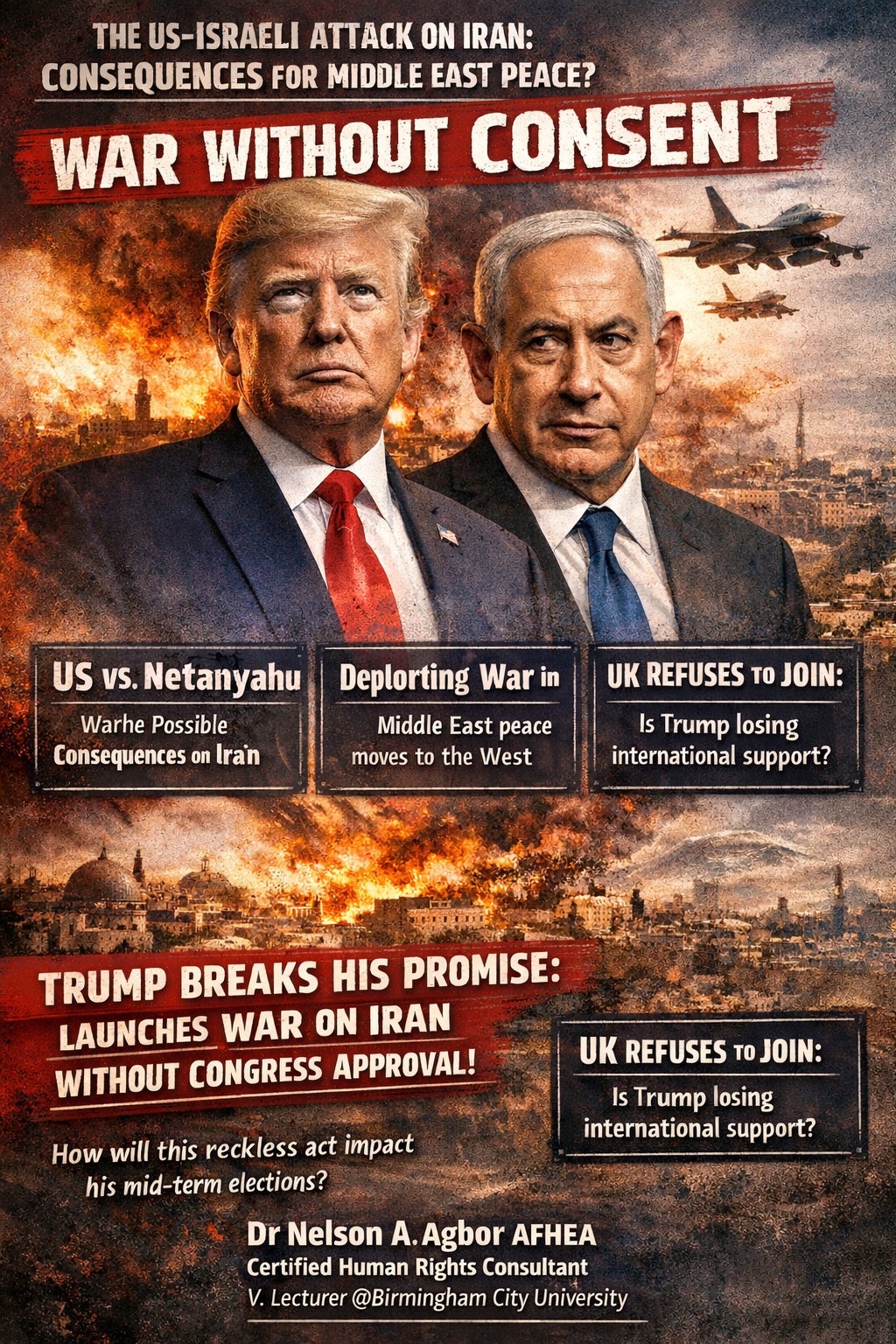
The reported military strike by the United States and Israel on Iran marks a significant escalation in an already volatile regional security environment. From an international relations perspective, such an action risks deepening the entrenched security dilemma that has long characterised Middle Eastern geopolitics. Iran’s regional influence—exercised through allied non-state actors and strategic partnerships—means that any direct attack on its territory could trigger asymmetric retaliation. This dynamic may not remain confined to bilateral confrontation but could spill over into neighbouring states, intensifying proxy conflicts in places such as Lebanon, Syria, Iraq, and Yemen. The strike thus carries implications not only for deterrence credibility but also for the fragile balance of power that, however imperfectly, has prevented full-scale interstate war in recent years.
The consequences for Middle East peace are potentially profound. A direct attack on Iran could undermine ongoing diplomatic normalisation efforts between Israel and several Arab states, as regional governments would face domestic pressure to distance themselves from overt or tacit cooperation. Moreover, Iran’s likely recalibration of its nuclear posture, whether through accelerating enrichment or reducing transparency, could weaken global non-proliferation frameworks. In such a context, the probability of miscalculation increases, particularly in contested maritime zones like the Strait of Hormuz, through which a significant portion of global energy supplies transits. Heightened tensions would therefore carry not only regional security costs but also global economic repercussions.
Domestically, Donald Trump’s decision to authorise military action without explicit approval from the United States Congress raises constitutional and normative concerns. The U.S. Constitution grants Congress the power to declare war, and while modern presidents have often relied on expansive interpretations of executive authority, unilateral escalation against a sovereign state represents a contentious use of that power. This is especially striking given Trump’s prior public statements emphasising restraint and opposition to “endless wars.” The perceived inconsistency between rhetoric and action may erode public trust and sharpen partisan divisions, particularly if the operation leads to prolonged military engagement or American casualties.
The United Kingdom’s refusal to participate militarily signals both strategic caution and potential strain on transatlantic alliances. London’s decision can be interpreted as an effort to avoid entanglement in a conflict lacking a broad international consensus or a clear legal mandate. This divergence may complicate NATO cohesion and weaken the appearance of a unified Western strategy toward Iran. At the same time, the UK’s stance reflects a broader European preference for diplomatic containment and multilateral engagement, underscoring persistent differences between Washington and its European partners over approaches to Iran’s regional and nuclear policies.
Finally, the domestic political ramifications for Trump could be substantial in the context of the upcoming mid-term elections. Historically, limited military action can generate a short-term “rally-around-the-flag” effect; however, sustained conflict or rising economic costs, particularly higher energy prices, may reverse that dynamic. If voters perceive the strike as strategically unnecessary, constitutionally questionable, or inconsistent with prior commitments, it could mobilise opposition turnout and intensify scrutiny of executive power. Conversely, if the administration successfully frames the action as decisive and protective of national security without leading to protracted conflict, it may consolidate support among core constituencies. The ultimate electoral impact will likely hinge on whether the strike evolves into a contained deterrent signal or the opening phase of a broader regional confrontation.
Dr Nelson A. Agbor AFHEA,
Certified Human Rights Consultant,
V. Lecturer @Birmingham City University




