
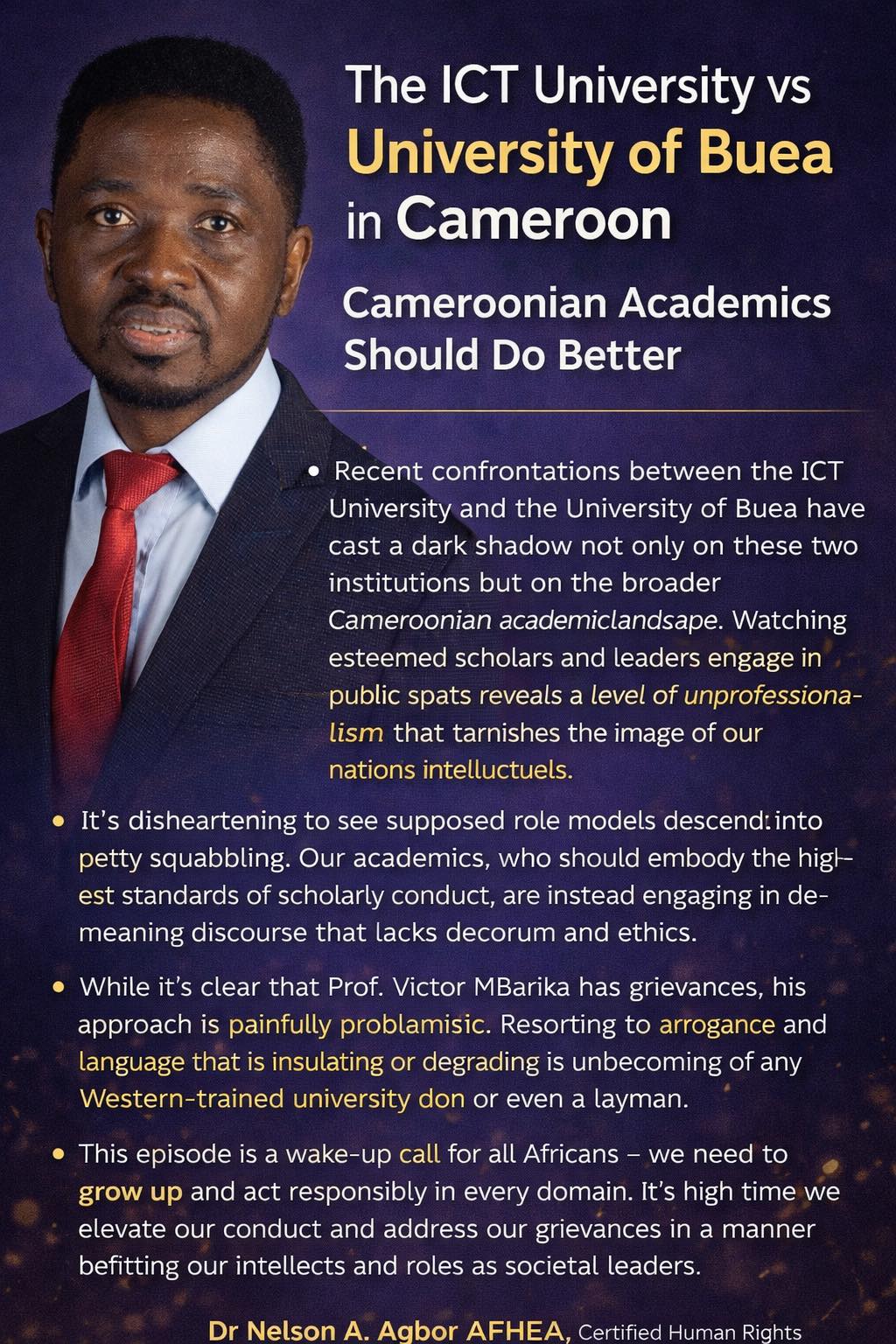
The ongoing academic imbroglio between ICT University and the University of Buea has, regrettably, become less a contestation of ideas and more a spectacle of ego, rhetoric, and institutional brinkmanship. At a time when Cameroonian higher education should be consolidating its intellectual capital and projecting scholarly maturity, the public tenor of exchanges emanating from both sides risks diminishing the credibility of our universities. Academic disagreement is neither new nor inherently problematic; indeed, it is the lifeblood of scholarly progress. However, when such disagreement devolves into personalised attacks and performative outrage, it undermines the very epistemic values universities are meant to safeguard.
What is most disconcerting in this episode is the unprofessionalism that has characterised segments of the discourse. Universities are custodians of reasoned debate, methodological rigour, and ethical restraint. When academics, those entrusted with shaping young minds, engage in public exchanges that appear combative rather than contemplative, they erode public trust in the academy. Cameroonian scholars must resist the temptation to substitute social media grandstanding for peer-reviewed engagement and institutional dialogue. Intellectual authority is not asserted through volume or invective, but through evidence, coherence, and civility.
At the same time, it would be remiss not to address the approach attributed to Professor Victor Mbarika in this controversy. A scholar of Western training and considerable exposure carries, by virtue of that formation, an obligation to model the highest standards of academic comportment. Arrogance, insulating rhetoric, and language that appears degrading, whatever the provocation, do little to elevate the debate. They instead reproduce the very hierarchies and exclusions that contemporary scholarship seeks to dismantle. A university don of his calibre should exemplify humility before knowledge and respect toward colleagues, even in moments of sharp disagreement.
This controversy also gestures toward a broader malaise within segments of African academia: a persistent struggle to reconcile intellectual ambition with institutional maturity. Across the continent, we must cultivate cultures of critique that are firm yet respectful, competitive yet collegial. The global academy is already rife with inequities; African scholars cannot afford to weaken their collective standing through internecine conflicts conducted without decorum. Growth demands self-regulation, ethical leadership, and an unwavering commitment to the norms that define scholarly communities worldwide.
Ultimately, this moment should serve as a catalyst rather than a calamity. It is an opportunity for individuals, institutions, and the broader African intellectual class to reflect. If our universities are to command global respect, we must first embody it in our internal dealings. Africans across all domains, academic, political, and economic, must outgrow performative antagonism and embrace disciplined engagement. The path to intellectual sovereignty lies not in rhetorical conquest, but in principled scholarship, institutional integrity, and the collective will to mature.US Institute of Diplomacy and Human RightsCameroon News Agency-EntertainmentCongossa barCandace Cameron BureUniversity of BueaCameroon TribuneMTN Cameroon
Dr Nelson A. Agbor AFHEA
Certified Human Rights Consultant
V. Lecturer @ Birmingham City University.




