
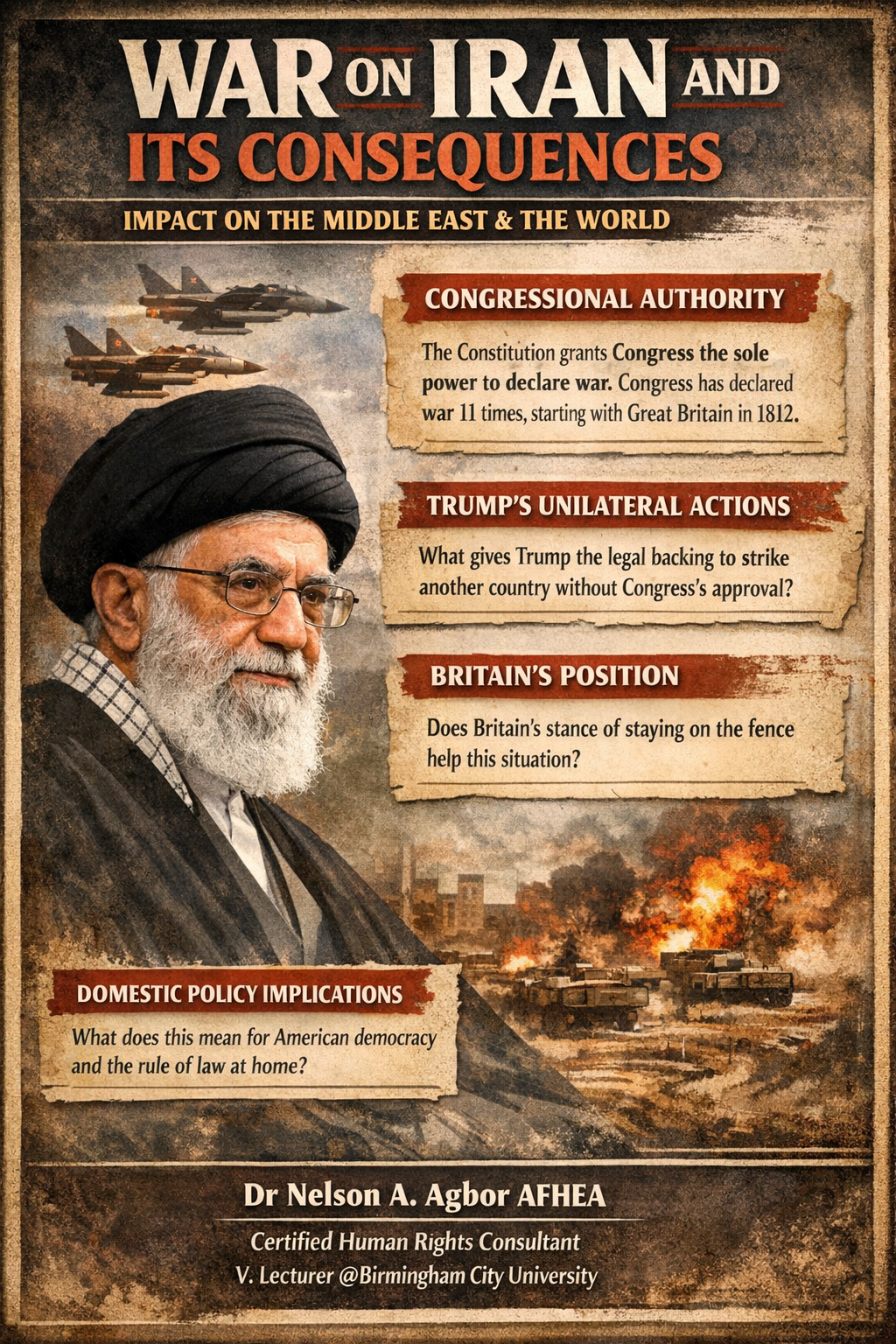
The war declared by the US and Israel on Iran would represent a pivotal moment for the Middle East and for global stability. Given Iran’s geographic position, regional influence, and strategic importance in global energy markets, armed conflict would reverberate far beyond its borders. While proponents might frame this military action as necessary for deterrence, nonproliferation, or regional security, critics warn of escalation, humanitarian crises, and long-term geopolitical destabilisation. Evaluating such a conflict requires examining not only its regional and international consequences, but also the constitutional and domestic policy implications within the United States.
In the Middle East, this war involving Iran would likely trigger a multi-front regional crisis. Iran maintains influence through allied governments and non-state actors in Iraq, Syria, Lebanon, and Yemen. This direct confrontation could spill into these arenas, drawing in regional rivals such as Saudi Arabia and Israel. Disruption of shipping in the Strait of Hormuz, through which roughly one-fifth of the global oil supply passes, could send energy markets into turmoil, increasing inflationary pressures worldwide. Moreover, civilian displacement and infrastructure destruction could exacerbate humanitarian and refugee emergencies in an already fragile region. Such escalation risks miscalculation among major powers with interests in the region, including Russia and China, potentially widening the conflict beyond its initial scope.
Globally, the consequences of this war and the killing of Iran’s Supreme Leader would extend to international law, alliances, and economic systems. Military action without broad multilateral support could strain relations within NATO and the United Nations. Financial markets would likely respond with volatility, particularly in the energy and defence sectors. A prolonged conflict might accelerate global realignments, strengthening ties between Iran and powers seeking to counterbalance U.S. influence. Conversely, advocates of decisive military action argue that demonstrating resolve could reinforce deterrence against adversaries. Whether the conflict stabilises or destabilises the global order would depend heavily on objectives, coalition-building, and post-conflict planning.
Domestically, this war with Iran would raise serious constitutional and policy questions in the United States. Article I, Section 8 of the U.S. Constitution grants Congress the sole power to declare war. Historically, Congress has formally declared war eleven times, beginning with the War of 1812 against Great Britain. However, modern military engagements have often proceeded without formal declarations. Presidents have relied on their Article II powers as Commander in Chief, as well as statutory authorisations such as the 2001 and 2002 Authorisations for Use of Military Force (AUMFs). In the case of these recent strikes ordered by President Donald Trump, legal justifications would likely centre on claims of inherent executive authority to defend U.S. interests or personnel against imminent threats. The executive branch has increasingly interpreted this authority broadly, arguing that limited military actions do not constitute “war” in the constitutional sense requiring congressional declaration. Critics contend that such interpretations erode Congress’s constitutional role and upset the balance of powers. Additionally, the War Powers Resolution of 1973 requires the president to notify Congress within 48 hours of deploying forces and limits engagement to 60 days without congressional authorisation, though its enforcement mechanisms remain politically contested rather than judicially decisive.
The United Kingdom’s position, whether supportive, neutral, or opposed, would also influence the situation, though it would not determine the legality of any action under U.S. law. A British decision to “stay on the fence” might reduce perceptions of broad allied backing and weaken diplomatic legitimacy, potentially isolating the United States and Israel. However, neutrality could also prevent further international escalation by signalling caution among Western allies. Ultimately, the long-term effects of war with Iran would depend on the scale of military action, diplomatic efforts to contain escalation, and adherence to constitutional processes at home. A balanced assessment suggests that while military force may be argued as a strategic necessity, the regional, global, and constitutional consequences would be profound and enduring, demanding careful deliberation before any such decision is made.
Dr Nelson A. Agbor AFHEA
Certified Human Rights Consultant
V. Lecturer @Birmingham City University




