
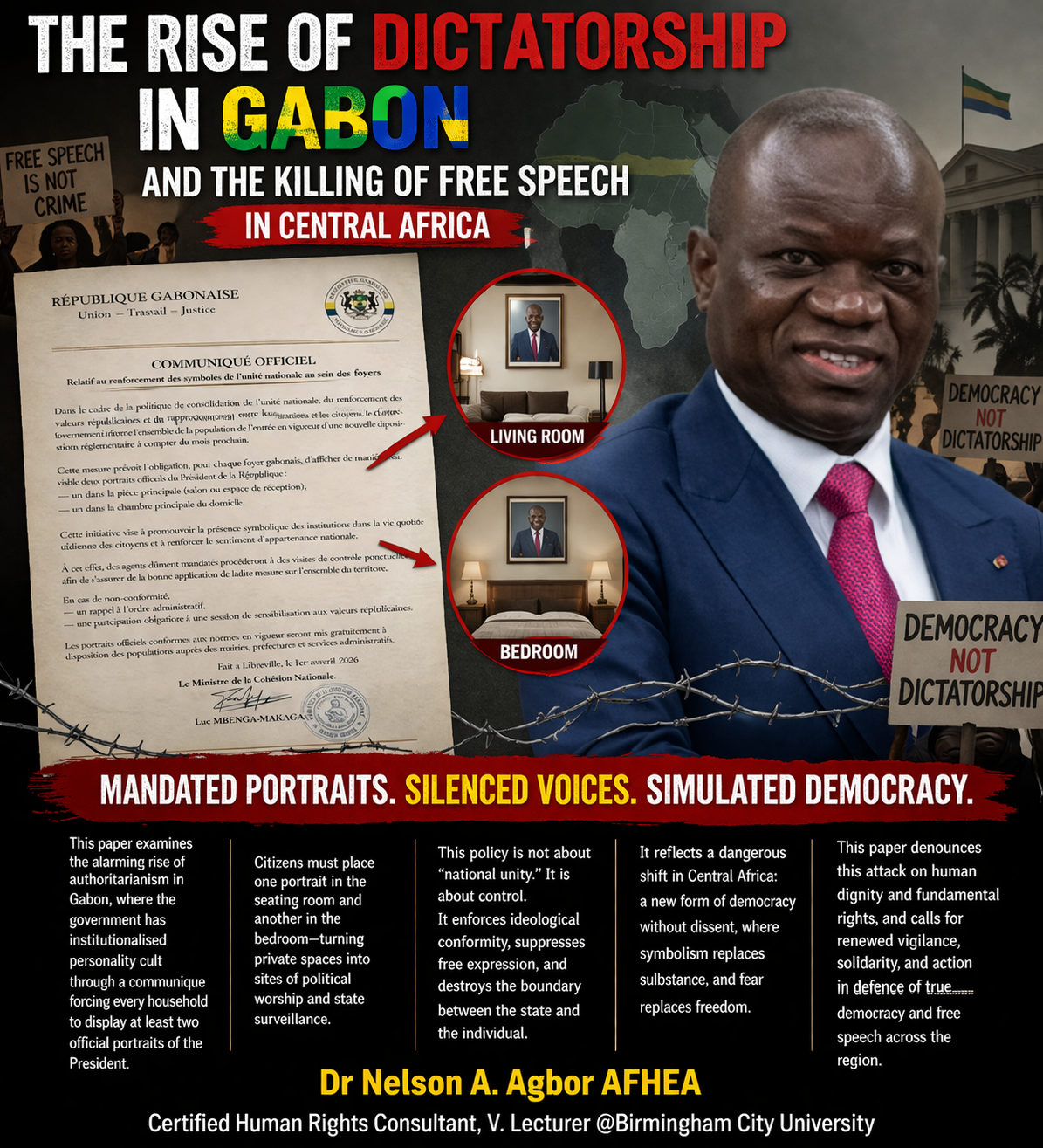
The statement issued by the Gabonese government, as shown in the attached document, indicates a worrisome shift in the relationship between state authority and personal life. Framed under the banners of “national unity” and “republican values,” the directive requires every household to display two official portraits of the President, one in the main reception area and another in the primary bedroom. While presented as a symbolic gesture, this demand constitutes a significant invasion of private space and a clear assertion of political dominance. Such measures recall historical patterns of authoritarian regimes, where visual propaganda is normalised to foster loyalty and suppress dissent.
From a constitutional and civil liberties standpoint, the policy raises serious concerns about freedom of expression and privacy. Forcing citizens to display political imagery in their homes eliminates the voluntary nature of political support, turning it into a state-enforced obligation. The communiqué explicitly states that compliance will be monitored through administrative inspections, with penalties for non-compliance including reprimands and compulsory ideological “sensitisation sessions.” This enforcement approach demonstrates a coercive system that is incompatible with democratic norms, in which political allegiance should be freely chosen rather than enforced.
The symbolic placement of portraits is especially revealing. Requiring one image in the living room aligns with public conformity, but extending this requirement to the bedroom, a private and intimate space, suggests an attempt to infiltrate all aspects of individual life. This mirrors practices seen in highly centralised regimes, where the leader’s presence is everywhere, both physically and psychologically. The effect is not just decorative but disciplinary: it conditions citizens to accept authority and discourages critical thinking or opposition.
In the broader Central African context, this development can be seen as part of a worrying trend towards the personalisation of political authority. Instead of strengthening institutions, such policies raise the figure of the president above the state itself, blurring the line between nation and individual leadership. This weakens democratic consolidation and risks entrenching a culture of obedience rather than participation. When governments prioritise symbolic loyalty over meaningful governance, they undermine accountability mechanisms and diminish public trust.
Ultimately, the communiqué does not affirm democracy but distorts it. By requiring visible displays of allegiance and punishing non-compliance, the state suppresses pluralism and restricts free expression. This is not the expansion of democratic values but their contraction under the pretense of unity. For Gabon and Central Africa more broadly, the challenge lies in resisting such encroachments and reaffirming the core principles of democracy: freedom, dignity, and the right to dissent without fear of reprisal.
Dr Nelson A. Agbor AFHEA
Certified Human Rights Consultant
V. Lecturer @Birmingham City University.




