
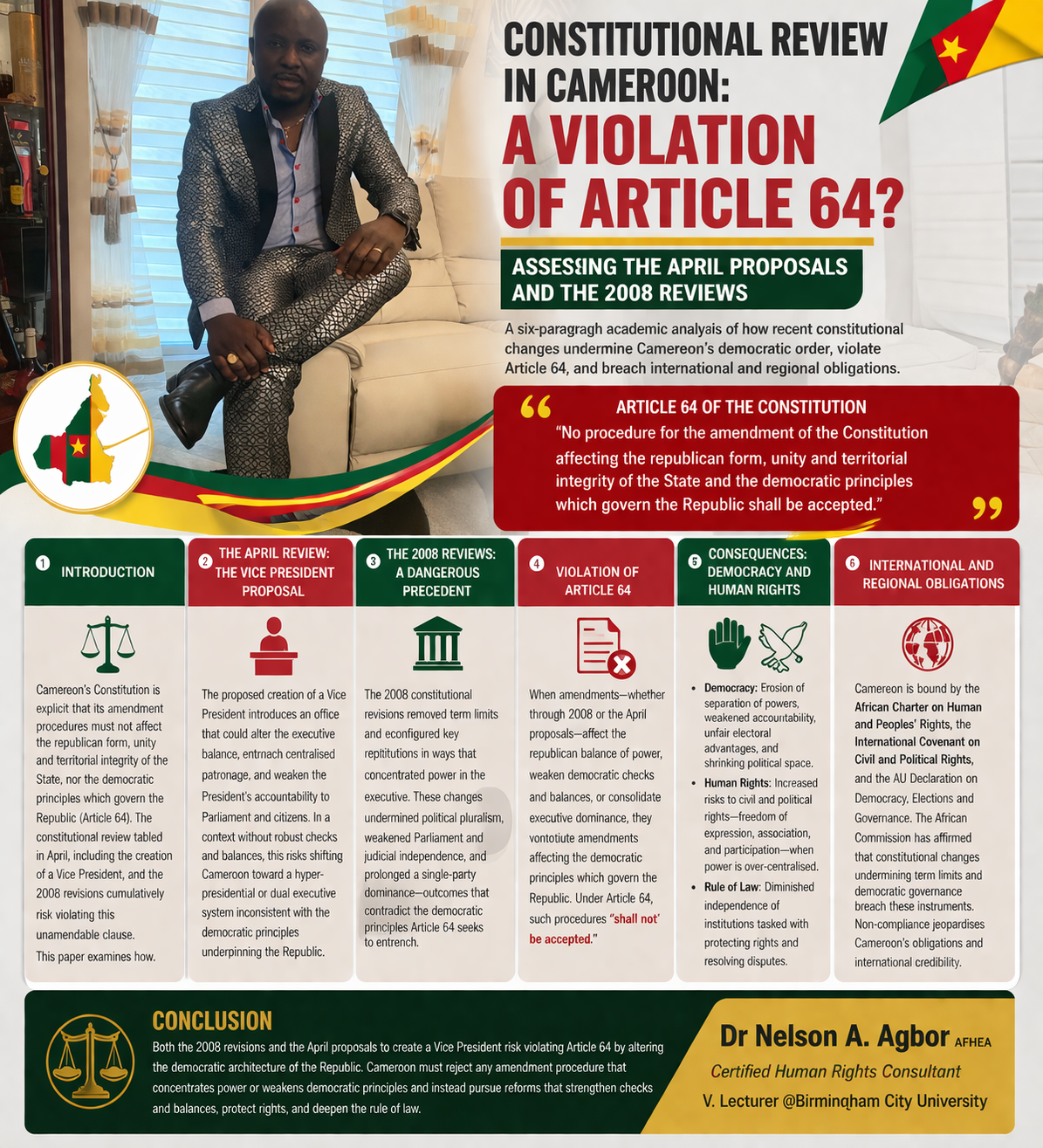
The constitutional trajectory of Cameroon has entered a critical phase following the April 2026 tabling of a reform bill introducing a Vice President, alongside the enduring legacy of the 2008 constitutional amendments. These developments must be scrutinised against Article 64 of the Constitution, which entrenches a substantive limitation on constitutional revision by prohibiting amendments that affect “the republican form, unity and territorial integrity of the State and the democratic principles which govern the Republic.” This clause operates as an eternity clause, designed to safeguard the state’s foundational constitutional identity. The recent reforms, particularly when read cumulatively with the 2008 amendments that abolished presidential term limits, raise significant concerns as to whether they undermine the democratic principles explicitly protected under Article 64.
The April 2026 constitutional bill introduces a Vice President appointed and dismissed at the President’s discretion, with powers entirely derived from presidential delegation. While presented as a mechanism for ensuring governance continuity, the office’s structure reflects a consolidation rather than a diffusion of executive power. Unlike traditional republican systems where a vice presidency functions as an independently legitimised office (often elected alongside the president), the Cameroonian proposal entrenches vertical executive dependency. This alters the constitutional balance of power by reinforcing a hyper-presidential system, already characteristic of Cameroon’s governance. Such restructuring could be argued to impact “democratic principles” by weakening institutional checks and reducing pluralistic executive accountability.
This concern becomes more pressing within the constitutional framework shaped by the 2008 amendments. Those revisions removed presidential term limits and broadened executive immunity, effectively allowing indefinite tenure. The removal of power alternation, a fundamental democratic principle, has already faced widespread criticism as incompatible with constitutional democracy. The combination of indefinite presidential tenure with the creation of an appointed Vice President who automatically succeeds to complete a term further consolidates executive continuity without electoral input. This setup may breach Article 64 by undermining the principle of democratic rotation of power, which is inherent in the concept of a republican form of government based on regular elections.
Furthermore, the manner in which these amendments are being pushed forward raises concerns about procedural legitimacy, which adds to the substantive constitutional issues. Reports show that the reform has been hastily pushed through a parliament controlled by the ruling party, with limited public consultation and debate. The lack of inclusive constitutional discussion damages participatory democracy, a fundamental aspect of the “democratic principles” protected under Article 64. Constitutionalism requires not only formal legality but also procedural legitimacy based on popular sovereignty. The lack of transparency around both the 2008 and 2026 amendments indicates a pattern of executive-led constitutional changes that exclude democratic participation.
The repercussions for democracy are significant. The cumulative impact of these reforms results in what comparative constitutional scholars would describe as “constitutional authoritarianism,” in which formal constitutional mechanisms are exploited to justify the concentration of power. The lack of term limits, combined with a controlled succession process, reduces electoral competition and weakens opposition viability. Additionally, the failure to tackle structural issues, such as Anglophone marginalisation—highlighted by critics of the Vice President proposal heightens tensions that threaten national unity. This also raises further concerns under Article 64 regarding the maintenance of the state’s unity and integrity.
From a human rights perspective, these constitutional changes threaten to undermine protections embedded in both national and international legal frameworks. Cameroon’s Constitution reaffirms commitments to instruments such as the Universal Declaration of Human Rights and the African Charter on Human and Peoples’ Rights. Democratic governance, political participation, and accountability are fundamental to these instruments. The gradual decline in electoral integrity and political pluralism could therefore lead Cameroon to breach its obligations under regional and international human rights law, including the provisions of the African Charter on the right to participate freely in government.
In conclusion, the April 2026 constitutional reform, particularly when analysed alongside the 2008 amendments, presents a credible case of incompatibility with Article 64 of the Cameroonian Constitution. By consolidating executive power, undermining electoral alternation, and marginalising participatory processes, these reforms weaken the democratic principles explicitly protected by Article 64. The broader implications extend beyond constitutional legality to the erosion of democratic governance, increased risks to human rights, and potential non-compliance with international and regional legal obligations. This trajectory highlights the tension between formal constitutional amendment procedures and the substantive limits imposed by entrenched constitutional norms.
Dr Nelson A. Agbor AFHEA
Certified Human Rights Consultant
V. Lecturer @Birmingham City University.




