
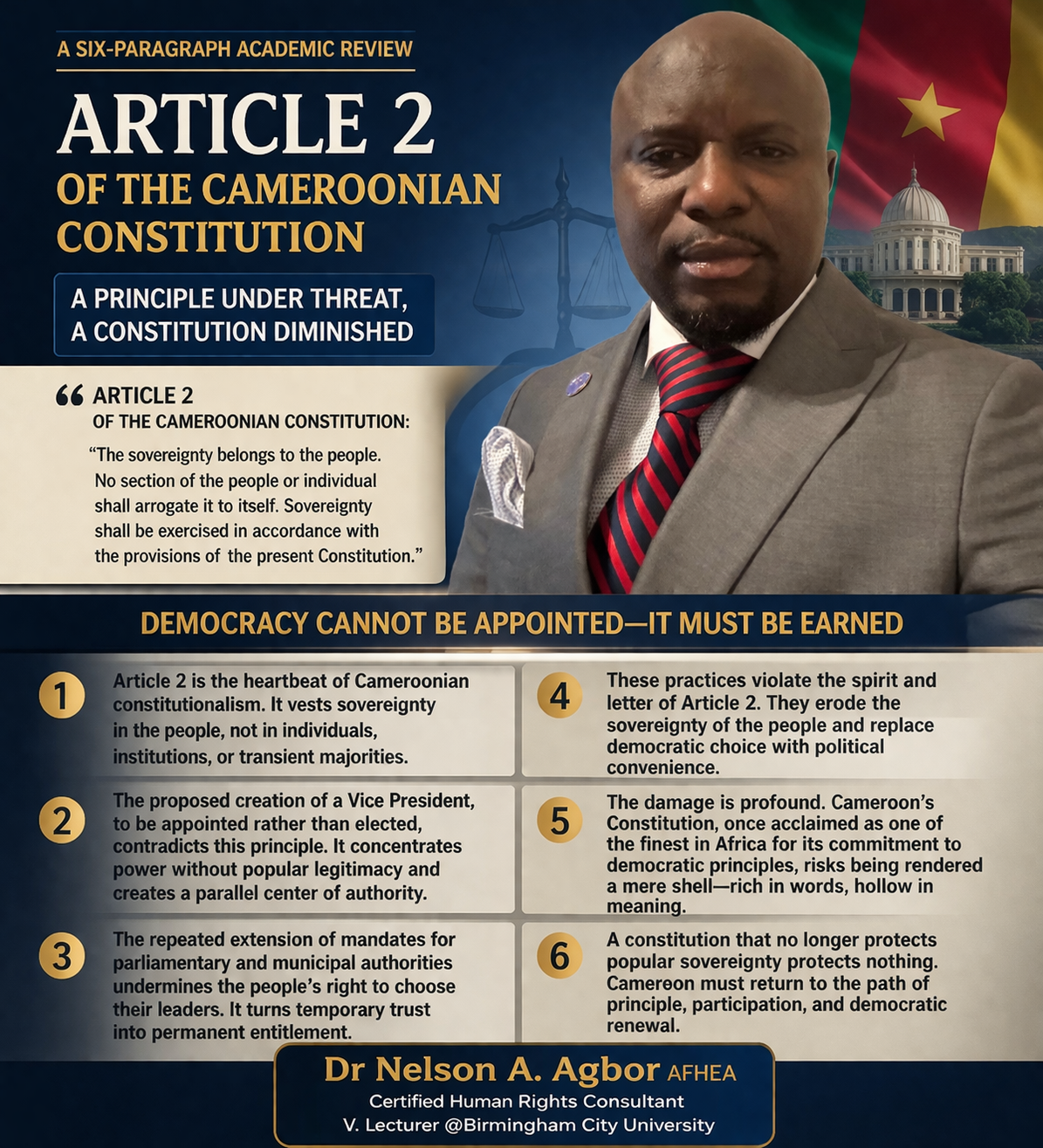
Article 2 of the Constitution of Cameroon holds a fundamental role within the country’s constitutional framework. It asserts that national sovereignty resides with the people, who exercise it either through elected representatives or via a referendum. The provision further affirms the democratic nature of the state, emphasising that authority stems from the will of the people, expressed through regular, free, and fair elections. In doctrinal terms, Article 2 captures the essential elements of constitutional democracy: popular sovereignty, political representation, and electoral legitimacy. It is not merely declaratory; it acts as a normative standard against which all institutional arrangements and political practices are evaluated.
A close reading of Article 2 shows that its main force lies in its emphasis on electoral mediation as the primary way of ensuring democratic legitimacy. The phrase “through elected representatives” is not accidental; it reflects a conscious constitutional decision to base public authority on the consent of the governed. This means that important political positions, especially those at the top of the executive branch, must gain their legitimacy from the electorate. Any departure from this principle risks destabilising the constitutional balance by allowing forms of authority that are shielded from direct or indirect popular control.
Within this analytical framework, the proposal to create a Vice President appointed rather than elected must be critically examined. Such an institutional innovation initially appears incompatible with the spirit and letter of Article 2. By introducing a high-ranking executive official whose authority does not derive from the electorate, the reform would effectively weaken the principle of popular sovereignty. The Vice President, potentially positioned as a successor to the Head of State, would exercise significant constitutional powers without having secured a democratic mandate. This creates a structural contradiction: an unelected office embedded at the core of a system that is constitutionally committed to electoral legitimacy.
The tension surrounding Article 2 is intensified by the recurring practice of extending the mandates of parliamentary and municipal authorities. Extending electoral terms beyond their constitutionally or statutorily designated limits disrupts the regular schedule of elections, which is a vital element of democratic governance. Regular elections are not merely procedural formalities; they serve as the mechanism through which the people renew or withdraw their consent. When mandates are extended without electoral validation, representation becomes fictitious, and the connection between the people and their representatives is broken. In this context, such practices directly violate the constitutional requirement that sovereignty be exercised through genuinely representative institutions.
Taken together, the appointment of a Vice President and the systematic postponement of elections indicate a broader erosion of constitutionalism. They reflect a shift from a system grounded in popular sovereignty to one increasingly characterised by executive discretion and institutional opacity. The damage to democratic principles is profound. Accountability is weakened, political competition is stifled, and public trust in institutions is eroded. Over time, these developments risk normalising a form of governance that is formally constitutional but substantively detached from democratic norms, a phenomenon often described in comparative constitutional law as “constitutional hollowing”.
The cumulative effect of these deviations renders the Constitution normatively empty. Cameroon’s Constitution is often regarded as one of the strongest in Africa in terms of its formal commitment to democratic principles. However, a constitution’s true value lies not in its elegant wording but in its actual enforcement. When its fundamental provisions, such as Article 2, are consistently ignored, the document becomes a symbolic relic lacking real power. In this way, the current path risks turning a previously principled constitutional framework into a hollow shell, thereby damaging both its domestic legitimacy and its position within the wider landscape of African constitutional law.
Dr Nelson A. Agbor AFHEA
Certified Human Rights Consultant
V. Lecturer @Birmingham City University.




