
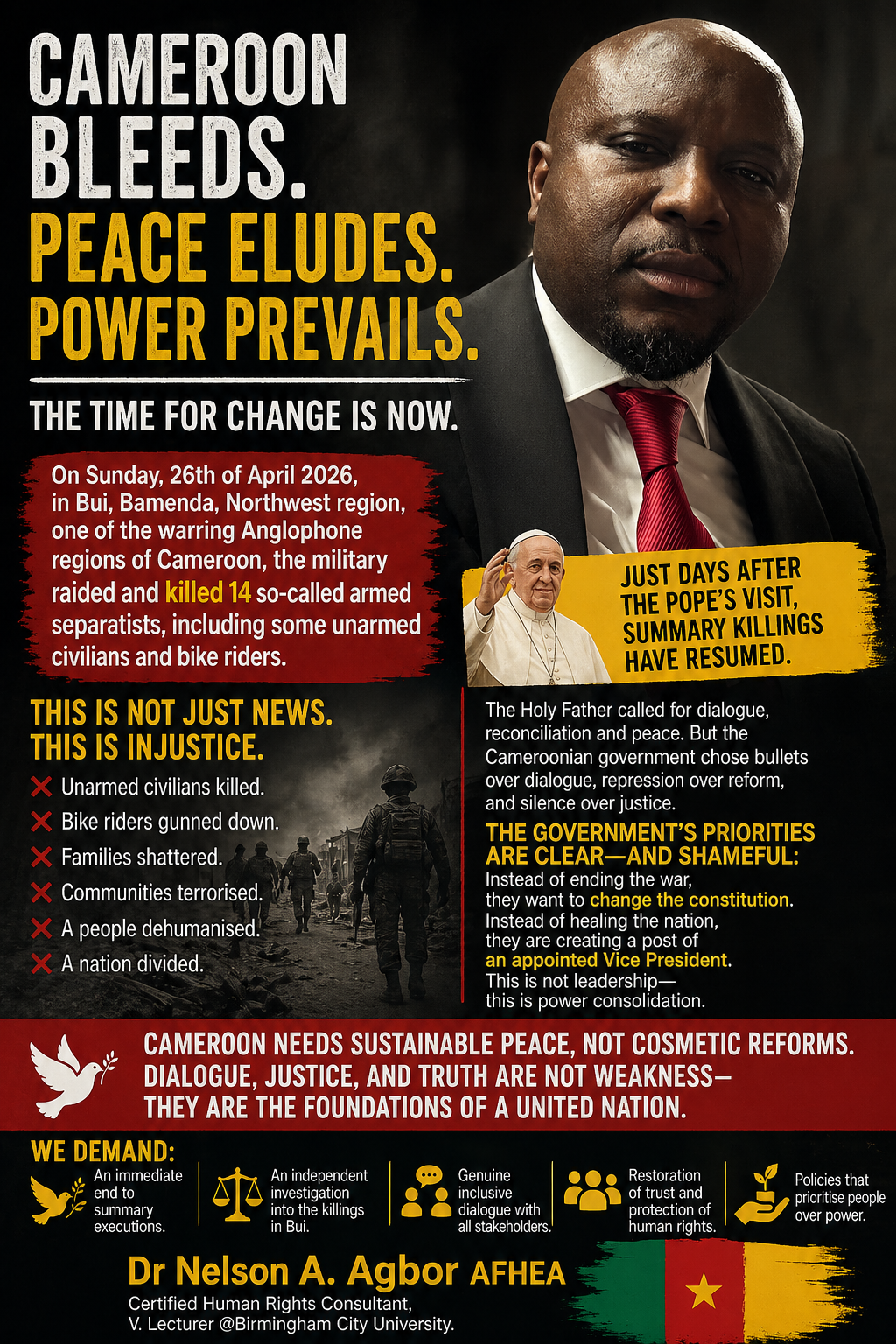
The events reported on 26 April 2026 in Bui and Bamenda underscore, yet again, the entrenched volatility of Cameroon’s Anglophone crisis. The killing of 14 people, reportedly including unarmed civilians and commercial bike riders, illustrates the persistent blurring of lines between combatants and non-combatants. Such incidents are not isolated; they are part of a broader pattern of militarised responses that have failed to deliver lasting stability. Instead, they reinforce cycles of grievance, retaliation, and distrust between the state and affected communities.
At its core, the Anglophone crisis is a political conflict rooted in historical marginalisation, governance asymmetries, and unresolved constitutional tensions between the Francophone-dominated central government and the Anglophone regions. Attempts to frame the conflict narrowly as a security problem requiring the suppression of “armed separatists” have proved analytically insufficient and strategically counterproductive. Sustainable peace cannot emerge from a paradigm that privileges force over dialogue, particularly when civilian harm continues to be reported.
The principle of sustainable peace demands more than the cessation of hostilities; it requires building legitimate, inclusive political arrangements that address root causes. In Cameroon’s case, this entails meaningful decentralisation, credible legal reforms, and the restoration of trust in public institutions. Continued reliance on military raids, particularly those resulting in civilian casualties, erodes the government’s claim to legitimacy and weakens prospects for reconciliation.
The reported inclusion of unarmed civilians among the killed is particularly troubling under international humanitarian and human rights law. Even in non-international armed conflicts, the protection of civilians is a non-derogable obligation. Allegations of summary killings, if substantiated, would constitute grave violations and demand transparent investigation and accountability. The absence of such accountability mechanisms contributes to a culture of impunity, further destabilising the region.
Equally concerning is the apparent dissonance between rhetorical commitments to peace and operational realities on the ground. Religious and moral authorities, including the Pope’s recent interventions advocating dialogue and restraint, carry significant normative weight. The rapid resumption of lethal operations shortly after such appeals signals either a lack of policy coherence within the state apparatus or a deliberate disregard for external counsel. Either way, it undermines confidence in the government’s stated willingness to pursue a peaceful resolution.
Concurrent national-level political developments compound this dissonance. The government’s apparent prioritisation of constitutional restructuring, particularly proposals to introduce an appointed Vice President, raises critical questions about governance priorities. At the same time, constitutional reform is not inherently problematic; its timing and perceived intent matter. In a context of ongoing conflict, such moves risk being interpreted as efforts to consolidate executive power rather than to address urgent national fractures.
From a political economy perspective, this prioritisation may reflect an elite calculus centred on regime durability rather than on conflict transformation. By concentrating on institutional arrangements that entrench authority at the centre, the government may inadvertently exacerbate alienation in the periphery. The Anglophone regions’ longstanding grievances are tied precisely to perceptions of centralised control and exclusion from meaningful decision-making. Reforms that deepen these dynamics are unlikely to yield stability.
A durable path forward requires a strategic pivot. First, there must be an immediate de-escalation of military operations that endanger civilians, coupled with independent investigations into alleged abuses. Second, the government should initiate genuinely inclusive dialogue that includes not only armed actors but also civil society, traditional authorities, and diaspora stakeholders. Third, constitutional discussions should be reframed to prioritise federal or highly decentralised arrangements that respond directly to Anglophone concerns.
International actors also have a role, though it must be calibrated to respect sovereignty while promoting accountability. Diplomatic engagement, targeted sanctions where appropriate, and support for mediation frameworks can create incentives for constructive behaviour. However, external pressure is most effective when it aligns with credible internal reform commitments, which currently appear inconsistent.
Ultimately, the persistence of violence in Cameroon reflects a failure of political imagination as much as a failure of policy. Sustainable peace will not be achieved through incremental adjustments or symbolic gestures; it requires a substantive reconfiguration of state-society relations. Until the government demonstrates a clear willingness to prioritise inclusive governance over coercive control, episodes such as the Bamenda killings will continue to recur, deepening a conflict that has already exacted a profound human and institutional toll.
Dr Nelson A. Agbor AFHEA
Certified Human Rights Consultant
V. Lecturer @Birmingham City University.




