
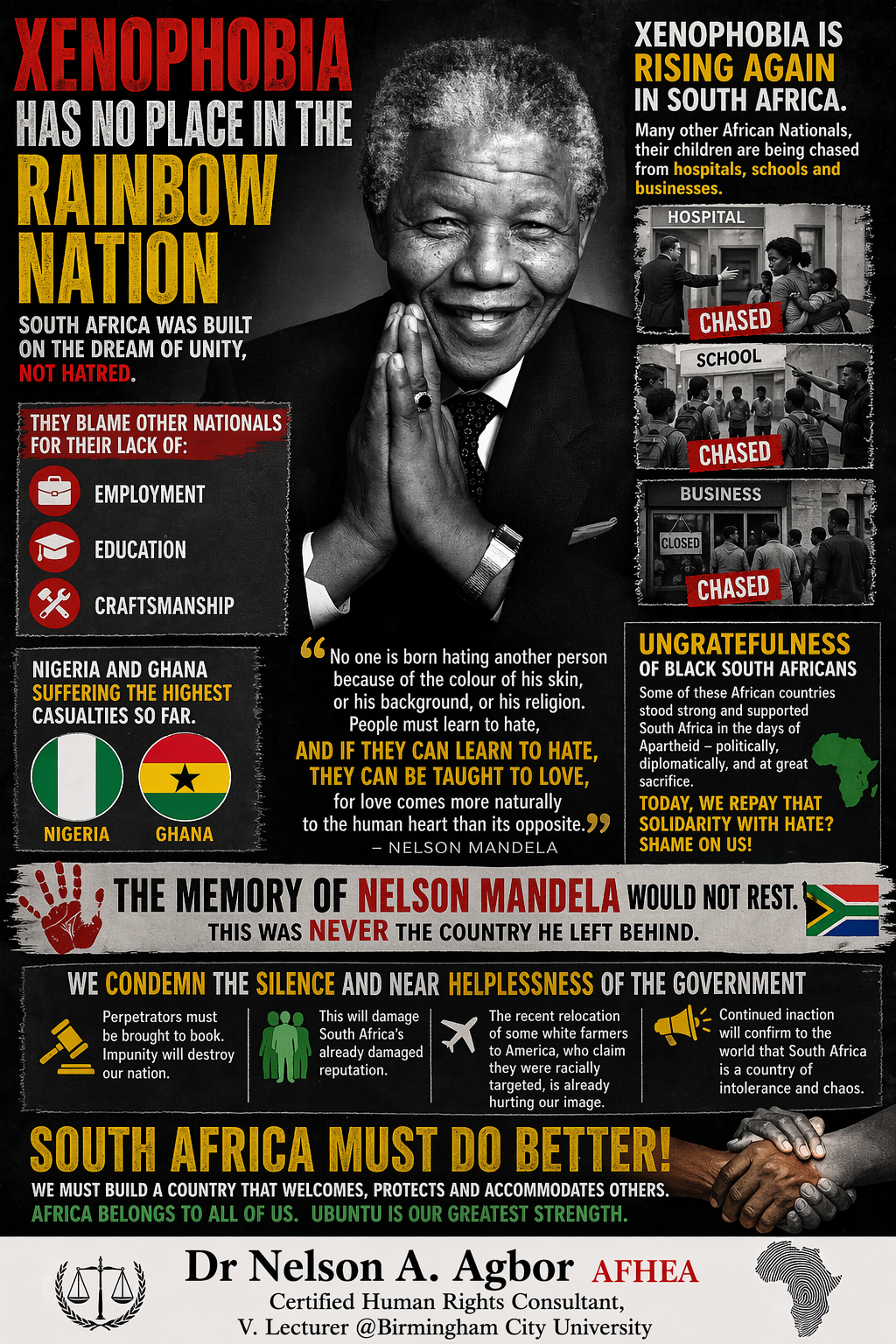
The resurgence of xenophobic violence in South Africa is a deeply destabilising social and political phenomenon with regional implications. Over the past decade, periodic outbreaks of violence have targeted African migrants—particularly those from Nigeria, Ghana, Zimbabwe, Somalia, and Ethiopia—causing deaths, displacement, and the destruction of livelihoods. These incidents are not isolated; they reflect structural stressors within South African society, including unemployment, inequality, and weak service delivery. The framing of foreign nationals as economic competitors has become a persistent narrative, amplified during moments of crisis.
At the micro level, xenophobia manifests in alarming ways: exclusion from healthcare facilities, harassment in schools, and targeted looting of migrant-owned businesses. Reports from civil society organisations indicate that migrants often encounter informal barriers to accessing public goods, despite constitutional protections. In some townships and urban peripheries, foreign-owned shops are singled out during unrest, with perpetrators justifying their actions as economic “reclamation.” This pattern reveals a normalisation of collective blame, in which nationality becomes a proxy for economic frustration.
Nigeria and Ghana have been particularly affected, not only because of the size and visibility of their diasporas, but also because of their concentration in the retail and informal trade sectors. Casualty figures vary across reporting periods, but both countries have repeatedly issued diplomatic protests and, at times, evacuated their citizens. The bilateral strain underscores how domestic instability can spill into foreign policy, eroding regional trust within the African Union framework.
The socioeconomic drivers of xenophobia are complex. South Africa’s unemployment rate, especially among young people, remains among the highest globally. In this context, competition for scarce jobs and opportunities intensifies. Migrants, often willing to accept lower margins in informal markets, are perceived as undercutting local businesses. This perception, whether accurate or not, is politically potent. It is further compounded by deficiencies in education and vocational training systems, which leave many citizens excluded from formal economic participation.
Political rhetoric has, at times, exacerbated tensions. Statements by local leaders and officials linking crime or unemployment to foreign nationals can legitimise public hostility. Even when not explicitly endorsing violence, such narratives create a permissive environment for vigilantism. The gap between constitutional ideals and on-the-ground discourse is therefore significant, raising questions about accountability and leadership.
This trajectory sits uneasily alongside South Africa’s historical identity as a beneficiary of pan-African solidarity during apartheid. Across the continent, countries provided material support, diplomatic backing, and safe havens for exiled activists. The legacy of figures such as Nelson Mandela is closely tied to ideals of human dignity, non-racialism, and continental unity. Contemporary xenophobic violence appears to contradict that legacy, creating moral and symbolic dissonance at home and abroad.
The government’s response has been uneven. Although there have been periodic condemnations of violence and some law-enforcement interventions, critics argue that prosecutions are limited and deterrence is weak. Structural measures, such as improving local economic conditions, reforming immigration systems, and strengthening community policing, have progressed slowly. This perceived inertia contributes to a sense of impunity among perpetrators and insecurity among migrant communities.
Internationally, South Africa’s reputation is sensitive to these developments. The country has long positioned itself as a continental leader and a proponent of human rights. Recurrent xenophobic incidents undermine that positioning. Compounding this reputational strain are other contentious narratives, including claims by some white farmers who have relocated abroad, alleging targeted violence. Regardless of the empirical debates surrounding these claims, their circulation in global media ecosystems adds another layer of scrutiny to South Africa’s domestic governance.
The economic costs are non-trivial. Informal-sector disruption disrupts local supply chains, indirectly erodes tax bases, and discourages small-scale investment. Moreover, diplomatic tensions can affect trade and labour mobility agreements within the region. In an interconnected African economy, instability in one node can have cascading effects, particularly when it involves a major economy such as South Africa.
Addressing xenophobia requires a multi-layered strategy. First, enforcement: credible investigation and prosecution of violent acts to deter future incidents. Second, economic inclusion: targeted programmes that expand employment and skills training for citizens while formalising parts of the informal sector to reduce zero-sum perceptions. Third, narrative correction: consistent, evidence-based public communication from political leaders that avoids scapegoating and reinforces constitutional values. Fourth, regional cooperation: bilateral and multilateral mechanisms to manage migration humanely and efficiently.
In conclusion, xenophobia in South Africa is not merely a law-and-order issue; it is a systemic challenge rooted in economic stress, political discourse, and historical contradiction. Reversing the trend will require institutional resolve and societal introspection. Aligning current policy and practice with the country’s foundational ideals is essential not only to protect vulnerable populations but also to preserve South Africa’s credibility as a continental leader committed to human dignity and justice.
Dr Nelson A. Agbor AFHEA,
Certified Human Rights Consultant
V. Lecturer @Birmingham City University.




