
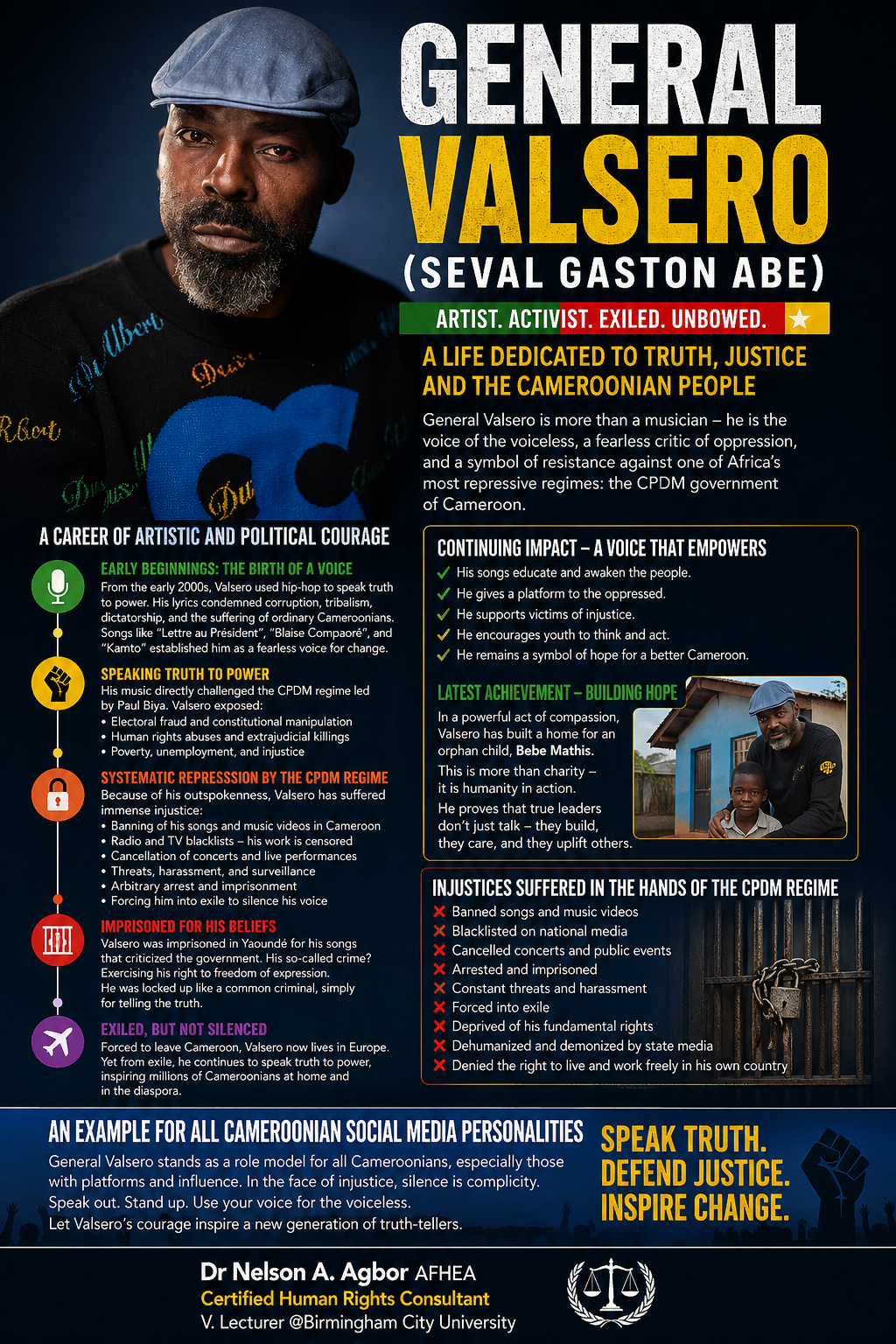
The career trajectory of Valsero (often styled “General Valsero”), born Gaston Philippe Abe Abe, offers a compelling case study in politically engaged African hip-hop as a form of resistance to entrenched authoritarian rule. Emerging from Cameroon’s urban milieu in the early 1990s, Valsero’s artistic evolution reflects a gradual yet decisive shift from socially conscious commentary to overt political dissent. His work must be situated within the broader context of the long-standing rule of Paul Biya and the dominance of the Cameroon People’s Democratic Movement (CPDM), a regime frequently criticised for restricting civil liberties and suppressing dissenting voices. From the outset, Valsero positioned himself not merely as an entertainer but as a civic actor, using lyrical production as a vehicle for political critique and youth mobilisation.
Valsero’s early career, beginning with the rap group Ultimatum in 1990, did not initially foreground explicit political antagonism. Instead, his lyrics addressed structural social issues such as poverty, unemployment, and marginalisation. However, these themes laid the groundwork for a more radical critique of governance. His later reflections indicate that a turning point came when he shifted from describing social conditions to explicitly “denouncing” those responsible, a shift that transformed him into what he termed a “dangerous” figure in the state’s eyes. This evolution underscores a broader theoretical pattern in protest music, where narrative observation gives way to direct political indictment.
The release of his seminal album Politiquement Instable (2008) marked a decisive rupture in Cameroon’s musical landscape. The album’s reception among young audiences was profound, positioning Valsero as a symbolic leader of dissent. Tracks such as “Lettre au président” and “Ce pays tue les jeunes” offered a direct critique of governance, explicitly targeting the state’s failures and Biya’s prolonged rule. These compositions exemplify hip-hop’s role as a counter-hegemonic discourse, in which lyrical content challenges official narratives and reclaims political agency for marginalised populations.
The Cameroonian state’s response to Valsero’s music illustrates the mechanisms of cultural repression typical of semi-authoritarian regimes. His songs were often excluded from radio and television, and his concerts were banned or obstructed by administrative measures. These measures align with broader patterns of soft censorship, in which the state avoids overt bans while effectively marginalising dissenting voices through institutional control of the media and public space. The denial of performance opportunities further constrained his ability to engage directly with audiences, thereby limiting the mobilising potential of his art.
Beyond censorship, Valsero’s career has been marked by direct state repression, culminating in his arrest on 26 January 2019 during protests challenging the legitimacy of the national elections. Although he was not formally aligned with an opposition party, he was detained alongside political activists and charged with serious offences, including insurrection and terrorism. The severity of these charges, some of which carried the possibility of the death penalty, demonstrates the extent to which the regime perceived his artistic expression as a political threat rather than mere cultural production.
Valsero’s nearly nine-month detention without bail marks a critical episode at the intersection of art and human rights. International organisations, including PEN America and Index on Censorship, characterised his imprisonment as an attempt to silence dissent and curtail freedom of expression. His eventual release in October 2019 followed sustained international pressure, highlighting the role of transnational advocacy networks in contesting domestic repression. This episode reinforces the concept of the “artist at risk,” in which cultural figures become targets of state control for their influence over public opinion.
Following his release, Valsero’s trajectory increasingly shifted towards diaspora activism. After relocating to Europe, he continued to engage Cameroonian audiences through digital platforms and transnational networks. His exile reflects a common pattern among politically outspoken African artists who, facing ongoing threats, seek relative safety abroad while maintaining influence at home. His post-incarceration activities, including performances and political commentary, demonstrate that exile can transform rather than diminish an artist’s capacity for engagement, particularly in an era of digital communication.
Valsero’s activism extends beyond music into structured civic initiatives. Through campaigns such as “Je vote donc j’existe” (“I vote, therefore I am”), he has sought to cultivate democratic consciousness among Cameroonian youth. These initiatives reflect a strategic understanding that political change requires both cultural and institutional engagement. His work thus operates at the intersection of artistic production and grassroots mobilisation, reinforcing his status as a hybrid figure, a musician, an activist, and a public intellectual.
Recent accounts of his philanthropic engagement, including the construction of a home for an orphan identified as Bebe Mathis, further underscore the ethical dimension of his activism. Although such acts are not extensively documented in major international sources, they align with his broader commitment to social justice and community support. This aspect of his work enhances his legitimacy among supporters, positioning him not merely as a critic of injustice but as an active participant in addressing its consequences.
In conclusion, General Valsero’s career exemplifies the transformative potential of politically engaged art in constrained political environments. His progression from a socially conscious rapper to an outspoken critic of the CPDM regime, together with his experiences of censorship, imprisonment, and exile, underscores the risks inherent in artistic dissent. Yet his continued influence, expressed through music, activism, and philanthropy, demonstrates the enduring power of cultural resistance. For Cameroonian social media personalities and public figures, Valsero’s trajectory offers a normative model of engagement: one that prioritises courage, accountability, and active opposition to injustice over silence and complicity.
Dr Nelson A. Agbor AFHEA
Certified Human Rights Consultant
V. Lecturer @Birmingham City University.




