
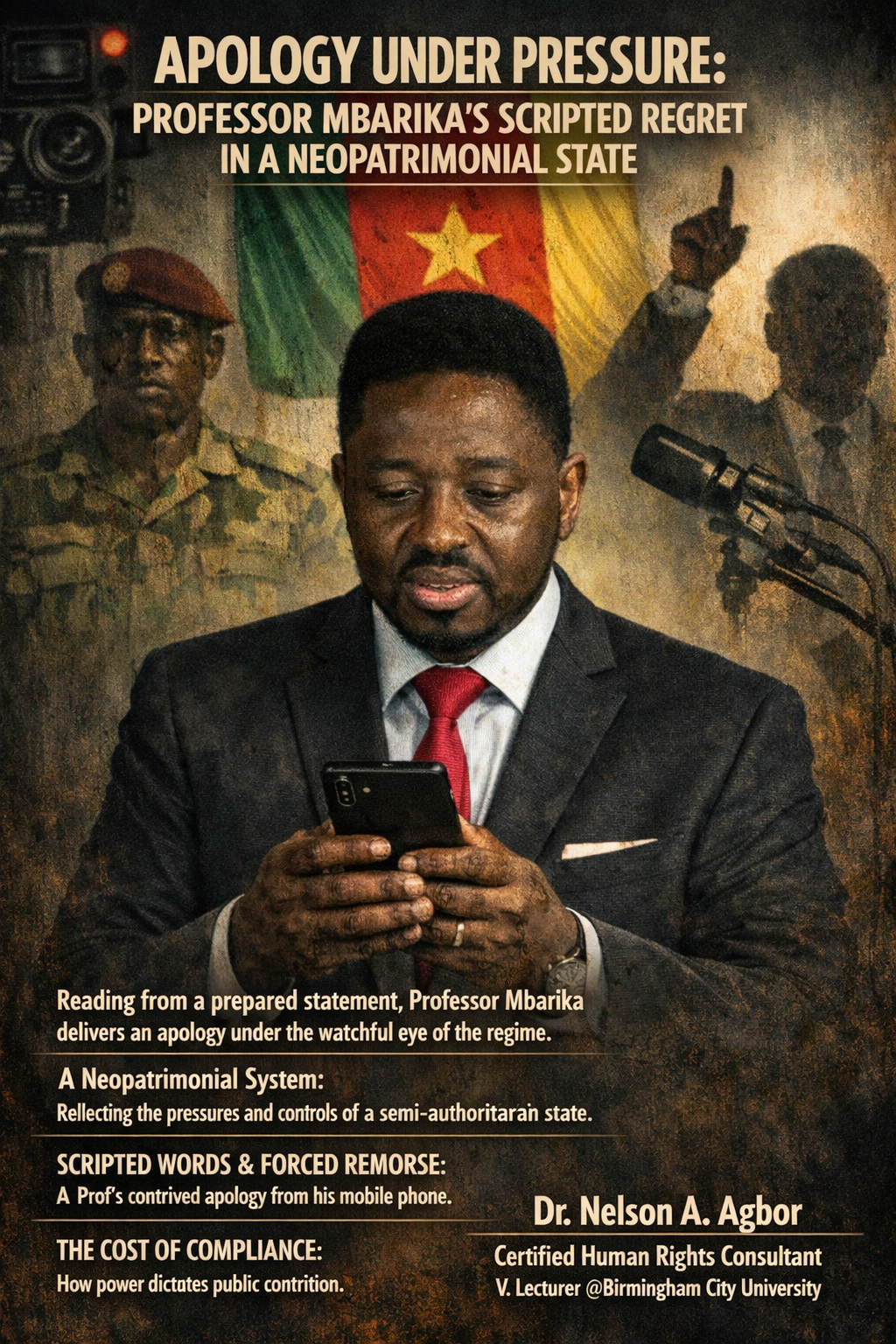
Professor Mbarika, the owner of ICT University in Yaounde-Cameroon, delivered a public apology, offering a revealing case study of leadership performance in neo-patrimonial and semi-authoritarian political contexts. In political science, neopatrimonialism describes systems in which formal bureaucratic institutions coexist with informal networks of personal loyalty, patronage, and centralised authority. Semi-authoritarian regimes, meanwhile, maintain the outward structures of democracy such as legal procedures and public communication—while concentrating real power in personalised leadership. Professor Mbarika’s apology, read verbatim from his mobile phone in a visibly scripted manner, illustrates how political culture and governance norms within such systems shape even ostensibly private institutional responses. Rather than a spontaneous act of accountability, the performance reflected broader patterns of control, hierarchy, and image management characteristic of neopatrimonial governance.
First, the delivery itself signalled the primacy of centralised authority over open deliberation. In neopatrimonial settings, leaders often rely on carefully crafted public statements to maintain loyalty networks and preserve elite cohesion. Reading from a mobile phone rather than speaking extemporaneously suggested that the apology had been pre-formulated, possibly negotiated, and strategically calibrated. Such scripting reduces the risk of deviation from approved narratives and reinforces the perception that communication flows from a controlled centre. This aligns with semi-authoritarian tendencies in which public discourse is tightly managed to prevent unpredictable outcomes or challenges to authority. The apology thus functioned less as a dialogue with stakeholders and more as a ritualised reaffirmation of hierarchical order.
Second, the content and tone of the apology reflected the personalisation of institutional responsibility. In neopatrimonial systems, institutions frequently revolve around the figure of the “big man,” whose authority supersedes formal rules. As owner of ICT University, Professor Mbarika occupies both administrative and symbolic positions, blurring the distinction between personal and institutional identity. By delivering the apology personally yet in a scripted format, he simultaneously personalised the crisis and controlled its framing. This duality mirrors the logic of semi-authoritarian regimes, where leaders embody the state or institution while ensuring that accountability remains carefully circumscribed. Responsibility is acknowledged to the extent necessary to preserve legitimacy, but not in ways that redistribute power or invite systemic reform.
Third, the performance highlights the strategic use of public contrition as a tool of regime maintenance. In semi-authoritarian contexts, apologies can serve as pressure valves: they acknowledge grievances without fundamentally altering the structures that produced them. The statement’s scripted nature underscores its instrumental character. Rather than signalling deliberative engagement or participatory accountability, the apology appeared to be a calculated move to stabilise authority and mitigate reputational damage. Such gestures are common in neopatrimonial systems, where symbolic concessions substitute for substantive institutional change. The ritual of apology becomes part of governance theatre, an enactment designed to reaffirm control while projecting responsiveness.
Finally, the episode reveals the tension between modern technological forms and traditional patronage politics. The use of a mobile phone as a script underscores the coexistence of contemporary tools with enduring political logics. While the medium suggests modernity and connectivity, the delivery method evokes a command-style communication pattern rooted in centralised oversight. This juxtaposition exemplifies how semi-authoritarian regimes adapt modern technologies to reinforce rather than democratise authority. In sum, Professor Mbarika’s scripted apology illustrates how neopatrimonial and semi-authoritarian dynamics shape public communication: authority is personalised, discourse is managed, and accountability is staged. The incident thus provides a microcosm of broader governance patterns in which symbolic performance substitutes for structural transformation.mation.
Dr Nelson A. Agbor AFHEA
Certified Human Rights Consultant
V. Lecturer @Birmingham City University




