
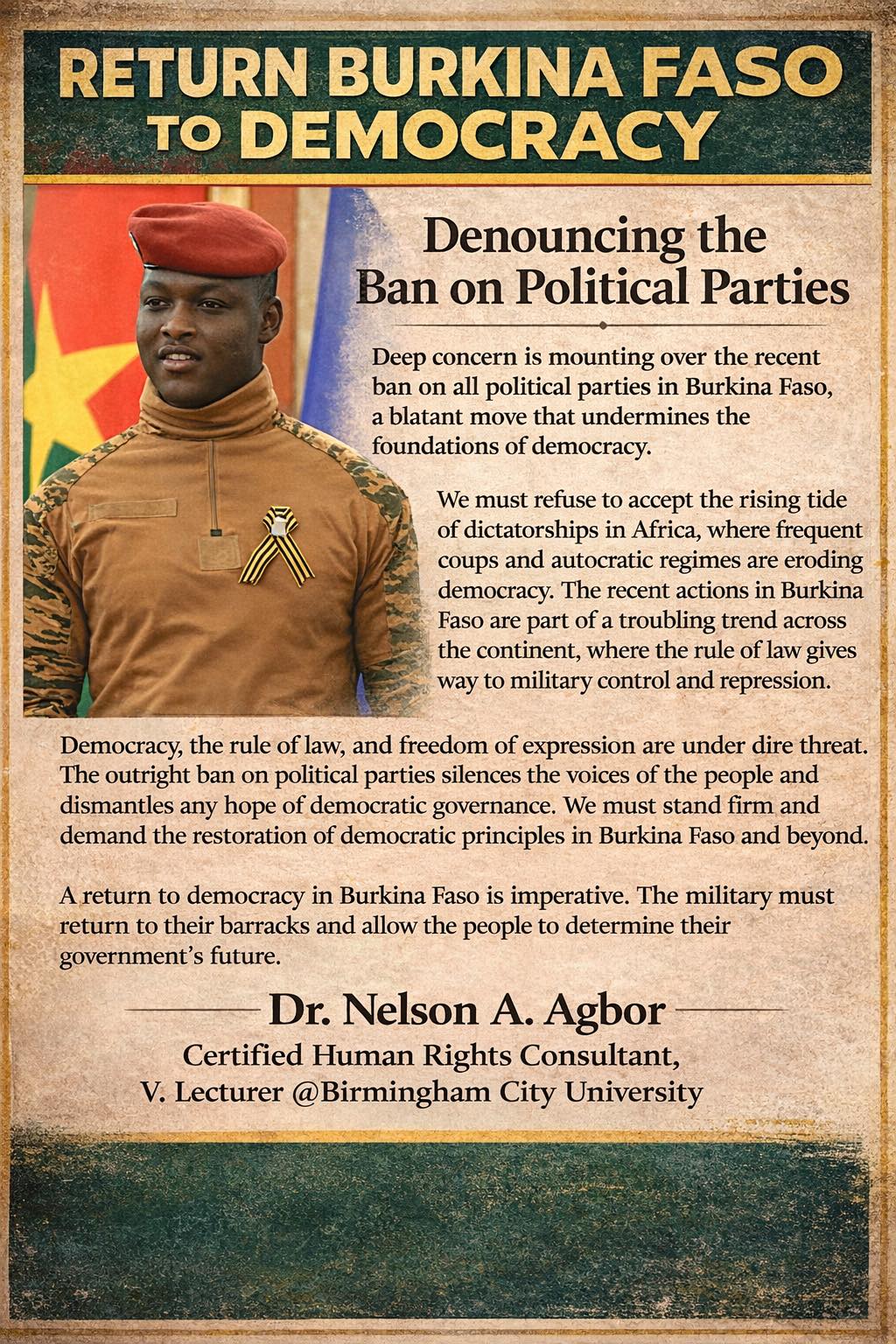
The recent ban on all political parties in Burkina Faso represents a grave setback for constitutional governance and pluralism. Political parties are not merely vehicles for electoral competition; they are essential institutions through which citizens organise interests, articulate dissent, and hold power to account. Their suspension signals an erosion of the basic architecture of representative government and raises serious questions about the country’s commitment to democratic norms.
This development cannot be viewed in isolation. Across much of the African continent, repeated coups and prolonged military rule have normalised authoritarian governance under the guise of “transitional” stability. These cycles of intervention undermine state institutions, weaken civilian oversight, and entrench a culture in which power is seized rather than legitimately conferred. The cumulative effect is the hollowing out of political life and the marginalisation of citizens from decisions that shape their futures.
At the core of this crisis lies a profound threat to democracy, the rule of law, and freedom of expression. When political parties are banned and civic space is constrained, legal certainty gives way to arbitrariness, and public debate is replaced by fear and silence. A state that suppresses peaceful political organisation cannot credibly claim to act in the name of its people, nor can it sustainably address the social and economic challenges it faces.
Burkina Faso urgently needs a transparent and credible return to democratic governance. This requires the restoration of political freedoms, the reestablishment of constitutional order, and a transparent transition led by civilians. Central to this process is the fundamental principle that the military must remain in the barracks, subordinate to elected authorities, and committed to defending the nation rather than governing it.
The international community, regional organisations, and African civil society must speak with clarity and consistency in calling for a return to democracy in Burkina Faso. Stability achieved through repression is illusory; only inclusive, lawful, and accountable governance can deliver lasting peace and legitimacy. The future of Burkina Faso and of democratic aspirations across Africa depends on rejecting authoritarian shortcuts and reaffirming the primacy of civilian rule.
African Court on Human and Peoples’ RightsInstitute for Human Rights and Development in Africa (IHRDA)Human Rights WatchUnited Nations Human RightsUnited NationsUnited States Institute of PeaceUS Institute of Diplomacy and Human RightsEuropean ParliamentAfrican UnionAfrican Committee of Experts on the Rights and Welfare of the ChildAgbor NkonghoChristopher FomunyohCentre for Human Rights and Democracy in Africa
Dr Nelson A. Agbor,
Certified Human Rights Consultant,
V. Lecturer @Birmingham City University.




