
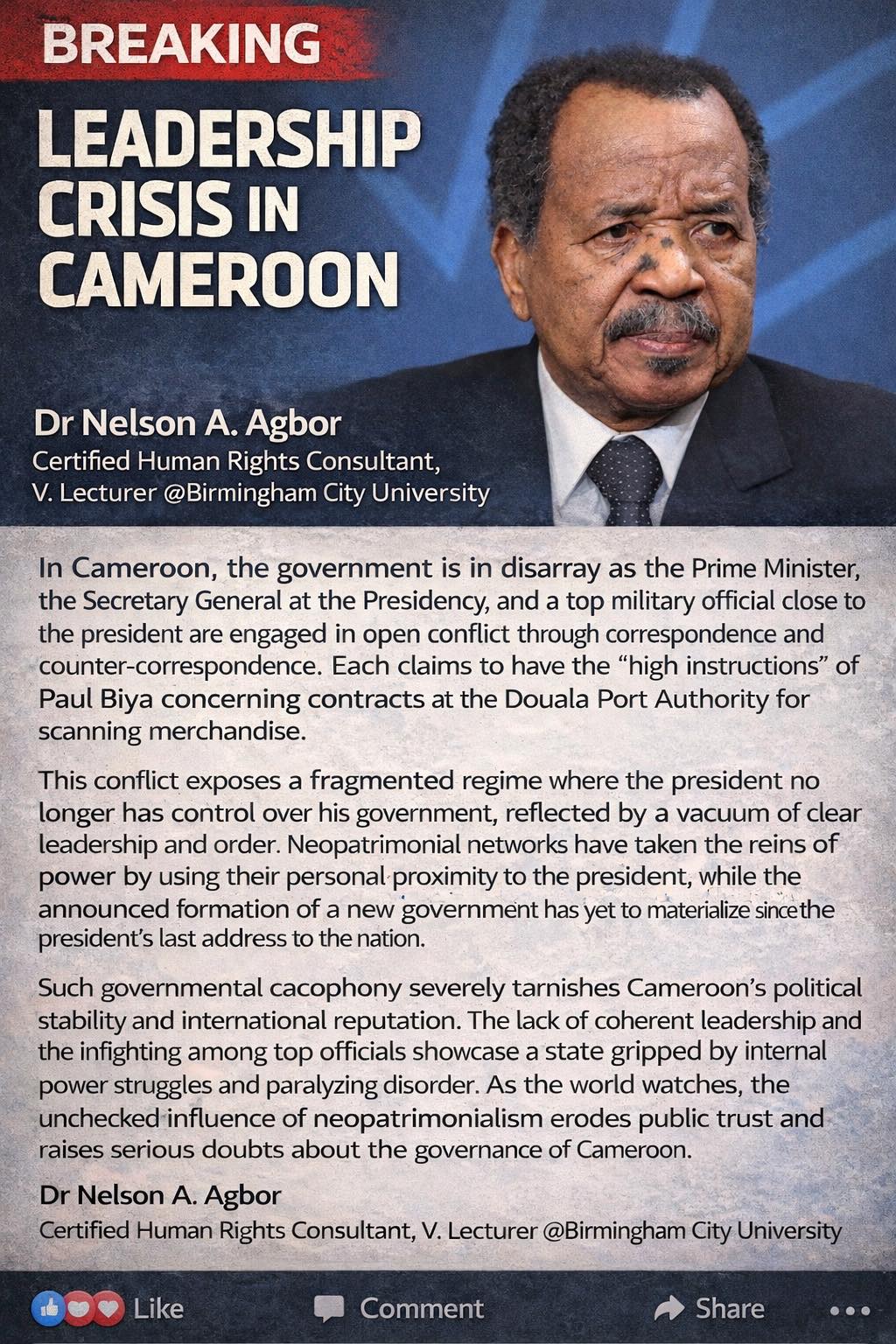
The ongoing public exchange of correspondence among senior Cameroonian officials over the management of scanning contracts at the Douala Port Authority reveals more than an administrative disagreement; it exposes the structural fragmentation of the Cameroonian state. When the Prime Minister, the Secretary General at the Presidency, and a senior military official, each claiming to act under the “high instructions” of Paul Biya, contradict one another in writing, the result is an institutional crisis of authority. In a centralised presidential system, such visible discord signals not pluralism, but a vacuum at the apex of power.
From a political economy perspective, this episode exemplifies the persistence and degeneration of neopatrimonial governance. Rather than transparent, rule-based decision-making, state authority appears mediated through informal networks of proximity to the presidency. Competing actors mobilise their alleged closeness to the president as a resource, transforming “high instructions” into a rhetorical weapon rather than a coherent policy directive. The state thus becomes an arena of factional bargaining, where personalised claims to power supplant bureaucratic hierarchy.
The contradiction is further sharpened by the president’s repeated announcement of an imminent government reshuffle, a promise that has remained suspended since his last address to the nation. This prolonged gap between proclamation and execution reinforces perceptions of paralysis at the centre of the regime. In such a context, senior officials are incentivised to entrench themselves, pre-empt rivals, and secure rents, rather than await formal institutional clarification. What emerges is not transitional governance, but an open struggle for positioning in anticipation of uncertain change.
The international and domestic reputational costs of this governmental cacophony are significant. Strategic infrastructure such as the port of Douala is central to Cameroon’s economic credibility, regional trade role, and investor confidence. Public infighting over contracts signals regulatory unpredictability and weak coordination, undermining trust in the state’s capacity to honour commitments. For a country already facing security and economic pressures, the image of a state speaking in multiple, conflicting voices erodes both stability and legitimacy.
Ultimately, the spectacle of elite discord points to a deeper erosion of presidential control and effective leadership in Cameroon. When authority is no longer exercised through institutions but contested through correspondence, the regime’s coherence depends less on governance than on survival through informal networks. This moment thus illustrates a fragmented regime in which the presidency no longer arbitrates decisively, and where the absence of clear leadership risks transforming routine administrative disputes into symptoms of systemic instability.
US Institute of Diplomacy and Human RightsCentre for Human Rights and Democracy in AfricaUnited NationsHuman Rights WatchAfrican Committee of Experts on the Rights and Welfare of the ChildAfrican UnionChristopher FomunyohEuropean ParliamentUnited Nations Human RightsInstitute for Human Rights and Development in Africa (IHRDA)African Court on Human and Peoples’ RightsUnited States Institute of PeaceGénéral ValseroRemy Ngono
Dr Nelson A. Agbor
Certified Human Rights Consultant
V. Lecturer @Birmingham City University.




