
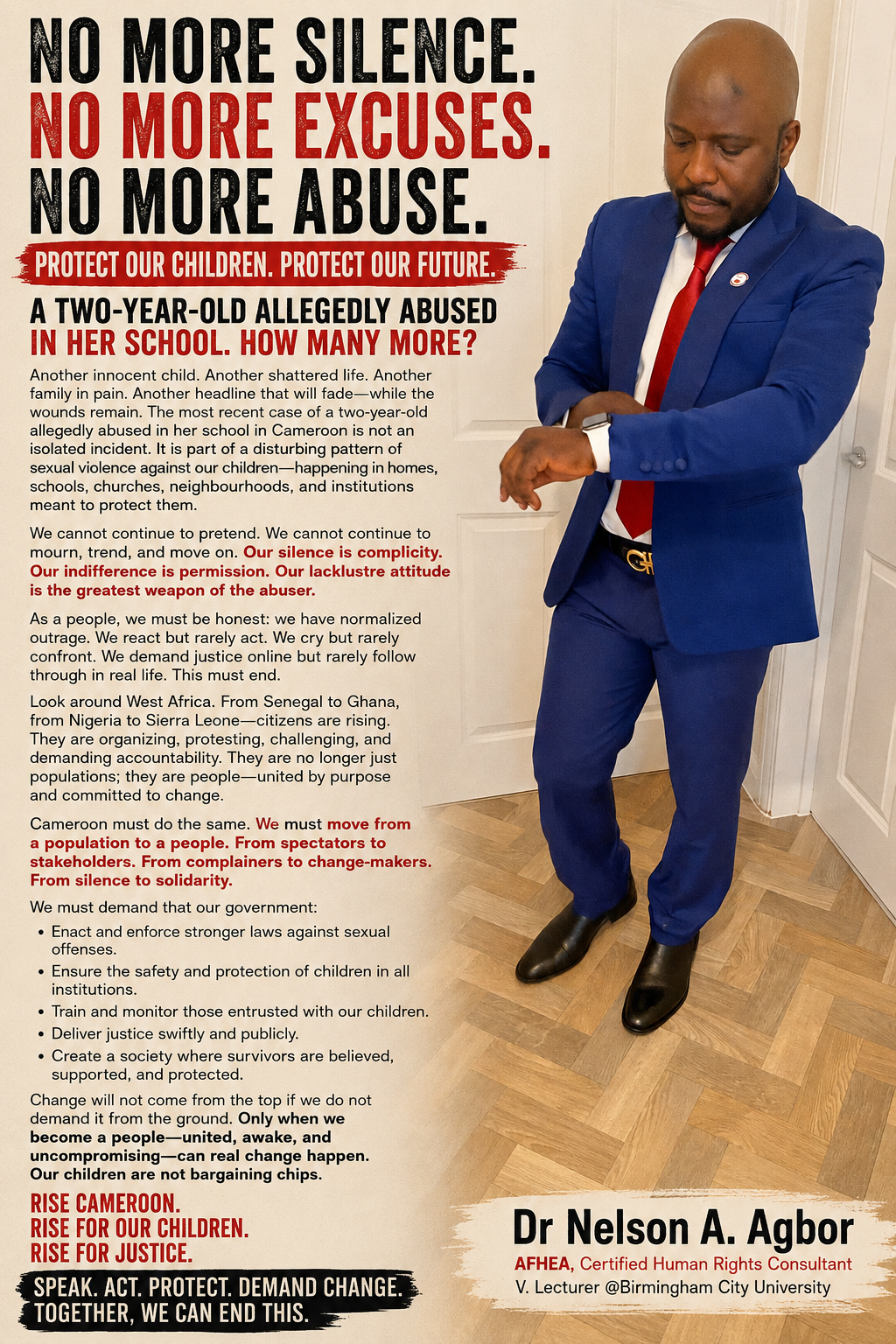
The alarming prevalence of sexual abuse in Cameroon has become one of the gravest social crises facing the nation today. The recent allegation of sexual abuse against a two-year-old child in a school setting has once again shocked the public conscience and exposed the vulnerability of children in spaces that should guarantee their safety. Such incidents are not isolated but part of a disturbing pattern of violence against women and children that has persisted for years. Each new case serves as a painful reminder of the inadequacies of existing child-protection mechanisms, the weaknesses of law-enforcement institutions, and the broader societal failures that enable such crimes. The alleged abuse of a child so young is not merely a criminal offence; it is a profound moral failure that demands urgent national reflection and action.
The horror of this latest case is compounded by the fact that schools are traditionally regarded as safe havens where children learn, grow, and develop under the care of trusted adults. When allegations of sexual abuse surface in such institutions, public confidence is severely undermined. Parents are left questioning whether their children are truly safe. At the same time, communities are forced to confront the uncomfortable reality that predators may be operating within institutions entrusted with the care of the most vulnerable members of society. The emotional trauma inflicted on victims and their families often extends far beyond the immediate incident, creating lifelong psychological, social, and emotional consequences that cannot be easily undone.
Equally troubling is the recurring pattern of public reaction to these incidents. Across Cameroon, each case of sexual abuse typically sparks widespread outrage on social media, emotional public commentary, and calls for justice. For a brief period, citizens express anger, grief, and solidarity with victims. Yet this collective outrage often fades with remarkable speed. Public attention shifts to other issues, discussions lose momentum, and demands for accountability gradually fade from the national conversation. The result is a cycle in which horrific crimes generate temporary indignation but rarely lead to sustained pressure for systemic reform. This tendency to move on too quickly has become one of the greatest obstacles to meaningful change.
The consequences of this collective amnesia are severe. Institutions are unlikely to reform themselves when they know public anger will eventually dissipate. Law enforcement agencies, government officials, educational authorities, and judicial institutions face little sustained pressure to improve child protection systems or strengthen accountability mechanisms. In such an environment, impunity flourishes. Perpetrators may fear legal consequences, but institutions rarely fear public consequences because they understand that societal attention is often short-lived. Every time citizens allow outrage to fade without demanding lasting reforms, they inadvertently perpetuate the conditions that permit future abuses.
This reality highlights a deeper problem in Cameroonian society: the absence of a strong, sustained civic culture. Too often, Cameroonians respond to events as isolated individuals rather than as members of a politically conscious community united by shared values and collective interests. The distinction between a population and a people is crucial here. A population is simply a collection of individuals living within a particular territory. A people, however, possess a shared sense of purpose, common aspirations, and the capacity to act collectively in pursuit of justice and societal improvement. While populations endure events, people shape their destinies through organised action and civic engagement.
Cameroon’s persistent inability to translate public outrage into sustained civic mobilisation suggests the country continues to function more as a population than as a people. The repeated sexual abuse scandals, coupled with the absence of enduring public campaigns for reform, reflect a broader culture of resignation and political disengagement. Many citizens have become accustomed to witnessing injustice without believing that collective action can produce meaningful change. This mindset has contributed to the normalisation of societal dysfunction and has weakened the public’s capacity to hold institutions accountable for their failures.
Recent developments across several West African countries show that another path is possible. Across the region, citizens have increasingly demanded accountability, transparency, and responsiveness from their governments. Through sustained civic engagement, public mobilisation, and organised advocacy, populations have demonstrated their ability to influence political outcomes and compel institutions to address pressing societal concerns. While each national context is unique, the broader lesson remains relevant for Cameroon: governments are more likely to respond when citizens act collectively, consistently, and strategically, rather than relying solely on temporary expressions of outrage.
The fight against sexual abuse must therefore become a national priority that transcends political, ethnic, linguistic, and religious divisions. Protecting children should be regarded as a fundamental responsibility shared across all sectors of society. Civil society organisations, religious institutions, professional associations, educators, parents, and community leaders must work together to demand stronger child-protection policies, improved vetting of school personnel, more effective reporting mechanisms, and harsher penalties for offenders. Equally important is the need for transparent investigations and judicial processes that ensure victims receive justice and that perpetrators are fully accountable under the law.
The media also bears significant responsibility in this struggle. Rather than allowing public attention to dissipate after the initial shock of an incident, journalists and media organisations should maintain pressure by continuously monitoring investigations, reporting on legal proceedings, and exposing institutional failures. Sustained public awareness is essential because the greatest ally of injustice is forgetfulness. When society remembers, institutions remain under scrutiny. When society forgets, complacency returns and opportunities for reform are lost. Long-term advocacy, rather than episodic outrage, is necessary for meaningful progress.
Ultimately, Cameroon’s future depends on whether its citizens can evolve from a mere population into a people. Real change will not emerge from social media reactions alone, nor will it result from isolated outbursts of anger after each new tragedy. It will come only when citizens recognise their collective power and commit to sustained civic engagement. People do not abandon their victims once headlines fade. People do not allow institutions to escape accountability over time. People organise, demand, monitor, and persist until justice is achieved. Only when Cameroonians embrace this collective civic responsibility will the country be able to confront the scourge of sexual abuse effectively, strengthen the protection of its children, and build a safer and more just society for future generations. a safer and more just society for future generations.
Dr Nelson A. Agbor AFHEA
Certified Human Rights Consultant
V. Lecturer @Birmingham City University.




