
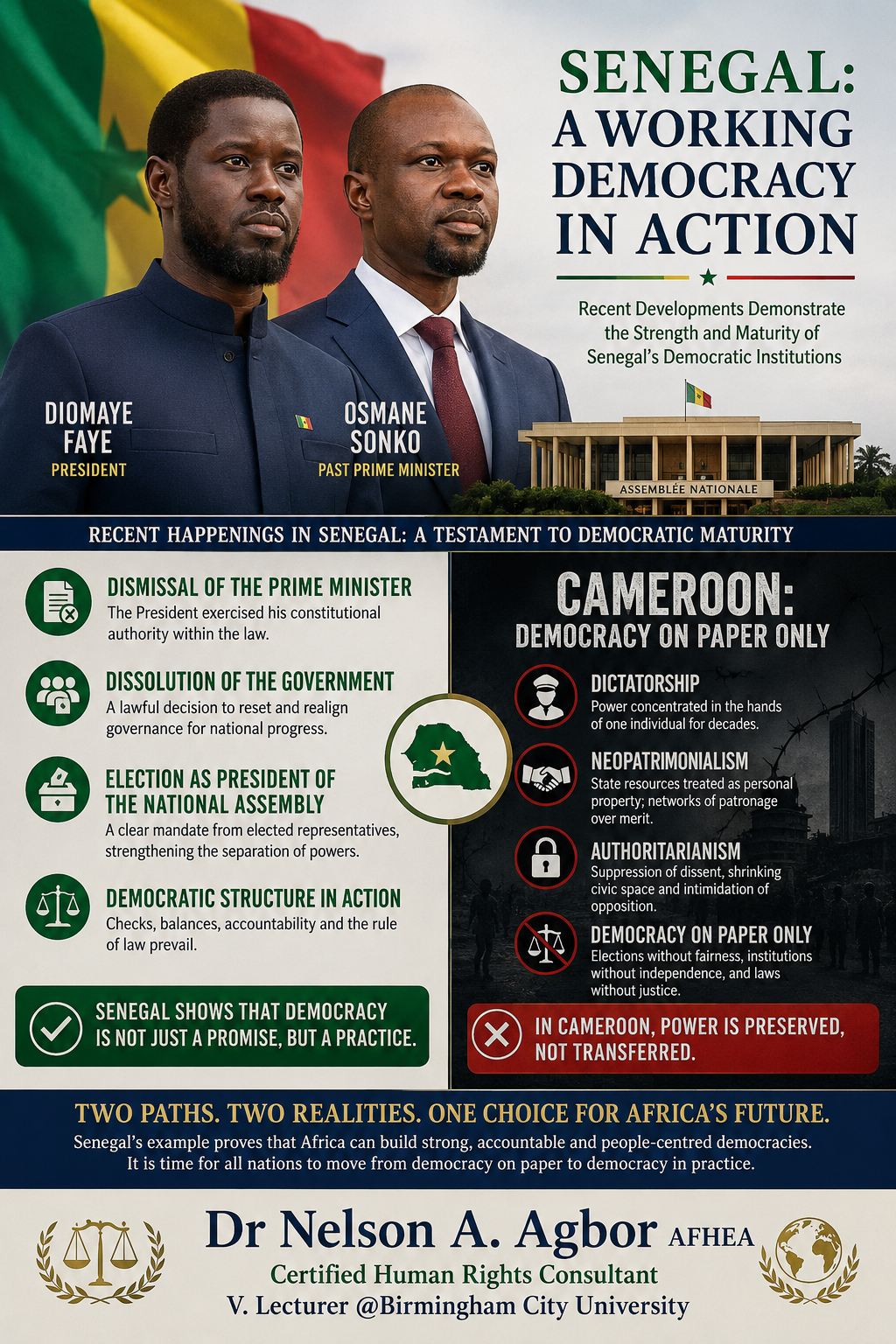
The recent political developments in Senegal, including President Bassirou Diomaye Faye’s dismissal of Prime Minister Ousmane Sonko, the dissolution of the government, and Sonko’s subsequent emergence as a central parliamentary actor, provide a compelling contemporary illustration of democratic institutional resilience in Africa. Rather than descending into constitutional crisis, military intervention, or violent repression, Senegal’s political transition has unfolded within the framework of constitutional legality and institutional negotiation. This demonstrates the maturity of Senegalese democratic culture, particularly when contrasted with the entrenched authoritarianism and neopatrimonial governance structure in Cameroon under President Paul Biya.
The dismissal of Ousmane Sonko in early May 2026 followed months of mounting political tension between Sonko and President Faye over economic policy, governance direction, and negotiations with the International Monetary Fund (IMF). After removing Sonko from office, President Faye dissolved the government and appointed economist Ahmadou Al Aminou Lo as the new prime minister. Although the move marked a dramatic rupture within the ruling PASTEF coalition, the transition was carried out through constitutional procedures rather than by coercive force. Such institutional adherence is significant in a continent where executive disagreements frequently trigger military coups, emergency rule, or unconstitutional political manoeuvres.
The Senegalese case is particularly noteworthy because both Faye and Sonko emerged from the same reformist political movement that defeated the long-dominant political establishment in 2024. Their political alliance symbolised democratic renewal, anti-corruption reform, and generational change. Yet when ideological and strategic disagreements surfaced, Senegalese institutions proved capable of managing elite fragmentation without systemic collapse. The president’s ability to dismiss the prime minister, dissolve the cabinet, and reconstitute executive authority within constitutional parameters demonstrates that state institutions, rather than individual personalities, remain the primary arbiters of political legitimacy.
Equally important is the role of the National Assembly in this democratic process. Senegal’s legislature has maintained operational autonomy and political relevance despite executive turbulence. Sonko’s subsequent election today or elevation to parliamentary leadership after his dismissal indicates that political competition remains open and institutionalised. Rather than criminalising opposition or permanently excluding rivals from public life, Senegalese politics continues to permit the circulation of power through constitutional channels. This is a hallmark of democratic consolidation, reflecting the normalisation of political rivalry within institutional frameworks rather than personalistic domination.
It’s the broader constitutional tradition that further strengthens Senegal’s democratic credentials. Since independence, the country has largely avoided military coups and has repeatedly seen peaceful transfers of power. The 2024 election that brought Faye to office followed major public protests against attempts to delay the electoral process, and the Constitutional Council ultimately compelled adherence to constitutional timelines. Such judicial independence and civic mobilisation illustrate that democratic accountability in Senegal extends beyond electoral rituals to active constitutional guardianship by both institutions and citizens.
In sharp contrast, Cameroon is one of Africa’s clearest examples of democratic stagnation under authoritarian continuity. President Paul Biya has remained in power since 1982, making him one of the world’s longest-serving heads of state. Although Cameroon formally operates as a multiparty democracy, the political reality is characterised by a centralised executive, electoral manipulation, repression of dissent, and the systematic weakening of opposition parties. Elections occur regularly, yet they function primarily as instruments of regime legitimisation rather than genuine mechanisms of political competition.
The Cameroonian political system exemplifies neopatrimonial governance, in which formal state institutions coexist with informal networks of patronage, ethnic balancing, and elite clientelism. Public office is often used to distribute favours and consolidate loyalty rather than to promote accountability or institutional development. Under this arrangement, state resources are personalised around presidential authority, and political survival depends less on democratic legitimacy than on access to patronage networks. Consequently, democratic institutions in Cameroon often exist only in name, while substantive political power remains concentrated in the presidency.
Unlike Senegal, where intra-elite conflict remains institutionally mediated, Cameroon has historically responded to political dissent with repression and securitisation. Opposition leaders are routinely harassed, arrested, or marginalised, and civil liberties remain heavily constrained. The Anglophone crisis further exposes the authoritarian nature of the Cameroonian state, as demands for political inclusion and federal reform have largely been met with militarised responses rather than democratic dialogue. This contrasts with Senegal’s political culture, where institutional compromise and constitutional procedures continue to shape political outcomes even during periods of instability.
Another critical distinction concerns the relationship between citizens and democratic institutions. In Senegal, political mobilisation has repeatedly shaped constitutional outcomes, as seen in protests against electoral postponement and demands for governmental accountability. Senegalese civil society, the judiciary, the media, and opposition actors retain meaningful influence in the political sphere. In Cameroon, however, prolonged authoritarian rule has eroded public confidence in democratic institutions, producing widespread political apathy, fear, and resignation. Consequently, democracy survives more as constitutional rhetoric than as a lived political reality.
In summary, recent developments in Senegal show that democracy in Africa can function effectively when institutions are respected, and political competition is normalised. The dismissal of a prime minister, the dissolution of the government, and continued parliamentary manoeuvring did not destroy the Senegalese political order, as democratic legitimacy remains rooted in constitutionalism rather than in personal rule. Conversely, Cameroon shows how authoritarian resilience, neopatrimonialism, and executive over-centralisation can hollow out democratic institutions while preserving only their formal appearance. The contrast between the two countries, therefore, offers an important lesson for African governance: democracy is sustained not merely by elections or constitutions, but by institutional accountability, separation of powers, political pluralism, and respect for constitutional processes.
Dr Nelson A. Agbor AFHEA
Certified Human Rights Consultant
V. Lecturer @Birmingham City University.




