
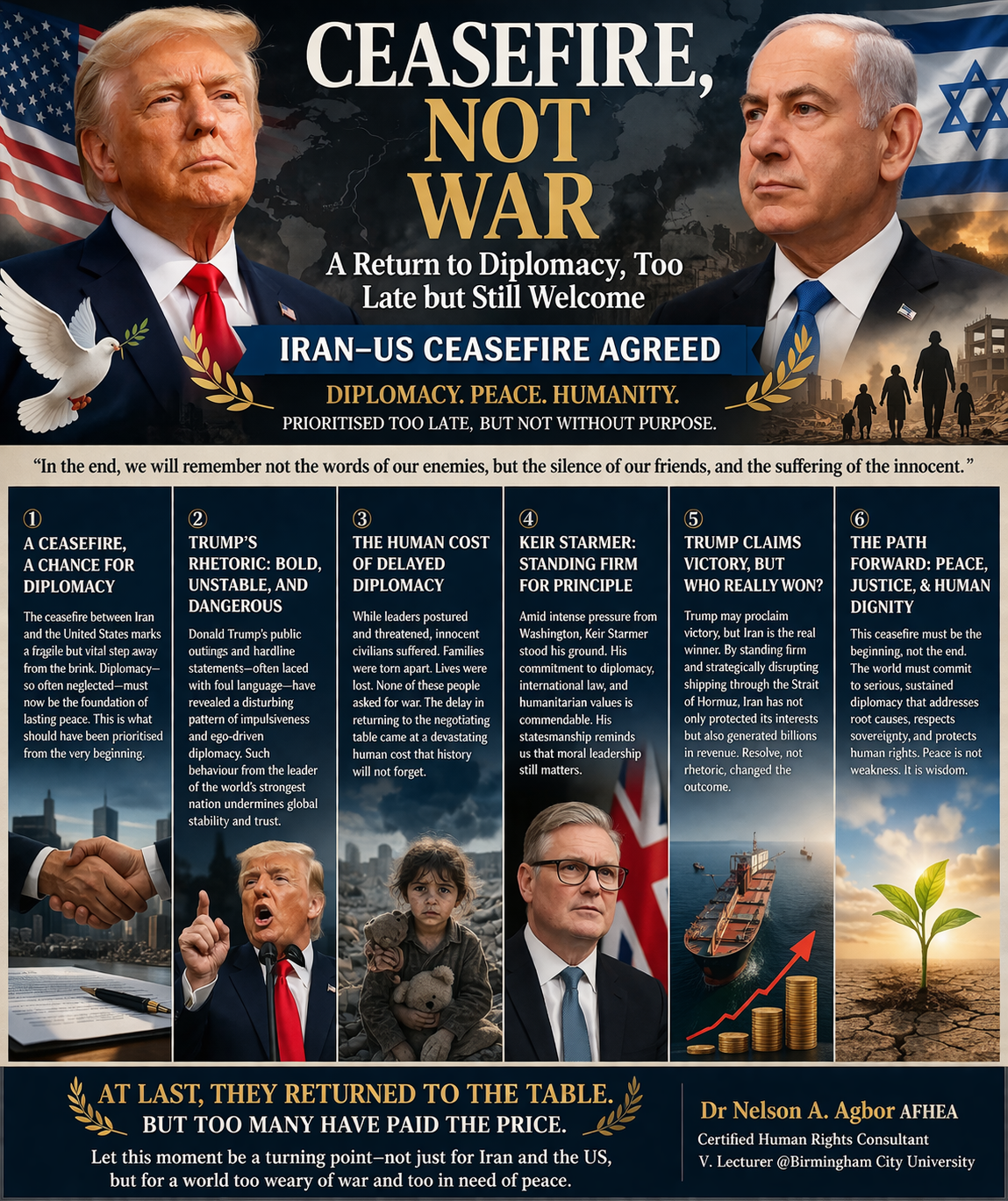
The recent ceasefire agreement between Iran and the United States marks a significant, albeit delayed, shift towards diplomacy in a relationship long characterised by hostility, strategic mistrust, and episodic escalation. From an international relations standpoint, this development highlights the continued importance of negotiation as a tool for de-escalation, even after extended brinkmanship. The end of hostilities, though tenuous, demonstrates that channels for dialogue remain open even in highly adversarial settings. The fact that a return to diplomatic engagement was not prioritised sooner reflects a broader failure within the international system to privilege conflict prevention over reactive crisis management.
Central to this failure has been the rhetorical and strategic stance adopted by Donald Trump, whose public statements and policy signals frequently swung between maximalist threats and sudden recalibrations. His use of inflammatory rhetoric, including instances of undiplomatic and coarse language, fostered an atmosphere of volatility that weakened predictability in U.S. foreign policy. From a governance perspective, this unpredictability raises significant concerns regarding the stability of decision-making at the highest level of the world’s most powerful state. In classical realist terms, credibility and consistency are fundamental to deterrence and alliance management; erratic signalling, by contrast, introduces strategic ambiguity that can escalate rather than contain conflict.
Furthermore, Trump’s framing of the conflict in absolutist and often personalised terms shifted focus away from structural causes of tension, such as regional security dilemmas and economic sanctions regimes. His tendency to proclaim imminent victories or catastrophic threats fostered a policy environment prone to swift changes, making diplomatic engagement harder not only with Iran but also with allied actors. The eventual return to negotiations, therefore, seems less driven by a clear grand strategy and more as a response to the unsustainable escalation that such rhetoric helped to create.
Conversely, Keir Starmer’s role deserves special recognition as an example of cautious political leadership under external pressure. Despite ongoing expectations to align closely with U.S. policy preferences, Starmer’s approach showed a commitment to multilateralism and restraint. By sticking to a stance that prioritised dialogue over confrontation, he helped preserve diplomatic space at a time when it was rapidly shrinking. His position reflects a broader tradition in British foreign policy that aims to balance alliance commitments with independent judgment, especially on issues of international security and humanitarian concerns.
The human toll of the conflict underscores the importance of earlier diplomatic efforts. Civilian populations, those least responsible for geopolitical disputes, have suffered disproportionately through displacement, economic hardship, and loss of life. From a humanitarian law perspective, the delay in reaching a ceasefire raises questions about the effectiveness of international mechanisms intended to protect non-combatants. The eventual agreement, while welcome, cannot retroactively undo the extensive harm inflicted on innocent individuals who neither started nor benefited from the conflict.
Finally, while Trump has sought to characterise the ceasefire as a strategic victory for the United States, an alternative interpretation suggests that Iran has gained significant leverage through its resilience. By maintaining its position and exerting influence over key maritime routes, such as the Strait of Hormuz, Iran has demonstrated its ability to shape regional economic dynamics and secure strategic concessions. This outcome challenges triumphalist narratives and instead highlights the asymmetrical nature of modern geopolitical struggles, where endurance and strategic positioning can provide advantages independent of traditional measures of military success. In this way, the ceasefire emphasises not only the importance of diplomacy but also the costs of delaying it.
Dr Nelson A. Agbor AFHEA
Certified Human Rights Consultant
V. Lecturer @Birmingham City University.




