
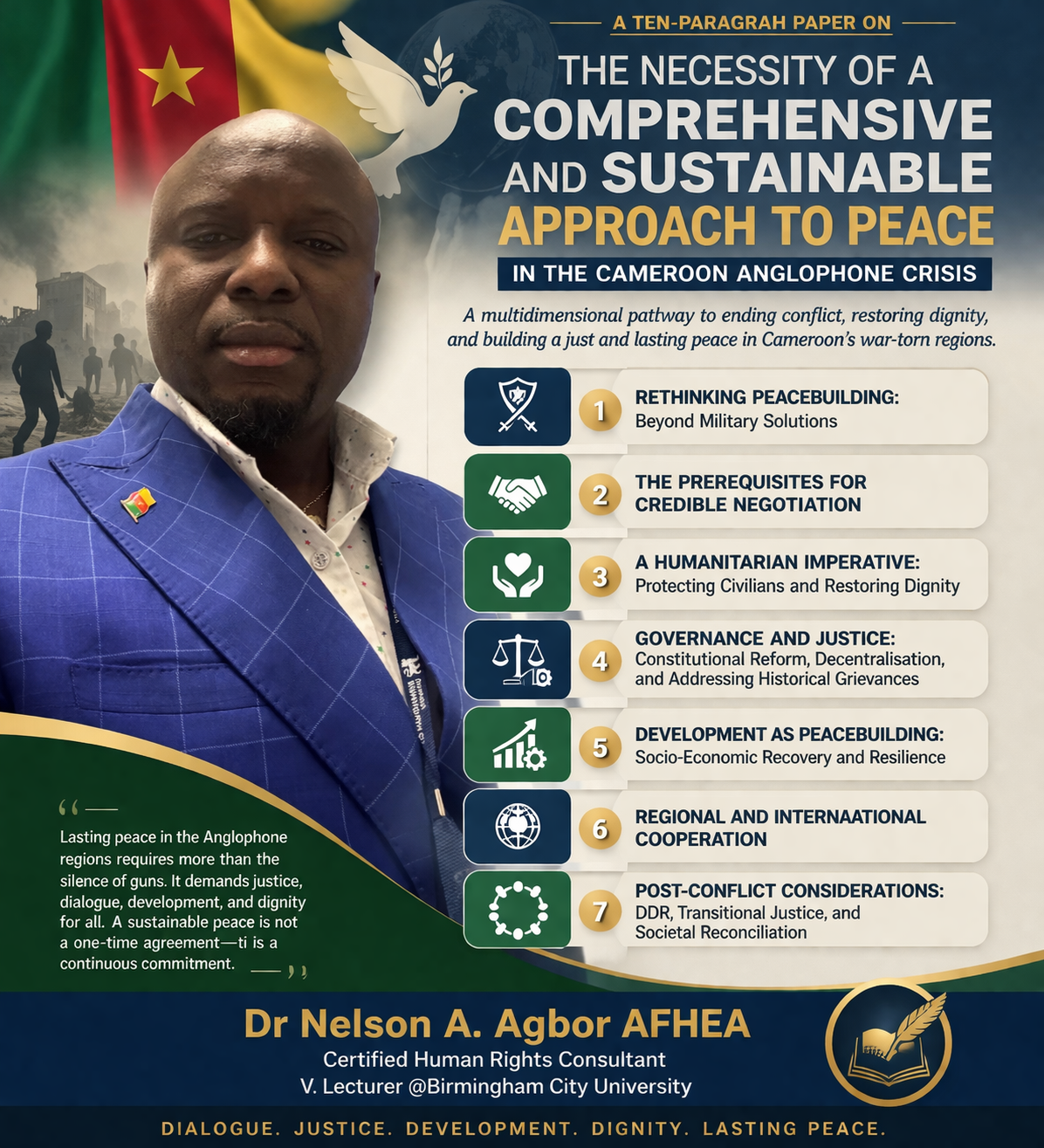
The prolonged Anglophone crisis in Cameroon is one of the most complex and deeply rooted conflicts in modern Africa, characterised by historical grievances, governance failures, and increasing violence. Since 2016, tensions between the central government and Anglophone regions have developed into an armed conflict marked by widespread human rights abuses, displacement, and socio-economic collapse. Tackling this crisis requires more than sporadic interventions or coercive state responses; it calls for a comprehensive and sustainable approach to peace. Such an approach must combine political, humanitarian, developmental, and justice-focused strategies to address both the symptoms and underlying causes of the conflict.
Rethinking peacebuilding in Cameroon requires a decisive move away from an over-reliance on military solutions. Although state security concerns are legitimate, the ongoing use of force has worsened mistrust, radicalised factions, and increased civilian suffering. Military action alone cannot resolve identity-based conflicts rooted in perceived marginalisation and systemic inequalities. A sustainable peace approach must instead focus on dialogue, inclusive political processes, and confidence-building measures. This shift signals an understanding that peace is not just the absence of violence but also the presence of justice, legitimacy, and institutional trust.
Central to this reframe is the establishment of prerequisites for credible negotiation. Effective dialogue must be inclusive, involving not only the government and armed separatist groups but also civil society actors, traditional leaders, women’s groups, and the diaspora. Preconditions such as ceasefires, release of political detainees, and guarantees of safe participation are vital for building trust. Furthermore, the mediation process must be seen as impartial, possibly requiring facilitation by neutral international actors. Without credibility and inclusiveness, negotiations risk being dismissed as performative and may further entrench divisions.
The humanitarian aspect of the crisis highlights the need to protect civilians and restore human dignity. Reports of extrajudicial killings, arbitrary arrests, village burnings, and kidnappings have fostered a climate of widespread fear. Internally displaced persons and refugees face severe conditions, with limited access to healthcare, education, and essential services. A sustainable peace strategy must prioritise humanitarian access, adherence to international humanitarian law, and mechanisms for civilian protection. Addressing immediate human suffering is not only a moral obligation but also a strategic necessity, as unaddressed trauma can perpetuate cycles of violence.
Equally important is addressing governance weaknesses and justice issues through structural reforms. The Anglophone crisis arises from longstanding grievances related to political exclusion, cultural assimilation, and the weakening of the common law and education systems. Constitutional reform centred on genuine decentralisation, or even federalism, should be carefully considered to redistribute power and establish meaningful local autonomy. Such reforms should also include institutional safeguards to protect linguistic and cultural rights, thereby tackling the identity-related aspects of the conflict.
Justice mechanisms play a crucial role in restoring legitimacy and encouraging reconciliation. Widespread impunity for human rights violations by both state and non-state actors has eroded public trust. Creating independent investigative bodies, prosecuting offenders, and offering reparations to victims are vital steps towards accountability. Transitional justice frameworks, such as truth commissions and community-based reconciliation processes, can help acknowledge harm and foster societal healing. Justice in this context is not only retributive but also restorative, focused on rebuilding fractured relationships.
Reconceptualise development as a vital part of peacebuilding rather than an afterthought post-conflict. The Anglophone regions face significant economic decline, with disrupted education systems, destroyed infrastructure, and reduced livelihoods. Targeted investments in reconstruction, education, healthcare, and employment can address core socio-economic grievances. Additionally, fostering resilience through community-driven initiatives empowers local populations and decreases vulnerability to renewed conflict. Economic inclusion and opportunity are therefore essential for maintaining peace.
Regional and international cooperation are essential in tackling the complex nature of the crisis. The cross-border effects, especially with refugee movements into neighbouring countries, require coordinated responses. Regional organisations and international partners can offer diplomatic backing, mediation expertise, and humanitarian aid. However, such involvement must respect national sovereignty while promoting compliance with international norms. Constructive engagement by external actors can help build trust and offer guarantees that strengthen peace agreements.
Post-conflict considerations, including disarmament, demobilisation, and reintegration (DDR), are crucial for consolidating peace once hostilities cease. Former combatants must be effectively reintegrated into civilian life through vocational training, psychosocial support, and economic opportunities. Failure to address the needs of ex-combatants risks the development of criminality or renewed insurgency. DDR programmes must be carefully designed to be inclusive, transparent, and sensitive to local contexts, ensuring they contribute to long-term stability rather than short-term containment.
Finally, societal reconciliation remains the foundation of any sustainable peace process. The deep divisions and mistrust caused by years of conflict cannot be resolved solely through political agreements. Grassroots initiatives that foster dialogue, intercommunal understanding, and shared memory are essential. Religious institutions, community leaders, and civil society organisations play a vital role in promoting reconciliation. Lasting peace in Cameroon’s Anglophone regions will ultimately rely on rebuilding social cohesion, where justice, dignity, and mutual recognition replace fear and division.
Dr Nelson A. Agbor AFHEA
Certified Human Rights Consultant
V. Lecturer @Birmingham City University.




