
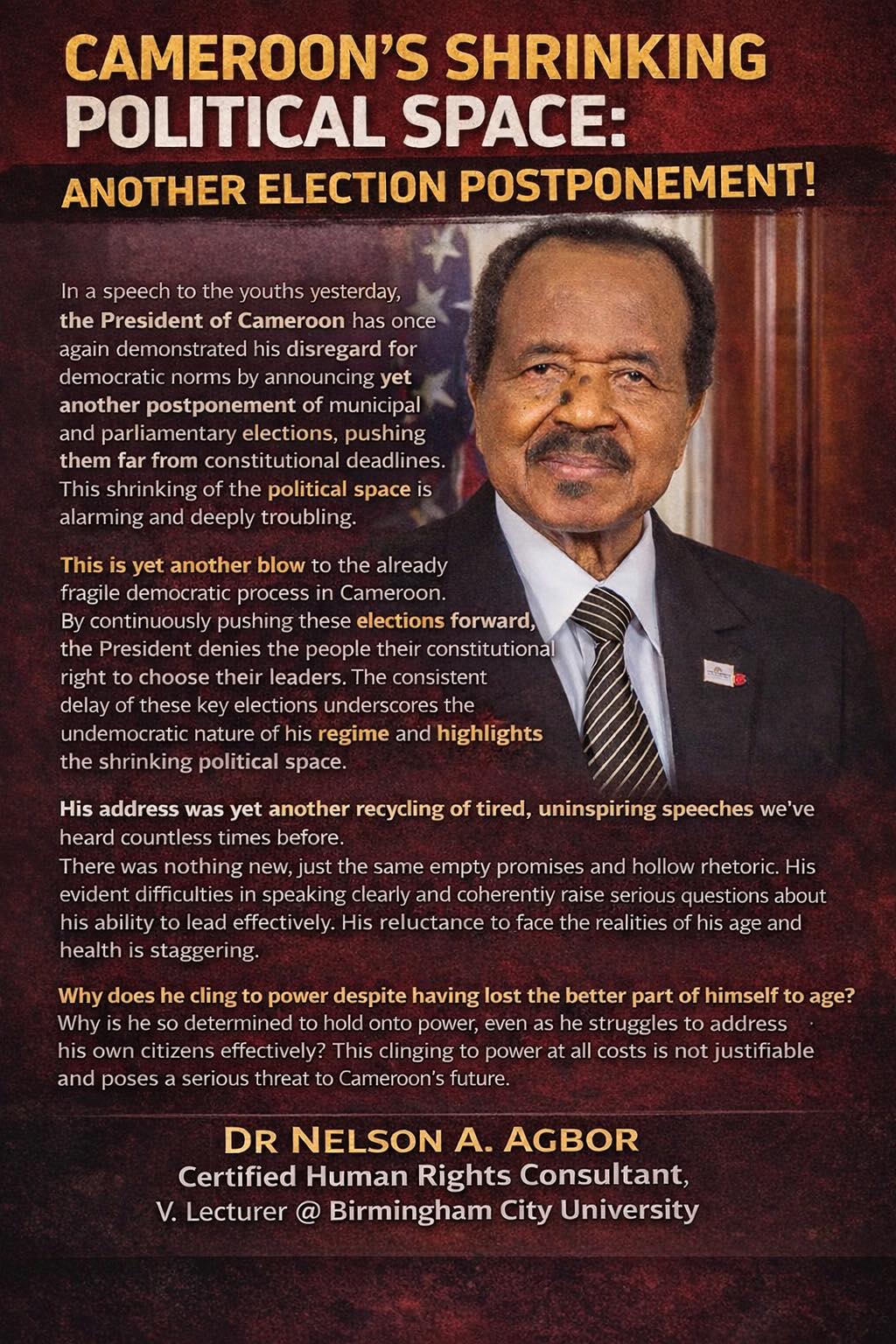
Biya’s presidential address to the youth of Cameroon yesterday once again invites rigorous intellectual scrutiny, particularly at a moment when the country stands at a delicate institutional crossroads. In political theory, the credibility of a constitutional democracy is measured not merely by the existence of formal structures, but by the consistency with which they are respected. Recent developments, therefore, compel a sober reassessment of the relationship between constitutional order and political practice in Cameroon.
The continued postponement of municipal and parliamentary elections raises fundamental questions about constitutional temporality, the principle that political power must remain anchored in clearly defined legal timelines. When electoral cycles are repeatedly deferred, the political arena risks contraction, not always through overt restriction, but through the gradual normalisation of exception. Scholars of democratic governance have long warned that such patterns can recalibrate citizens’ expectations, making institutional irregularity appear routine rather than extraordinary.
Equally deserving of examination is the nature of presidential communication. Political leadership, especially in societies marked by a youthful demographic majority like Cameroon, demands rhetorical renewal and responsiveness to evolving socioeconomic realities. When national addresses appear to recycle familiar formulations, they risk signalling continuity without adaptation. This posture may unintentionally widen the psychological distance between governing institutions and the generations tasked with inheriting them.
This moment also invites reflection on the longevity of political systems within modern states. Across comparative political scholarship, extended tenure often provokes debates not only about leadership capacity but about institutional elasticity, that is, whether political systems remain open enough to regenerate themselves through new actors, ideas, and energies. The question is therefore less about age as a biological fact than about governance as a dynamic enterprise that requires intellectual vigour, strategic clarity, and symbolic reassurance.
For Cameroon, a nation endowed with immense human potential and civic intelligence, the stakes are unmistakably high. Constitutional fidelity, credible electoral rhythms, and revitalised public discourse are not abstract academic concerns; they are the infrastructure upon which durable legitimacy is constructed. A politically engaged youth, attentive civil society, and resilient institutions together form the architecture of democratic continuity. The present moment thus calls not for polemics, but for heightened analytical vigilance and an unwavering commitment to the principles that sustain republican life.
US Institute of Diplomacy and Human RightsCentre for Human Rights and Democracy in AfricaUnited NationsHuman Rights WatchAmnesty International UKAfrican Committee of Experts on the Rights and Welfare of the ChildSky NewsAfrican UnionOccupy DemocratsUnited Nations Human RightsAfrican Court on Human and Peoples’ RightsInstitute for Human Rights and Development in Africa (IHRDA)United States Institute of PeaceEuropean Convention on Human RightsUK House of LordsUK House of CommonsAgbor NkonghoHigh Commission of Canada to CameroonChristopher Fomunyoh
Dr Nelson A. Agbor,
Certified Human Rights Consultant,
V. Lecturer @Birmingham City University.




