
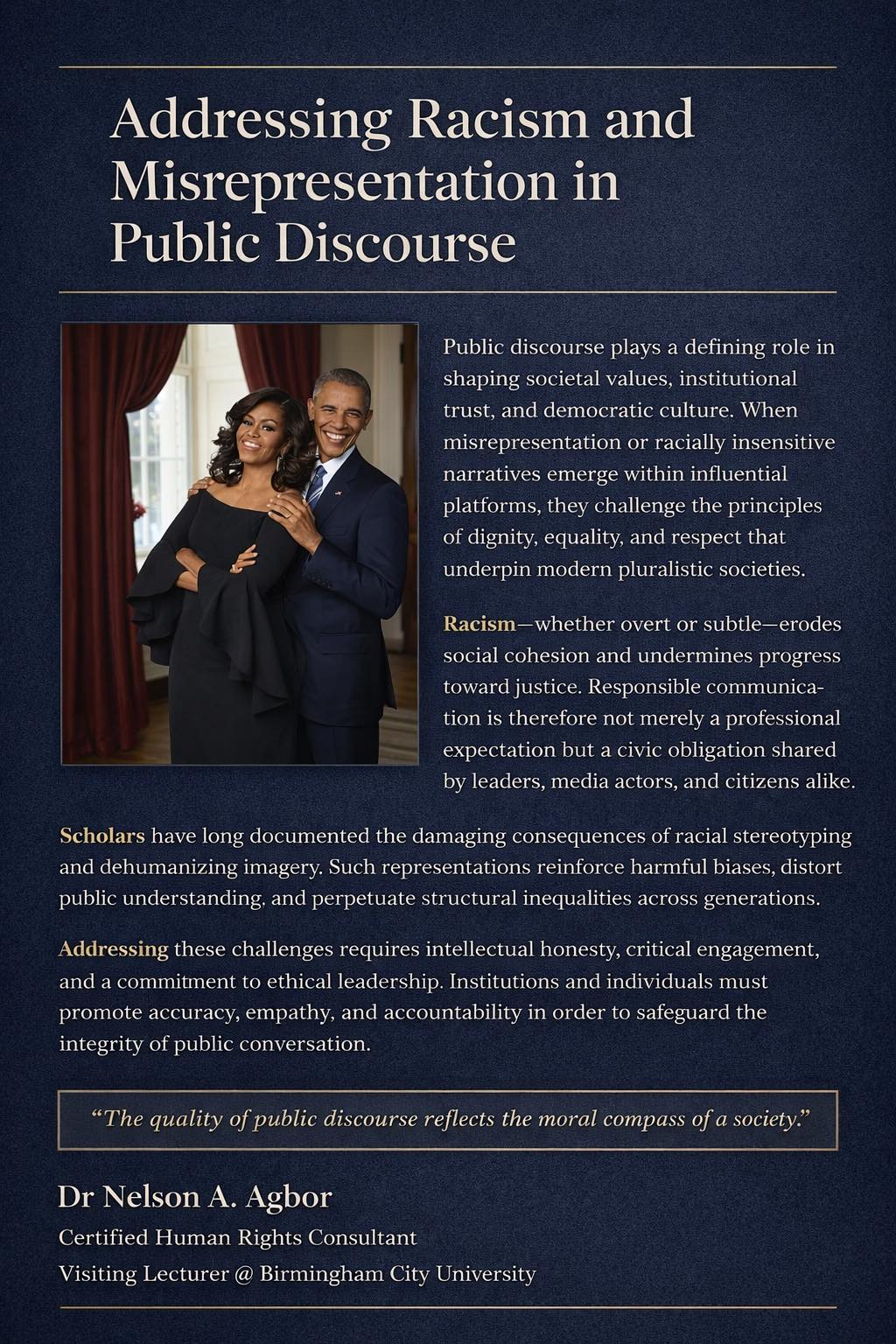
Yesterday, President Donald J. Trump shared an image on social media depicting Barack and Michelle Obama in a manner likening them to apes on his Truth Social account. This act has rightly generated widespread condemnation. Regardless of one’s political affiliations, the use of imagery that invokes historically racist caricatures is deeply troubling. Such depictions do not constitute legitimate political critique; instead, they draw on a long legacy of dehumanisation that has been used to justify exclusion, violence, and discrimination against Black people in the United States and beyond.
This incident must be situated within a broader pattern of conduct. Over the course of his public life, President Trump has repeatedly been accused of racist and misogynistic rhetoric, from his comments about Mexican immigrants during the 2016 campaign to derogatory remarks about women to repeated attacks on people of colour that draw on racial stereotypes. Scholars of political communication have documented how language and imagery from public figures can reinforce structural inequalities and normalise prejudice when left unchallenged.
The normalization of dehumanizing language, especially by someone who holds or aspires to hold public office, carries real social consequences. Research in social psychology demonstrates that when political leaders employ or tolerate racist tropes, it can embolden similar attitudes among their followers, contribute to a hostile public climate, and erode trust in democratic institutions. It is not simply offensive; it has measurable effects on social cohesion and the lived experiences of marginalised communities.
Moreover, the repeated targeting of female public figures with derogatory language and imagery, whether implicitly or explicitly undermining their dignity, reflects misogynistic undercurrents that demand scrutiny. Misogyny in public discourse, like racism, does not exist in a vacuum: it shapes and reflects broader patterns of gender inequality and exclusion in both political institutions and society at large.
In light of these concerns, it is incumbent upon all of us, citizens of the world, scholars, academics and public officials to speak out against behaviour that degrades individuals or groups based on race or gender. Doing so is not about partisanship; it is about upholding the dignity of public discourse and the fundamental values of equality and respect that are enshrined in the Constitution and that give honour to the United States’ global standing. Silence in the face of such conduct only permits its perpetuation.
US Institute of Diplomacy and Human RightsCentre for Human Rights and Democracy in AfricaUnited NationsHuman Rights WatchAmnesty International UKAfrican Committee of Experts on the Rights and Welfare of the ChildSky NewsAfrican UnionUnited Nations Human RightsDelbrando E-tInstitute for Human Rights and Development in Africa (IHRDA)African Court on Human and Peoples’ RightsUnited States Institute of PeaceEuropean Convention on Human RightsUK House of LordsUK House of CommonsOccupy Democrats
Dr Nelson A. Agbor,
Certified Human Rights Consultant,
V. Lecturer @Birmingham City University.




