
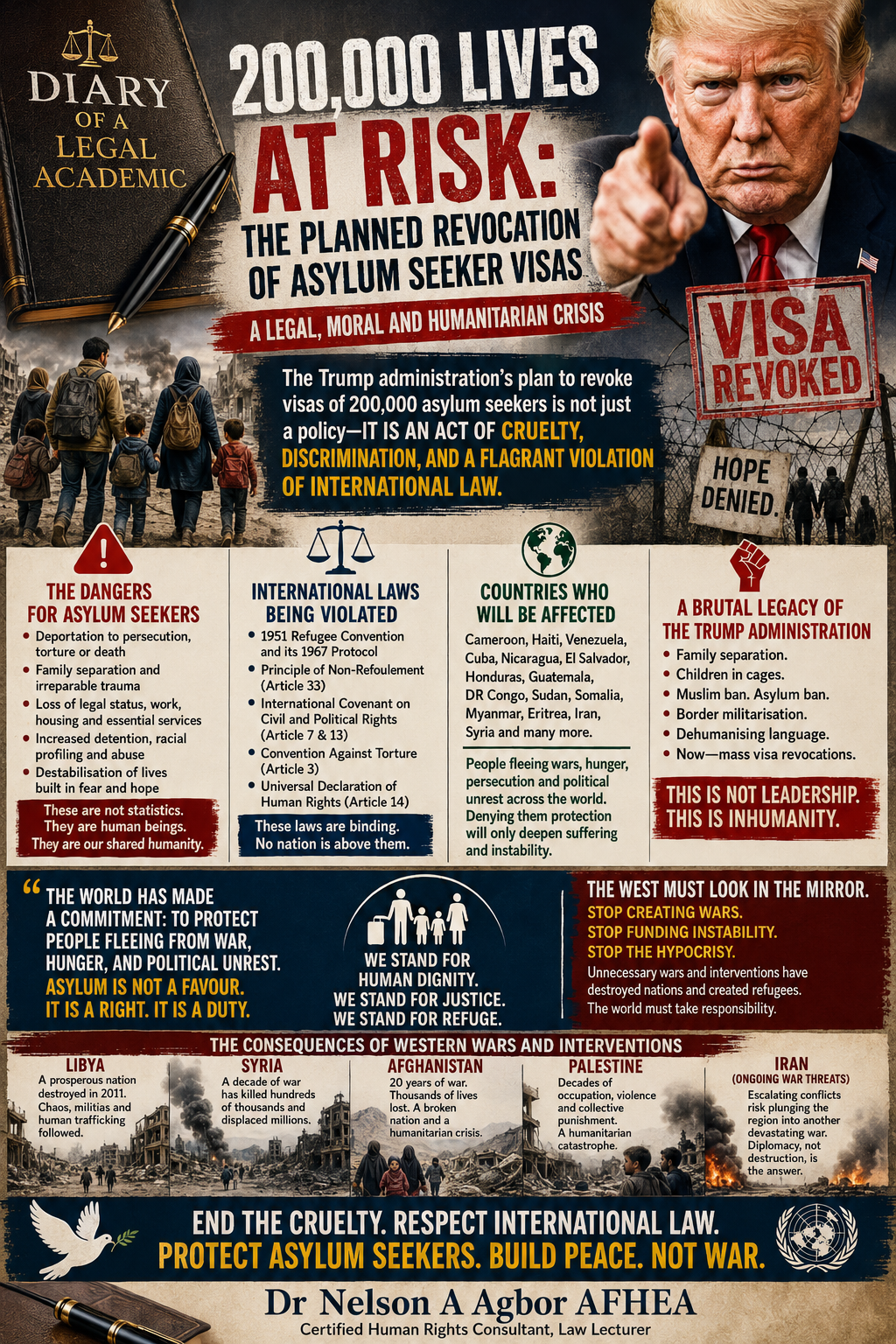
The reported decision by the Trump administration to prepare to revoke as many as 200,000 B-1 and B-2 visas held by persons who have applied for or are seeking asylum in the United States represents a potentially profound development in contemporary American migration policy. Reports published on 24 August 2026 indicate that the Department of State, working with the Department of Homeland Security, is considering withdrawing the underlying business or tourist visas of individuals who entered the United States lawfully but subsequently sought international protection. If implemented at the reported scale, it could constitute the largest mass visa revocation in United States history. The administration argues that individuals who obtain temporary visas while intending to remain through asylum may be abusing the non-immigrant visa system. Yet that proposition must be treated cautiously. Seeking asylum after entering on a temporary visa is not, by itself, proof that the original visa was fraudulently obtained; circumstances in an applicant’s country may deteriorate, persecution may arise or intensify, or an individual may only later appreciate the availability or necessity of international protection. Moreover, reports indicate that visa revocation would not itself automatically terminate pending asylum claims or result in immediate deportation.
The danger lies principally in the broader architecture within which this policy is being developed. Visa revocation may increase insecurity among asylum seekers, complicate future travel, intensify their vulnerability to immigration enforcement, and create a powerful deterrent against exercising the right to seek protection. The United States has already adopted extensive nationality-based restrictions: as of January 2026, visa issuance was fully suspended, subject to limited exceptions, for nationals of Afghanistan, Burma, Burkina Faso, Chad, the Republic of the Congo, Equatorial Guinea, Eritrea, Haiti, Iran, Laos, Libya, Mali, Niger, Sierra Leone, Somalia, South Sudan, Sudan, Syria and Yemen, as well as persons travelling on documents issued or endorsed by the Palestinian Authority. (Travel State) The new mass-revocation proposal has not, on presently available evidence, been confined to these nationalities, and no authoritative nationality breakdown of the potentially affected 200,000 people has yet been published. Nevertheless, asylum seekers originating from conflict-affected and politically unstable states including Afghanistan, Iran, Syria, Sudan, Somalia, Haiti, parts of Central and West Africa and other countries experiencing persecution or armed violence have obvious reasons to fear policies that make access to protection increasingly precarious.
International refugee law establishes an important boundary that no immigration-control policy may legitimately erase. The United States is party to the 1967 Protocol Relating to the Status of Refugees, through which the substantive refugee-protection framework of the 1951 Refugee Convention applies to it, and the Refugee Act of 1980 incorporated central refugee principles into American domestic law. (UNHCR) Most important is Article 33 of the 1951 Convention, which embodies the principle of non-refoulement: refugees must not be returned to territories where their life or freedom would be threatened on account of a Convention reason. Article 31 is also significant because the international refugee regime recognises that persons fleeing persecution cannot always obtain prior immigration authorisation and therefore limits penalisation for irregular entry in specified circumstances. Article 32 provides protections concerning expulsion. (See UNHCR) Accordingly, revoking a temporary visa is not automatically a violation of the Refugee Convention. Still, if revocation is used to prevent the meaningful determination of an asylum claim, to facilitate removal without adequate individual assessment, or to return a person to persecution or serious harm, substantial questions of compatibility with international and domestic refugee law arise.
The principle of non-refoulement is particularly important because international protection attaches to the danger confronting the individual, rather than simply to the immigration document by which that individual entered a country. UNHCR expressly states that non-refoulement applies to asylum seekers as well as recognised refugees, because a person should not be returned to danger before a final determination of their claim for protection. It further regards non-refoulement as a rule of customary international law. (See Emergency UNHCR) Protection against removal to torture may additionally arise under Article 3 of the Convention against Torture, while the broader international human-rights framework reinforces protection against return to irreparable harm. The Universal Declaration of Human Rights, Article 14, recognises the right to seek and enjoy asylum from persecution. These principles do not confer an unconditional right upon every applicant to remain permanently in the United States, nor do they prohibit governments from investigating fraudulent claims. They do, however, require procedures capable of distinguishing an unfounded application from a genuine plea for protection. Collective suspicion cannot substitute for individualised adjudication.
The human consequences of abandoning that distinction could be severe. An Iranian dissident fearing political persecution, an Afghan woman confronting gender-based repression, a Syrian whose community has been devastated by years of conflict, a Sudanese civilian escaping warfare, or a Cameroonian alleging persecution arising from political activity or the Anglophone conflict cannot responsibly be reduced to the administrative category of a “visa abuser” merely because that person initially entered using a visitor visa. The asylum system exists precisely because apparently ordinary migration can become forced displacement when political circumstances change, or previously concealed threats become intolerable. UNHCR projects that approximately 136 million people could be forcibly displaced or stateless during 2026, demonstrating the extraordinary scale of the contemporary protection challenge. (UNHCR) A policy that systematically links asylum applications to immigration wrongdoing therefore risks generating a chilling effect: people with legitimate claims may fear that seeking protection will itself trigger punitive consequences.
Against this background, the Trump administration’s approach deserves forceful criticism. Immigration control is a legitimate sovereign function, and states are entitled to investigate fraud, protect their borders, and reject asylum applications that do not meet applicable legal standards. But sovereignty is not a licence to extinguish international obligations or to treat vulnerable human beings as instruments of political deterrence. A system becomes brutal when deterrence is achieved by deliberately increasing insecurity among people who may face persecution, torture, armed conflict or death upon return. The reported mass-revocation proposal also sits within a wider programme of increasingly restrictive immigration measures. Indeed, only days before these reports, a federal judge struck down another administration policy that suspended immigrant visa processing for nationals of 75 countries, finding that the policy exceeded the Secretary of State’s statutory authority. (Reuters) The rule of law requires more than executive assertions of national security: it requires legality, proportionality, procedural fairness and meaningful access to protection.
There is also a deeper contradiction within Western refugee policy. Wealthy states frequently emphasise humanitarianism after wars have displaced civilian populations while giving insufficient attention to the foreign-policy decisions that contribute to displacement in the first place. The 2011 NATO intervention in Libya, the prolonged military intervention in Afghanistan, external involvement in the devastating conflict in Syria, and continuing international military and political involvement surrounding Palestine illustrate, in different ways and with different causal histories, the relationship between geopolitics, armed intervention, institutional collapse and forced migration. These conflicts should not simplistically be described as having a single Western cause: domestic authoritarianism, regional powers, armed groups, terrorism, sectarian politics and other actors have played major roles. Nevertheless, Western governments cannot credibly debate migration as though displacement begins at their borders. Libya is particularly instructive. The overthrow of Muammar Gaddafi was followed by prolonged institutional fragmentation, militia violence and insecurity, while the country subsequently became a major transit space for refugees and migrants. In August 2026, UNHCR continued to register substantial refugee and asylum-seeking populations there, predominantly Sudanese but also Eritrean, Syrian, Ethiopian, South Sudanese, Somali and Palestinian. ( See UNHCR Data Portal)
The same contradiction has acquired renewed urgency through the ongoing conflict involving the United States, Israel and Iran. The military escalation that began on 28 February 2026 has produced another major humanitarian emergency. UNHCR reports that attacks across the Middle East have killed civilians, destroyed infrastructure and forced millions from their homes; government estimates cited by UNHCR indicated that between 600,000 and one million households temporarily left their homes across Iran, while approximately one million people were displaced in Lebanon after the regional escalation. (UNHCR) As of 25 August, the conflict remains unresolved, with continuing confrontation, economic sanctions and instability surrounding the Strait of Hormuz. (Reuters) There is therefore a profound normative inconsistency when powerful states participate in military strategies that can generate displacement while simultaneously erecting increasingly restrictive legal barriers to people fleeing the resulting insecurity. States cannot reasonably help internationalise conflict and then pretend that the displacement flowing from regional destabilisation is solely somebody else’s responsibility.
The appropriate response is not an abandonment of border regulation but a reorientation of Western foreign and migration policy around conflict prevention, diplomatic settlement and genuine responsibility-sharing. The international community must become considerably more reluctant to pursue wars of choice, externally engineered regime change and military interventions whose post-conflict consequences have not been adequately anticipated. Libya demonstrates the danger of removing a regime without establishing a sustainable political settlement; Afghanistan demonstrates the limits of attempting political transformation through prolonged military occupation; Syria demonstrates the destructive consequences of internationalised proxy warfare; Palestine demonstrates the catastrophic civilian consequences of unresolved occupation, insecurity and recurring armed conflict; and the current Iran conflict demonstrates how rapidly geopolitical confrontation can create new displacement across an already fragile region. UNHCR itself has long stressed that humanitarian assistance cannot substitute for political action capable of preventing and resolving refugee-producing crises. (UNHCR) If Western governments genuinely wish to reduce irregular migration and asylum pressures, preventing displacement through diplomacy, accountable foreign policy, peace-building and economic stability is more sustainable than closing protection routes after displacement has already occurred.
Ultimately, the reported plan to revoke up to 200,000 visas should become a test of whether the international refugee-protection system retains substantive meaning in an era of resurgent nationalism. The post-war refugee regime was constructed around a basic moral and legal proposition: a person facing persecution or grave danger should not be returned to it merely because that person’s presence has become politically inconvenient. That commitment must endure. At the same time, international law should be described precisely: poverty or hunger alone does not automatically establish refugee status under the 1951 Convention, whereas persecution for a Convention reason can; people fleeing armed conflict may qualify depending upon their individual circumstances and other applicable protection regimes. What the international community must reject is the normalisation of policies that transform vulnerability into suspicion and asylum into an administrative offence. The United States and other Western democracies should lead through lawful refugee determination, non-refoulement, due process, humanitarian protection and serious investment in preventing the wars and political instability that drive displacement. Protecting people fleeing persecution, warfare and political upheaval is not an act of generosity detached from law. It is part of the international legal order constructed from the experience of catastrophic displacement and its credibility depends upon powerful states respecting it precisely when doing so becomes politically difficult.
Dr Nelson A. Agbor AFHEA
Certified Human Rights Consultant
V. Lecturer @Birmingham City University.




