
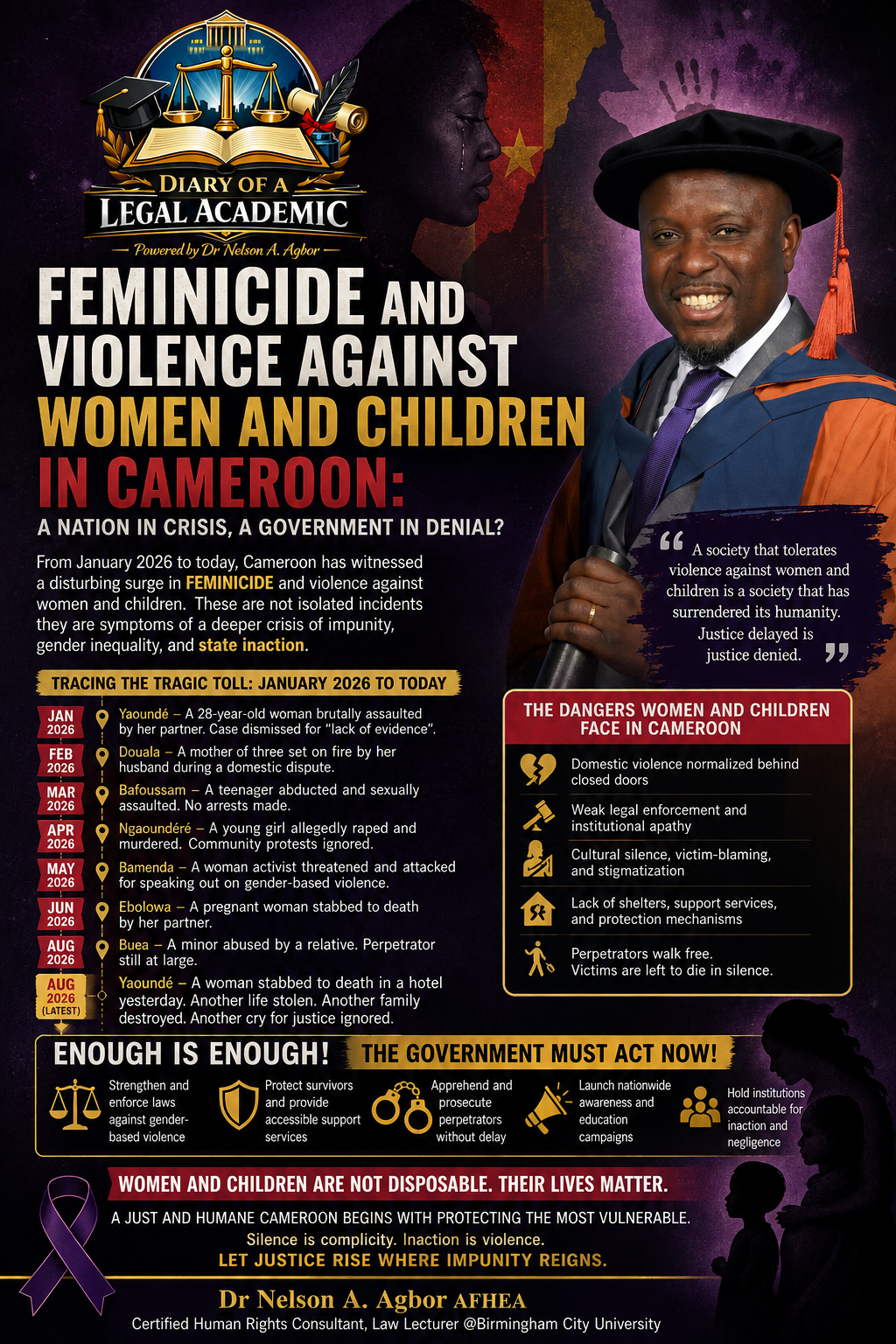
Cameroon is facing an alarming escalation in violence against women and children, which can no longer be credibly treated as a collection of isolated criminal incidents. Since the beginning of 2026, reports of feminicide, intimate-partner killings, rape, child sexual abuse, infanticide and other forms of extreme violence have exposed profound weaknesses in the country’s protection architecture. Government figures presented to the National Assembly in June indicated that 50 cases of feminicide had already been officially recorded during the first four months of 2026, alongside 166 cases of rape and 13 cases of infanticide. The Minister of Women’s Empowerment and the Family acknowledged that these statistics may represent only the “tip of the iceberg,” given underreporting caused by fear, stigma and family pressure. More recently, Cameroon reportedly experienced seven femicides within seven days, across locations including Yaoundé, Douala, Belabo and Tibati (see Cameroon Tribune). These figures point not merely to an increase in ordinary criminality but to a systemic human-rights and public-protection emergency in which women and children appear increasingly unsafe in homes, schools, intimate relationships and public spaces.
From January 2026 to a Pattern of Feminicide
The trajectory since January shows why the current situation demands urgent national attention. By 14 April 2026, monitoring cited in recent reporting indicated that at least 33 women had already been killed since the beginning of the year, including 11 deaths linked to intimate-partner circumstances. The alleged methods, including stabbing, beating and machete attacks, are particularly disturbing as they reveal the extreme physical brutality characterising some of these killings. The victims have reportedly included students, mothers, professionals and women from different regions and socioeconomic backgrounds. This suggests that vulnerability to gender-based violence cannot be conveniently confined to a particular social class or locality. More importantly, the recurrence of killings involving husbands, boyfriends, relatives and acquaintances demonstrates the danger posed by intimate and domestic environments. A woman may therefore face the gravest threat not from an unknown criminal but from someone in a position of proximity, familiarity or supposed trust. This reality requires feminicide to be understood within the broader continuum of coercive control, domestic violence, economic dependency, gender inequality and institutional failure, rather than simply as homicide committed against individual women.
Violence against Children and the Collapse of Spaces of Safety
Children have likewise become victims of deeply troubling acts of violence. In June, the Government itself identified several cases illustrating the scale of the problem: three-year-old Bissong Omgba Pauline Joyce was reportedly subjected to sexual abuse linked to a nursery school in the Odza neighbourhood of Yaoundé; 11-year-old Divine Mbarga was raped and murdered in Nkoabang; three children were killed by their mother before she took her own life in Nkolbisson on 16 February; an 11-month-old infant was killed in Ndogpassi, Douala, on 24 March; and two secondary-school girls were murdered in Kribi in March. (Cameroon Tribune) The United Nations subsequently expressed profound concern about the resurgence of infanticide, feminicide and sexual violence, particularly violence directed against children. These incidents are especially disturbing because several occurred within environments where children should reasonably have expected protection from the family, neighbourhood and educational institutions. When schools, homes and caregiving relationships cease to function as reliable spaces of safety, the problem transcends individual offending. It becomes a question of whether the State has constructed an effective child-protection system capable of prevention, early intervention, investigation and accountability.
August 2026 and the Intensification of the Crisis
The violence appears to have intensified rather than diminished as 2026 has progressed. Recent reports describe a woman killed by her husband in Mendong after she reportedly fled the matrimonial home to escape violence; another woman reportedly died after repeated domestic violence in Ekié; and an 11-year-old girl was killed with a bladed weapon in Anguissa. In another extraordinary sequence of violence, a 19-year-old woman was allegedly killed by her 22-year-old partner and concealed in a pit; a 34-year-old mother of two was stabbed to death inside her home, reportedly while her children were present; another woman was reportedly beheaded in Douala; a woman’s body was abandoned in Belabo; another victim was killed and buried in Tibati; and Ze Ebogo Lydie was reportedly beaten to death by her husband in Nkolafamba. The geographical dispersion of these incidents is significant. Violence against women cannot be dismissed as an aberration confined to one city, region or community. The recurrence of lethal violence across different parts of Cameroon suggests a broader societal and institutional problem requiring a coordinated national response.
The Killing at Hôtel Salvador: Another Woman Added to the Statistics
The killing of Crescence Merline Beguel, aged 44, on 25 August 2026 offers the latest disturbing illustration of this crisis. According to Cameroon Tribune, she was killed in a furnished room at Hôtel Salvador in the Fouda neighbourhood of Yaoundé. Authorities reportedly found evidence of a violent struggle and a bloodstained kitchen knife, and a 22-year-old suspect was apprehended. Subsequent reporting states that investigators recovered from the suspect’s belongings a new rope, identity cards belonging to two women, and various items of clothing. The significance of these materials remains under investigation, and no conclusion regarding motive or criminal liability should be drawn before the judicial process. What is already beyond dispute, however, is the wider social context in which this killing occurred. It came immediately after national concern over multiple femicides within days. Consequently, Crescence Merline Beguel must not simply become another statistic briefly dominating social media before disappearing from public consciousness. Her death should intensify demands for a systematic investigation of violence against women and for effective institutional mechanisms capable of identifying risk before violence culminates in death.
Government Response and the Problem of Institutional Inaction
It would be inaccurate to suggest that the Cameroonian Government has been entirely silent: officials have publicly recognised the crisis, called for stronger action, and announced work on legislation specifically addressing gender-based violence (see Cameroon Tribune). The more serious criticism concerns the gulf between official recognition and effective protection. In June 2026, Human Rights Watch reported that Cameroon had failed to meet its longstanding commitment to substantially reduce violence against women, identifying discriminatory laws, weak institutions, inadequate protection for survivors, and chronic underinvestment in public services as factors enabling abuse. It further noted that Cameroon still lacks a national policy or guidelines specifically addressing domestic violence, and that a comprehensive Family Code has remained in draft form for more than two decades (see Human Rights Watch). Government condemnation after a woman or child has been raped or killed cannot substitute for prevention. Nor can press conferences and ministerial statements satisfy the State’s protective responsibilities when victims continue to encounter inadequate reporting mechanisms, delays in justice, insufficient shelters and support services, and informal settlements of serious domestic-abuse allegations. A credible response must therefore be judged by measurable reductions in violence, successful investigations and prosecutions, survivor protection, and institutional reform, rather than the frequency of official declarations.
Violence against Women as a Human-Rights Violation
The crisis engages Cameroon’s binding international and regional human-rights obligations. Cameroon ratified the Convention on the Elimination of All Forms of Discrimination against Women (CEDAW) in 1994 and the Convention on the Rights of the Child (CRC) in 1993 (United Nations Treaty Collection). It is also bound by instruments, including the African Charter on Human and Peoples’ Rights, the African Charter on the Rights and Welfare of the Child, and the Maputo Protocol. These frameworks impose obligations that go beyond merely refraining from direct State violence. Under the principle of due diligence, states must take reasonable and effective measures to prevent foreseeable violence by private actors, protect persons at risk, promptly investigate allegations, prosecute alleged perpetrators through fair procedures, and provide effective remedies to victims and survivors. The Maputo Protocol specifically protects women’s rights to dignity, life, integrity and security, and requires states to prevent, investigate and punish violence against women. Persistent failure to establish effective mechanisms to combat gender-based violence therefore raises questions not merely about public policy but about compliance with Cameroon’s international human-rights obligations.
Why Women and Children Remain Particularly Vulnerable
The killings also expose structural conditions that leave women and children particularly vulnerable. Gender inequality, economic dependency, patriarchal understandings of marriage, social tolerance of intimate-partner abuse, victim-blaming, fear of retaliation and pressure to preserve family relationships can deter women from reporting violence at its earliest stages. Human Rights Watch has documented physical, psychological and economic violence against Cameroonian women, often by husbands and intimate partners, and has highlighted how economic control and discriminatory family arrangements can undermine women’s ability to leave abusive relationships. Children face additional vulnerability because they depend on adults and institutions for protection and may lack the capacity, vocabulary, financial independence or social authority to report abuse. When allegations are silenced, trivialised or privately “settled”, perpetrators may view the consequences of violence as negotiable. This fosters a dangerous culture of impunity. Protection therefore requires dismantling the social and institutional conditions that allow abuse to escalate from intimidation and coercion to assault, rape and ultimately murder.
From Condemnation to Accountability and Deterrence
Cameroon urgently requires a comprehensive national strategy to translate the State’s responsibility to protect into functioning institutions. Parliament should enact comprehensive legislation addressing domestic and gender-based violence, including mechanisms for emergency protection and restraining orders, while accelerating the long-delayed reform of discriminatory family laws. Police and gendarmerie units require specialised training in gender and child protection, effective risk-assessment procedures, and adequately resourced investigative capacity. Prosecutors and courts must ensure that credible allegations of rape, serious assault, child abuse and feminicide are investigated and prosecuted without unreasonable delay. Survivors require accessible shelters, medical treatment, psychosocial assistance, legal aid and confidential reporting systems across all ten regions. Schools should implement enforceable safeguarding procedures, including clear reporting obligations when abuse is suspected. Most importantly, criminal accountability must become visible and predictable. Those accused remain entitled to due process and the presumption of innocence; however, where guilt is established following a fair trial, penalties must reflect the gravity of the offence. Effective investigation, prosecution and proportionate punishment serve not only retributive purposes but also the broader objectives of deterrence, public confidence and reaffirmation of the value the legal order places on women’s and children’s lives.
Synopsis: The State Must Protect
The recent rise in feminicide and violence against children should mark a defining moment for Cameroon. From women killed in the first months of 2026 to children raped or murdered in homes, neighbourhoods and educational settings, to the extraordinary cluster of femicides reported in August, and finally the killing of Crescence Merline Beguel in a Yaoundé hotel on 25 August, the pattern demands far more than expressions of shock. Cameroon has both sovereign responsibility and international legal obligations to protect those within its jurisdiction, particularly those whose vulnerability makes effective State protection indispensable. The Government must treat violence against women and children as a national human-rights and security priority: prevent violence before it becomes fatal, protect those reporting threats, properly fund survivor services, reform deficient laws, investigate every credible allegation, apprehend alleged perpetrators and ensure fair and effective prosecution. The fundamental measure of a state’s commitment to human rights is not found in constitutional declarations or international treaties alone; it lies in whether an endangered woman can seek and receive protection, whether an abused child can speak and be believed, and whether those who violate their rights face justice. The lives of Cameroonian women and children cannot continue to be reduced to statistics by preventable violence. Protection must become practical, accountability must be certain, and impunity must cease to be an option.
Dr Nelson A. Agbor AFHEA
Certified Human Rights Consultant
V. Lecturer @Birmingham City University.




