
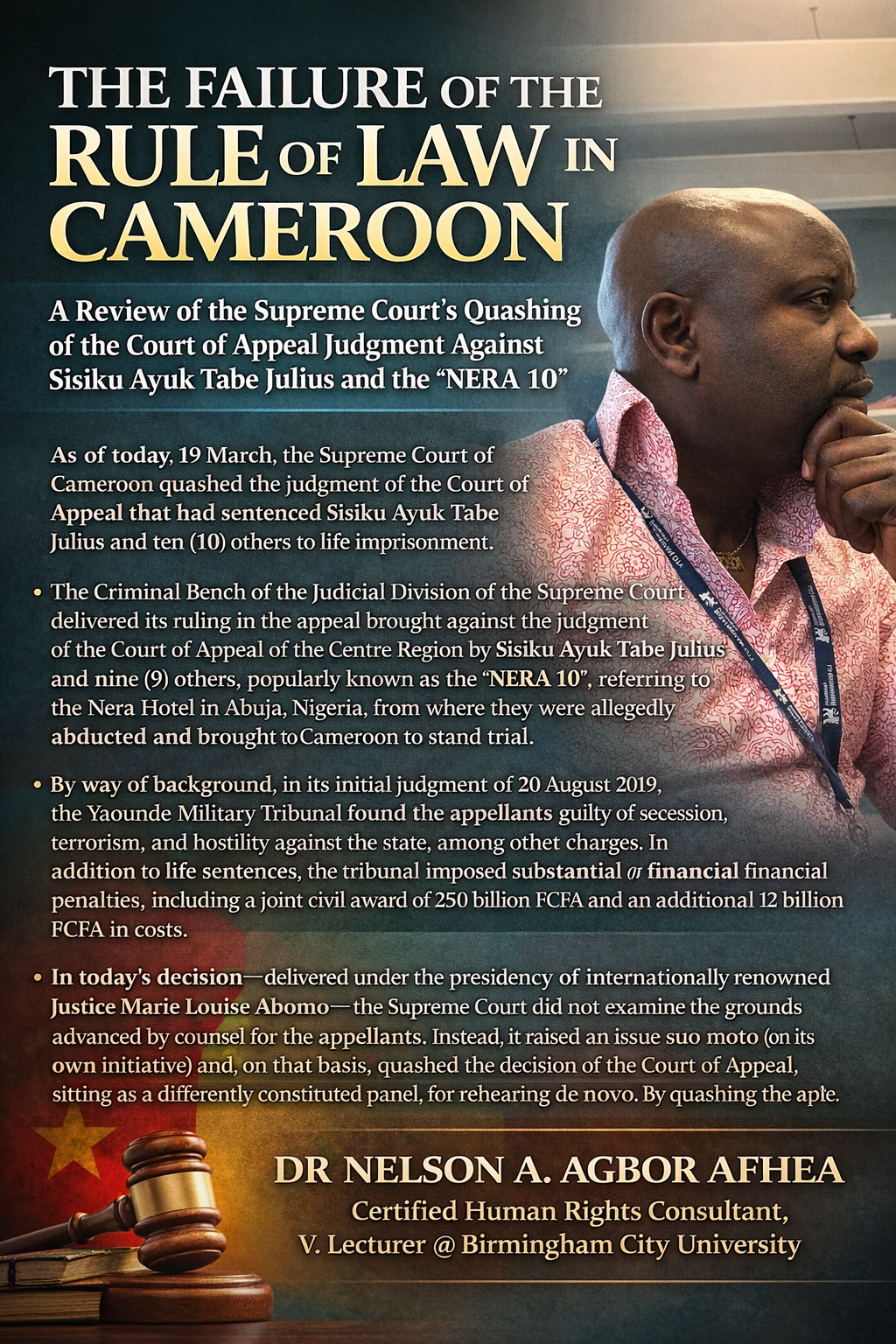
The rule of law, as a core principle of constitutional governance, requires that legal procedures be fair, predictable, and guided by established standards of justice. In Cameroon, however, the handling of high-profile political and criminal cases has increasingly raised concerns about systemic flaws in judicial independence and procedural fairness. The recent decision on 19 March 2026 by the Supreme Court of Cameroon to quash the judgment of the Court of Appeal in the case of Sisiku Ayuk Tabe Julius and others, known as the “NERA 10”, offers a critical perspective to analyse these flaws. Instead of strengthening the integrity of the legal process, the ruling exposes deeper structural weaknesses that have long undermined the Cameroonian judiciary.
The origins of the NERA 10 case are highly controversial. The appellants were reportedly abducted from the Nera Hotel in Abuja, Nigeria, and forcibly transferred to Cameroon to face trial. Such circumstances raise serious questions under international law, particularly concerning the legality of extraterritorial abduction and the right to due process. The initial trial before the Yaoundé Military Tribunal in August 2019 resulted in convictions for secession, terrorism, and hostility against the state, along with life sentences and substantial financial penalties. The use of a military tribunal to try civilians in this politically sensitive case further emphasises tensions between national security interests and fundamental legal protections.
The appellate process did little to address these concerns. In September 2020, the Court of Appeal of the Centre Region upheld both the convictions and the sentences, effectively endorsing the military tribunal’s findings without adequately addressing the defence’s procedural and substantive criticisms. This confirmation reinforced the perception that appellate review in Cameroon may serve less as a corrective mechanism and more as an extension of previous judicial decisions. Such a pattern weakens the vital role of appellate courts in safeguarding against miscarriages of justice.
The Supreme Court’s ruling of 19 March 2026 presents a paradox. On one hand, by overturning the appellate judgment and ordering a rehearing before a differently composed panel, the Court implicitly recognises that the previous proceedings were fundamentally flawed. This recognition is significant, as it indicates that serious procedural or legal irregularities occurred. On the other hand, the Court’s decision not to examine the substantive grounds of appeal raised by counsel, but instead to rely on a suo moto issue, raises questions about judicial transparency and accountability. The lack of a thorough engagement with the appellants’ arguments deprives the ruling of doctrinal clarity and diminishes its value as a precedent for future cases.
This approach exposes broader issues within Cameroon’s legal system, such as limited judicial independence, executive influence, and inconsistent adherence to due process standards. The reliance on military tribunals, the handling of politically sensitive cases, and the procedural opacity demonstrated in the Supreme Court’s ruling all indicate a judiciary that struggles to operate independently and transparently. Furthermore, the decision to remand the case for a de novo hearing, while theoretically sound, introduces further uncertainty for the accused and raises concerns about the effectiveness and finality of justice in Cameroon.
In conclusion, the NERA 10 case underscores a serious crisis in Cameroon’s rule of law. While the Supreme Court’s intervention can be regarded as a corrective measure, it also exposes systemic weaknesses that continue to diminish confidence in the judiciary. The failure to address key legal arguments, coupled with broader issues of contested jurisdiction and procedural irregularities, demonstrates that reform is urgently necessary. Strengthening judicial independence, ensuring fair trial standards, and increasing transparency in judicial reasoning are essential steps if Cameroon is to rebuild trust in its legal system and uphold the rule of law.
Dr Nelson A. Agbor AFHEA
Certified Human Rights Consultant
V. Lecturer @Birmingham City University.




