
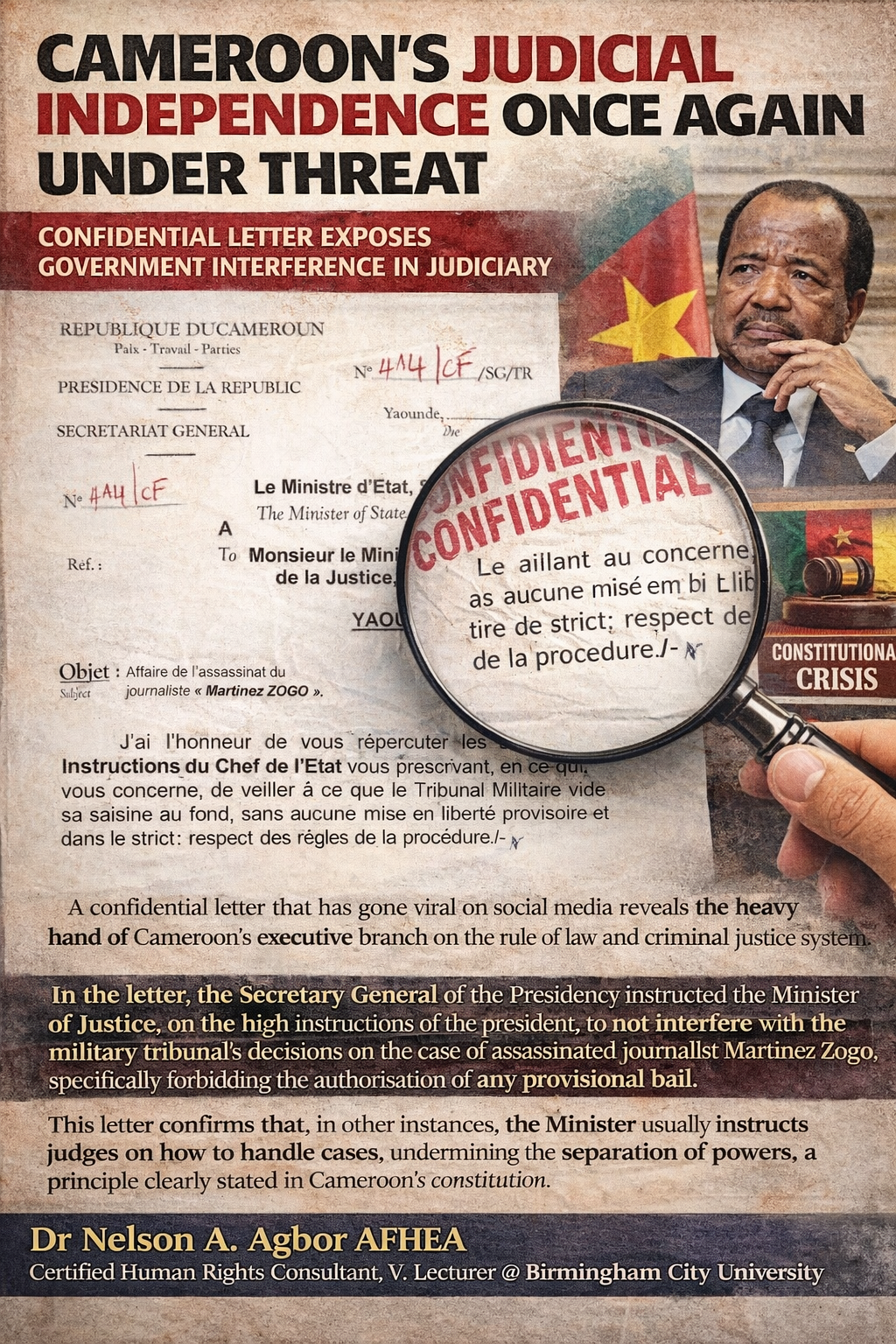
The principle of the separation of powers remains a fundamental element of constitutional democracy, designed to ensure that the executive, legislative, and judicial branches function independently to prevent abuse of authority. In Cameroon, however, this principle, although formally enshrined in the Constitution, has increasingly come under scrutiny due to ongoing allegations of executive interference in judicial processes. The recent circulation of a “confidential” letter from the Secretary General of the Presidency to the Minister of Justice has reignited debate about the integrity of the country’s criminal justice system. The letter, which has gone viral on social media, appears to provide direct evidence of executive overreach into judicial affairs, raising serious concerns about the rule of law.
The letter reportedly instructs the Minister of Justice, acting on the “high instructions” of the President, not to interfere with the decisions of military tribunals handling the case of the assassinated journalist Martinez Zogo. Specifically, it directs that no provisional bail should be authorised and that judges should be allowed to complete their work without intervention. On its face, such an instruction might be interpreted as an attempt to preserve judicial independence. However, the underlying implication is far more troubling. By explicitly instructing the Minister not to intervene in this instance, the letter tacitly acknowledges that executive intervention in judicial proceedings is not only possible but perhaps routine.
This implicit admission is especially significant within Cameroon’s legal framework. The Constitution enshrines an independent judiciary, but the institutional reality indicates a system where judicial actors can be influenced by the executive, whether directly or indirectly. The Minister of Justice, who also functions as the head of the judiciary administratively, occupies a role that blurs the lines between executive power and judicial independence. The leaked letter reinforces the impression that the executive branch retains considerable control over legal processes, thereby undermining the courts’ integrity and diminishing public trust in the justice system.
The case of Martinez Zogo, a prominent journalist whose assassination shocked the nation, has become a litmus test for the government’s commitment to justice and accountability. Given its high-profile nature, any sign of interference, whether to expedite, delay, or influence outcomes, risks delegitimising the entire process. The instruction to deny provisional bail, regardless of its legal justification, raises questions about whether political considerations are restricting judicial discretion. In a functioning rule-of-law system, such decisions should rest solely with the courts, based on evidence and legal standards, rather than executive directives.
Furthermore, the wider implications of this incident go beyond a single case. If the executive can choose when to “allow” judicial independence, then such independence is inherently conditional and therefore compromised. The separation of powers is not just a formal arrangement but a practical safeguard that must be consistently maintained. The seemingly normalisation of executive influence over judicial decisions presents a systemic threat to democratic governance and the protection of fundamental rights in Cameroon.
Overall, for justice to be fair, it must also appear to be done. The credibility of Cameroon’s legal and political institutions is once again at risk. This episode, rather than reassuring the public, underscores longstanding concerns about government interference in the judiciary. To restore confidence, meaningful reforms are necessary to ensure genuine judicial independence, transparency, and accountability. Without such measures, the rule of law risks becoming a nominal principle rather than a lived reality, and public trust in the justice system will continue to diminish.
Dr Nelson A. Agbor AFHEA
Certified Human Rights Consultant
V. Lecturer @Birmingham City University.




