
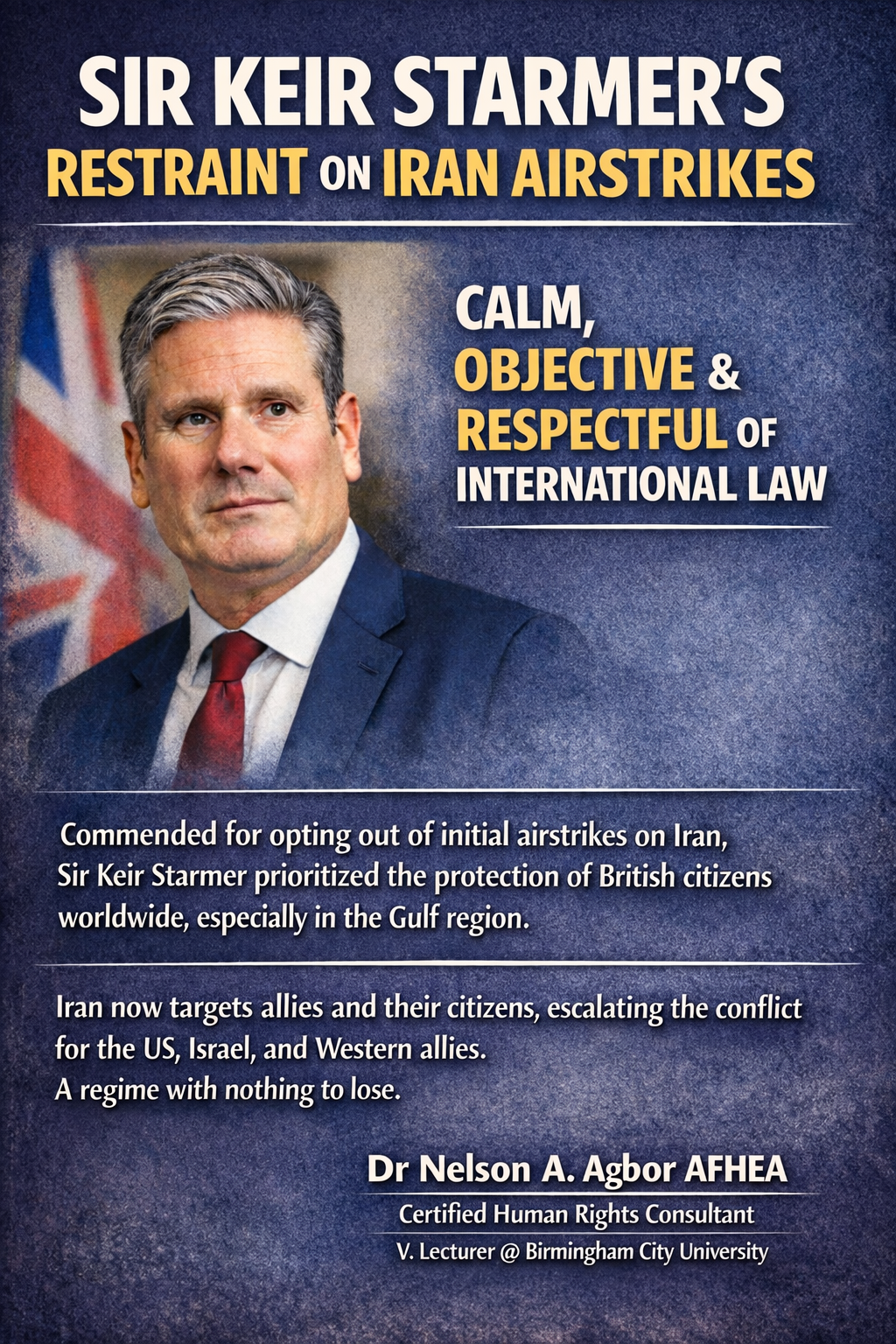
The British Prime Minister, Sir Keir Starmer, chose not to involve the United Kingdom in the initial airstrikes against Iran, reflecting a strategically cautious posture that is also legible as ethical and legal. In the early phase of the conflict, when the United States and Israel moved first with direct attacks on Iranian targets, the UK government positioned itself outside the opening offensive, signalling that Britain would neither be a co-belligerent by default nor allow momentum alone to determine participation. In doing so, Starmer treated military force as an instrument requiring explicit justification, not an automatic demonstration of alignment, thereby preserving Britain’s freedom of action and its credibility in later diplomatic and defensive roles.
That initial restraint can be read as an attempt to keep British conduct tightly tethered to the principles of international law governing the resort to force, particularly the baseline prohibition on the use of force and the narrow exceptions commonly invoked by states. Starmer’s public framing distinguished between offensive strikes and actions tied to the protection of nationals and the collective defence of allies, a distinction that maps onto the legal concepts of self-defence and necessity, as well as the practical disciplines of proportionality and risk containment. By emphasising lessons “from the mistakes of the past” and refusing to endorse “regime change from the skies,” he presented a governing logic of limited aims and lawful ends, rather than maximalist war objectives that can widen legal ambiguity and strategic exposure.
This posture also showcased a political temperament characterised by calmness and objectivity: a willingness to absorb pressure, including from close partners, without allowing external demands to collapse the distinction between solidarity and participation. Reports indicate friction with Washington over basing and operational posture, yet Starmer’s stance remained that UK involvement must be conditioned on a defensive posture and the protection of clearly defined interests. Such an approach is not merely rhetorical. It reduces the likelihood of UK forces becoming direct participants in a campaign whose aims, escalation pathways, and humanitarian consequences may be uncertain at the outset, while keeping open the option to contribute to stabilisation, deterrence, and protection once the threat environment materially changes.
Crucially, Starmer’s subsequent involvement is best understood as a second-stage decision, informed primarily by the need to protect British citizens worldwide, particularly those in, transiting through, or economically tied to the Gulf region. In his parliamentary statement, he drew a clear line: the UK was not involved in the initial strikes and would not join offensive US action, but would defend British nationals and support collective self-defence as Iran escalated. That sequencing matters analytically: it situates later British measures within a protective rationale rather than an elective expansion of the war’s objectives, and it frames the UK as responding to a deteriorating threat rather than helping to create it.o create it.
The evolving pattern of Iranian retaliation further underscores why the war has become more consequential for the United States, Israel, and the wider set of Western-aligned partners. Recent reporting describes Iran striking beyond the immediate battlefield, targeting regional US partners and even diplomatic sites, while also threatening core global chokepoints such as the Strait of Hormuz. When a state signals willingness to broaden retaliation to allies and civilians, the conflict’s centre of gravity shifts from discrete military exchanges to regional security and global economic risk; escalation management becomes harder, and deterrence more brittle. In that context, Starmer’s initial restraint can be defended as prudent legal-statecraft. In contrast, his later, citizen-protection-centred involvement can be defended as a bounded response to a conflict that Iran appears willing to widen, creating the impression of leadership that believes it has little left to lose and therefore fewer incentives to limit the scope of harm.
Dr Nelson A. Agbor AFHEA
Certified Human Rights Consultant,
V. Lecturer @Birmingham City University.




