
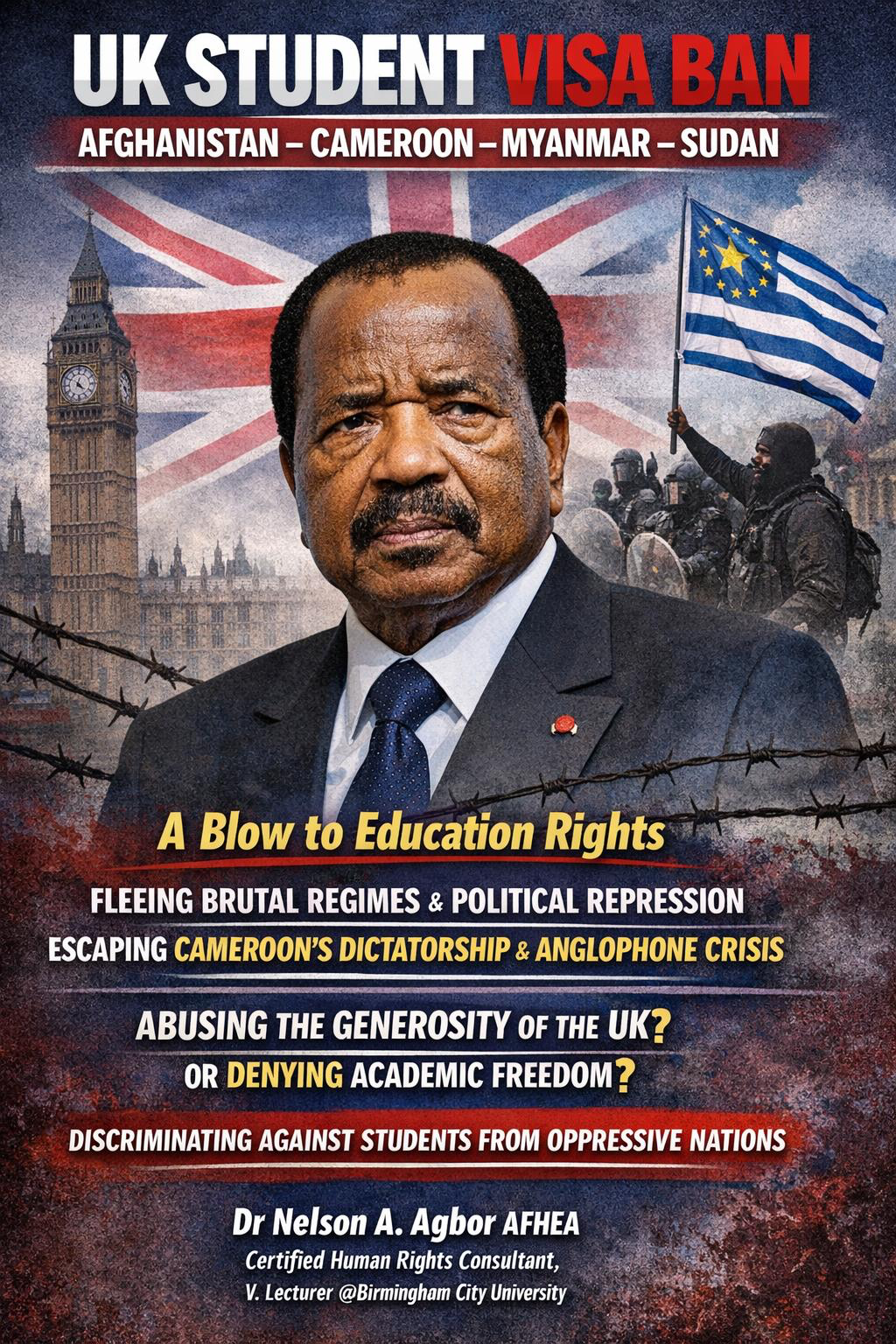
The decision by the United Kingdom to suspend student visa applications from Afghanistan, Cameroon, Myanmar, and Sudan has sparked significant debate about its fairness and its alignment with international human rights standards. The Home Office justified the policy by claiming that many students from these countries enter the UK via study routes and then apply for asylum, allegedly “abusing the generosity” of the immigration system. The measure follows a rise in asylum claims from individuals who initially arrived through legal migration channels, with reports showing a substantial increase in such claims between 2021 and 2025. However, from an academic and human rights perspective, assessing the fairness of the ban involves considering the wider political contexts of the affected countries and the principles of non-discrimination and access to education embedded in international law.
A common factor among Afghanistan, Cameroon, Myanmar, and Sudan is the presence of severe political instability, violent conflicts, or authoritarian governments that have raised widespread human rights concerns. In Afghanistan, the Taliban’s return to power has drastically reduced civil liberties, especially those of women and minorities. Myanmar has been under repression following the 2021 military coup, while Sudan has undergone cycles of civil war and military dictatorship. These political situations motivate students who travel abroad to seek protection rather than return to conditions marked by persecution, insecurity, or lack of democratic freedoms. From a human rights perspective, the high number of asylum applications from these countries may therefore reflect underlying structural push factors driven by political repression rather than intentional misuse of immigration pathways.
Cameroon provides a clear example for understanding this dynamic. The country is often seen as having a shrinking political space under the long-standing rule of President Paul Biya, whose government has been criticised by human rights organisations for authoritarian practices and restrictions on political dissent. The ongoing Anglophone crisis stemming from protests in 2016 against the marginalisation of English-speaking regions has escalated into a violent conflict between government forces and separatist groups. Numerous academic studies (In what ways do political factors and relations of power interfere with the legal protection of human rights in Cameroon?) and reports from rights groups have documented serious abuses during this conflict, including extrajudicial killings, torture, and the destruction of villages. One widely condemned incident was the 2020 Ngarbuh massacre, in which Cameroonian soldiers and allied militia killed more than twenty civilians, including children. In such circumstances, students from Cameroon studying abroad may reasonably fear returning to an environment characterised by political repression, insecurity, and limited academic freedom.
From a normative perspective, the blanket suspension of student visas based on nationality raises concerns about discrimination and the right to education. International human rights instruments, including the Universal Declaration of Human Rights and the International Covenant on Economic, Social and Cultural Rights, stress equal access to education without discrimination on grounds of nationality or political origin. A policy that outright bans students from certain countries rather than evaluating individuals on a case-by-case basis risks undermining these principles. It may also contribute to a wider trend linked to restrictive immigration policies, often described as part of the UK’s “hostile environment,” which critics say has promoted exclusionary practices and unequal treatment of migrants. Such measures could disproportionately impact young people seeking education as a means of personal growth and international engagement.
In conclusion, although the UK government’s concerns about the integrity of its asylum and visa systems may be justified from a migration-management point of view, the objectivity of a blanket visa ban targeting Afghanistan, Cameroon, Myanmar, and Sudan remains questionable from an academic and human rights perspective. The policy seems to ignore the wider political realities that influence asylum claims from these countries, especially the dominance of authoritarian rule, armed conflict, and systemic human rights violations. In Cameroon, the Anglophone crisis and shrinking democratic space provide clear evidence of the hostile conditions that may deter students from returning after their studies. As a result, the visa suspension risks being seen as discriminatory and potentially incompatible with the universal principle of equal access to education, raising significant ethical and legal concerns within the global academic community.
Dr Nelson A. Agbor AFHEA
Certified Human Rights Consultant
V. Lecturer @Birmingham City University




