
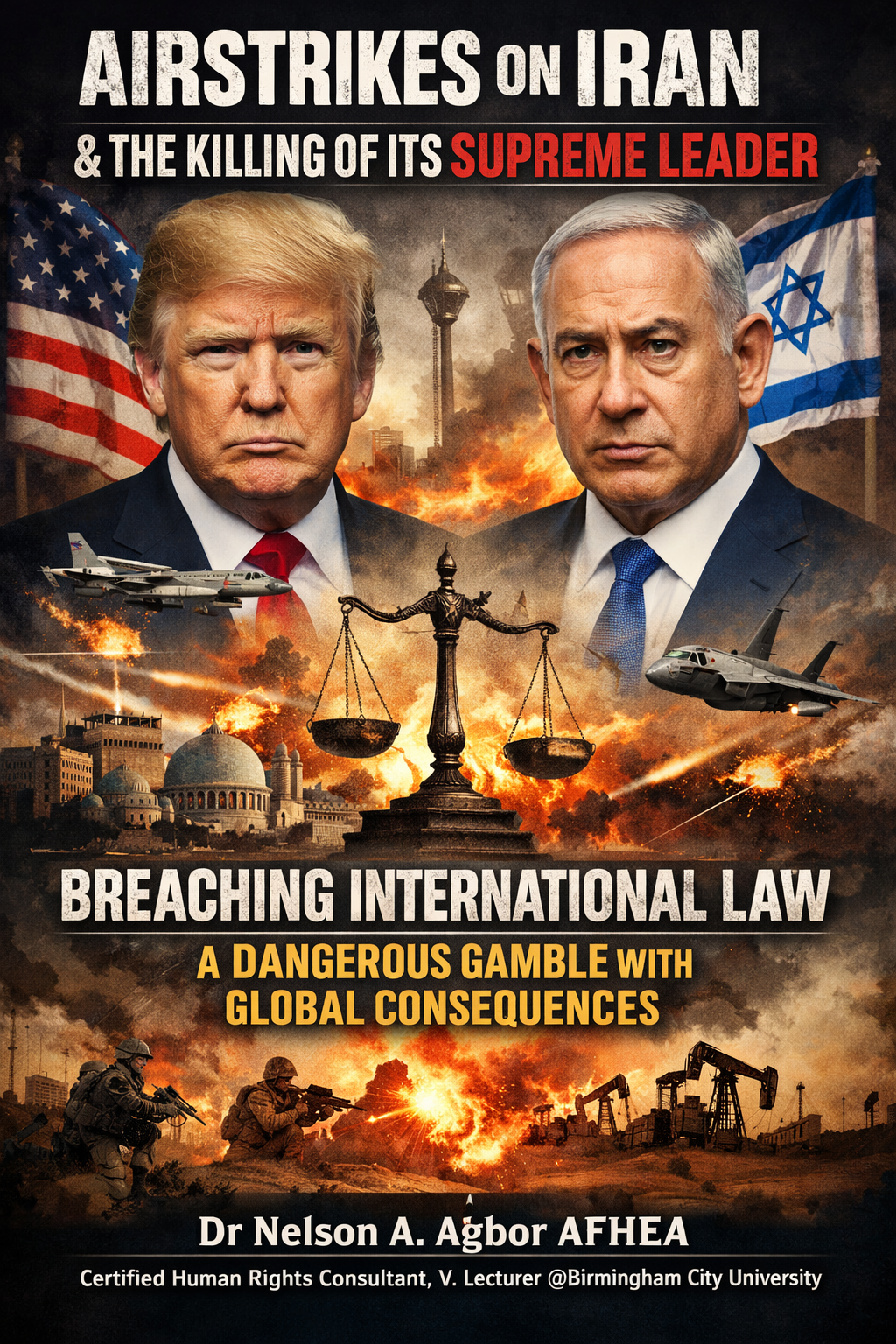
On 28 February 2026, the United States and Israel launched a massive coordinated military operation against the Islamic Republic of Iran, involving airstrikes and missile attacks across Tehran and other Iranian cities. The offensive, described by Israeli officials as necessary to counter threats posed by Iran’s military and nuclear programmes, resulted in the confirmed death of Iran’s Supreme Leader, Ayatollah Ali Khamenei, who had led the Iranian state since 1989. This development represents an unprecedented escalation in Middle Eastern hostilities and marks the most dramatic strategic intervention by the U.S. and Israel in decades. Iran’s state media confirmed Khamenei’s killing after the strikes, and Iranian authorities declared 40 days of mourning and pledged retaliation.
Under international law, the joint U.S.–Israeli strikes raise profound legal questions. The United Nations Charter prohibits the use of force against the territorial integrity or political independence of another state except in cases of self-defence against an actual armed attack or with explicit Security Council authorisation. Article 51 allows for defensive force only if a threat is imminent, necessary, and proportionate, thresholds that international jurists generally interpret strictly. In the absence of evidence of an imminent Iranian attack on U.S. or Israeli territory or forces, the legality of the strikes is highly debatable. Many international law scholars would consider the operation a breach of international law, particularly because pre-emptive or preventive strikes are not universally recognised as lawful absent clear and imminent danger.
The United Kingdom’s response illustrates the diplomatic and legal complexity surrounding allied support for military interventions. UK Defence Secretary John Healey stated that the United States must articulate the legal basis for the airstrikes, refraining from asserting whether they were lawful under international law, and noted that the UK itself did not participate in the offensive. Instead, British forces have focused on regional defensive operations, such as protecting bases and intercepting drone attacks, and have bolstered defensive deployments in the Gulf. This cautious posture reflects concern among UK policymakers about the potential legal and political ramifications of endorsing or participating in a military action widely seen as unanchored in internationally accepted legal justification.
Strategically, the decision by President Donald Trump and the Israeli leadership to pursue a direct military campaign, including the killing of a head of state, is a gamble with far-reaching consequences. Rather than neutralising threats, the offensive has triggered a wider regional conflagration: Iran has launched missiles and drones at Israel and U.S. bases throughout the Middle East, including in Qatar, Kuwait, Bahrain, and the UAE; allied militias, such as Hezbollah, have re-entered hostilities; and civilian infrastructure has been damaged across multiple countries. This escalation reflects a failure to anticipate the second-order effects of decapitation strikes and highlights how military actions driven by long-term strategic aims (such as regime change) can rapidly spiral into broader conflict with unpredictable outcomes.
The current crisis also echoes the 2003 Iraq War, widely criticised for its reliance on unfounded intelligence and preventive logic. Then, claims of imminent threats from weapons of mass destruction were used to justify a large-scale invasion that lacked clear imminent danger, undermining international legal norms and provoking long-term regional instability. Today’s U.S.–Israeli strikes, likewise conducted without demonstrable immediate threat and without Security Council endorsement, risk repeating these mistakes. They risk eroding established international legal standards, contributing to protracted conflict, and diminishing global trust in mechanisms intended to regulate the use of force. As the situation continues to unfold, it is likely to have long-term implications not only for Middle Eastern geopolitics but also for the structure and credibility of international security law.
Dr Nelson A. Agbor AFHEA
Certified Human Rights Consultant
V. Lecturer @Birmingham City University




