
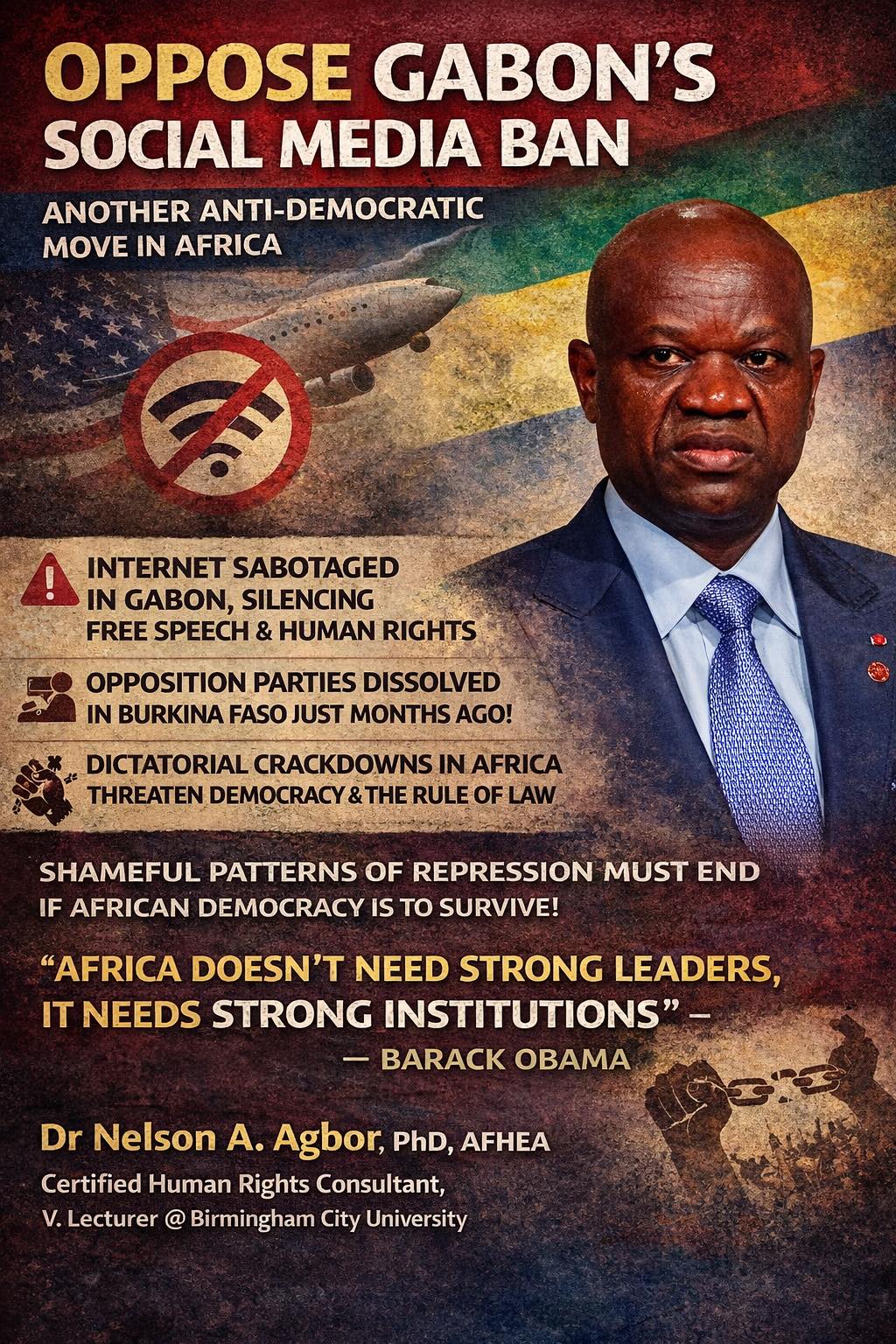
The recent decision by the Gabonese government to restrict access to social media represents a troubling regression in democratic governance and civic freedom. In contemporary political systems, digital platforms function as essential spaces for public discourse, civic mobilisation, and political participation. Curtailing these channels undermines citizens’ ability to exchange ideas, hold leaders accountable, and participate meaningfully in national life. Such measures signal not stability, but insecurity within governing institutions.
From a constitutional and human rights perspective, shutting down social media networks erodes core democratic principles: freedom of expression, access to information, and the rule of law. International human rights frameworks, including the African Charter on Human and Peoples’ Rights, affirm that citizens have the right to communicate and receive information without undue interference. When governments impose sweeping digital restrictions, they not only silence dissent but also weaken legal norms meant to safeguard democratic participation.
Disturbingly, this development reflects a broader pattern emerging across parts of Sub-Saharan Africa. Only months ago, the military authorities in Burkina Faso dissolved all opposition parties, effectively extinguishing alternative political viewpoints and narrowing the space for pluralistic governance. Now, the social media crackdown in Gabon itself, a state that transitioned from military intervention to civilian rule, demonstrates how power consolidation can persist under nominally civilian leadership. These actions, taken together, erode political competition and weaken institutional accountability.
Such patterns risk normalising executive overreach and legitimising authoritarian tendencies under the guise of national security or political stability. When restrictions on speech and political organisation become routine, democratic institutions lose credibility both domestically and internationally. Citizens may grow disillusioned with electoral processes and constitutional governance, while external partners question commitments to democratic norms and the rule of law.
If African democratic institutions are to retain legitimacy and public trust, these shameful patterns must end. Sustainable governance depends not on the concentration of power, but on resilient institutions that uphold transparency, accountability, and civic participation. As former U.S. President Barack Obama aptly observed, Africa does not need strong leaders; it needs strong institutions. Protecting fundamental freedoms, including digital expression, is indispensable to building those institutions and safeguarding the democratic future of the continent.
Dr Nelson A. Agbor, PhD, AFHEA
Certified Human Rights Consultant
V. Lecturer @Birmingham City University.




