
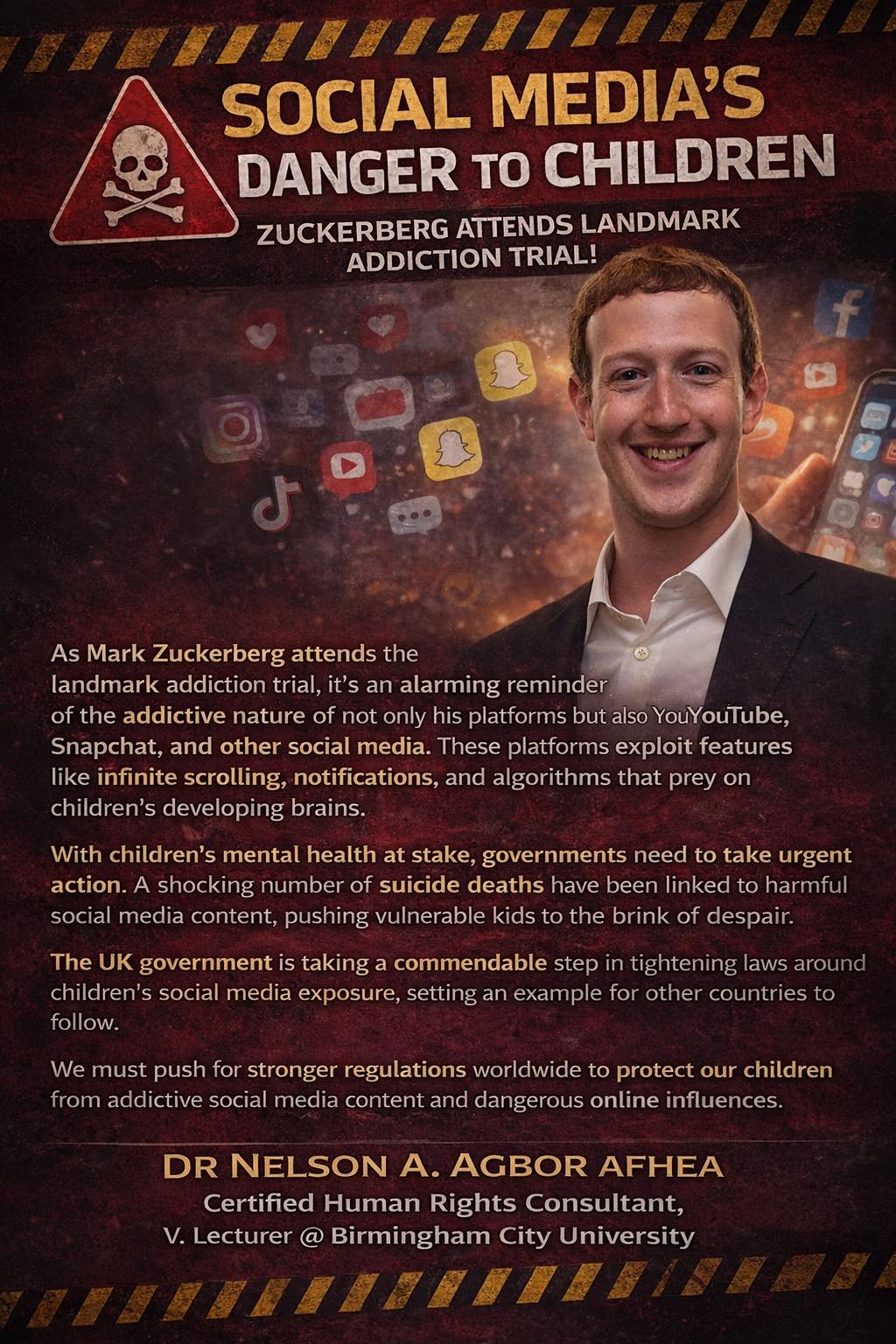
As Meta CEO Mark Zuckerberg appears in a landmark U.S. courtroom trial examining whether social media platforms are designed to addict children, the global community is confronting urgent questions about the role of digital technologies in shaping young minds. The case, one of the first to test claims that platform design harms minors, alleges that products such as Instagram and YouTube intentionally maximise engagement through psychologically manipulative features.  This moment reflects a broader reckoning: social media has become an environment in which childhood development increasingly unfolds under algorithmic influence rather than human guidance.
Research and testimony presented in the trial underscore concerns that the architecture of social media is engineered to sustain prolonged use. Features such as infinite scrolling, algorithmic recommendation systems, beauty filters, and engagement metrics are designed to encourage continuous interaction, reinforcing compulsive behaviours.  While industry leaders often dispute the term “addiction,” experts describe patterns of compulsive use that mirror behavioural dependency and correlate with deteriorating mental health outcomes in adolescents.  The core issue is not merely content but design: systems optimised for engagement may exploit neurological reward pathways in developing brains.
Although Meta’s platforms remain central to public debate, the concerns extend far beyond a single company. YouTube has been named alongside Meta in litigation alleging harm to youth, while TikTok and Snapchat have faced similar claims and settlements. Across platforms, autoplay features, personalised feeds, streak mechanics, and short-form video loops reinforce habitual use patterns. These systems expose children to harmful material at scale, including self-harm content, eating disorder promotion, sexual exploitation risks, and extremist messaging. The convergence of algorithmic amplification and developmental vulnerability creates a digital ecosystem where harmful exposure can occur rapidly and repeatedly.
The human cost is increasingly visible. Families involved in litigation include parents of children who died by suicide after exposure to harmful online content, highlighting the most tragic consequences of unmoderated digital environments. A growing body of research links heavy social media use with increased depressive symptoms and psychological distress in adolescents, particularly among early users. While causation remains complex, correlations between compulsive usage, social comparison pressures, sleep disruption, and emotional dysregulation are well documented. The scale of the crisis demands urgent attention: youth mental health services worldwide report rising rates of anxiety, self-harm, and suicidal ideation in the era of pervasive social media.
In this context, the United Kingdom deserves recognition for moving toward stronger protections for children online. Through measures such as the Online Safety Act and strengthened regulatory oversight, the UK government has begun imposing duties of care on technology platforms and limiting minors’ exposure to harmful content. These efforts represent an important step toward accountability, yet more decisive action is needed globally. Governments must mandate safeguards for age verification, restrict addictive design features, enforce transparency in algorithms, and hold platforms accountable for foreseeable harm. Protecting children in the digital age is no longer optional; it is a moral imperative requiring coordinated international action before another generation grows up shaped by systems designed to capture attention rather than nurture wellbeing.
US Institute of Diplomacy and Human Rights
Dr Nelson A. Agbor, AFHEA
Certified Human Rights Consultant
V. Lecturer @ Birmingham City University.




