
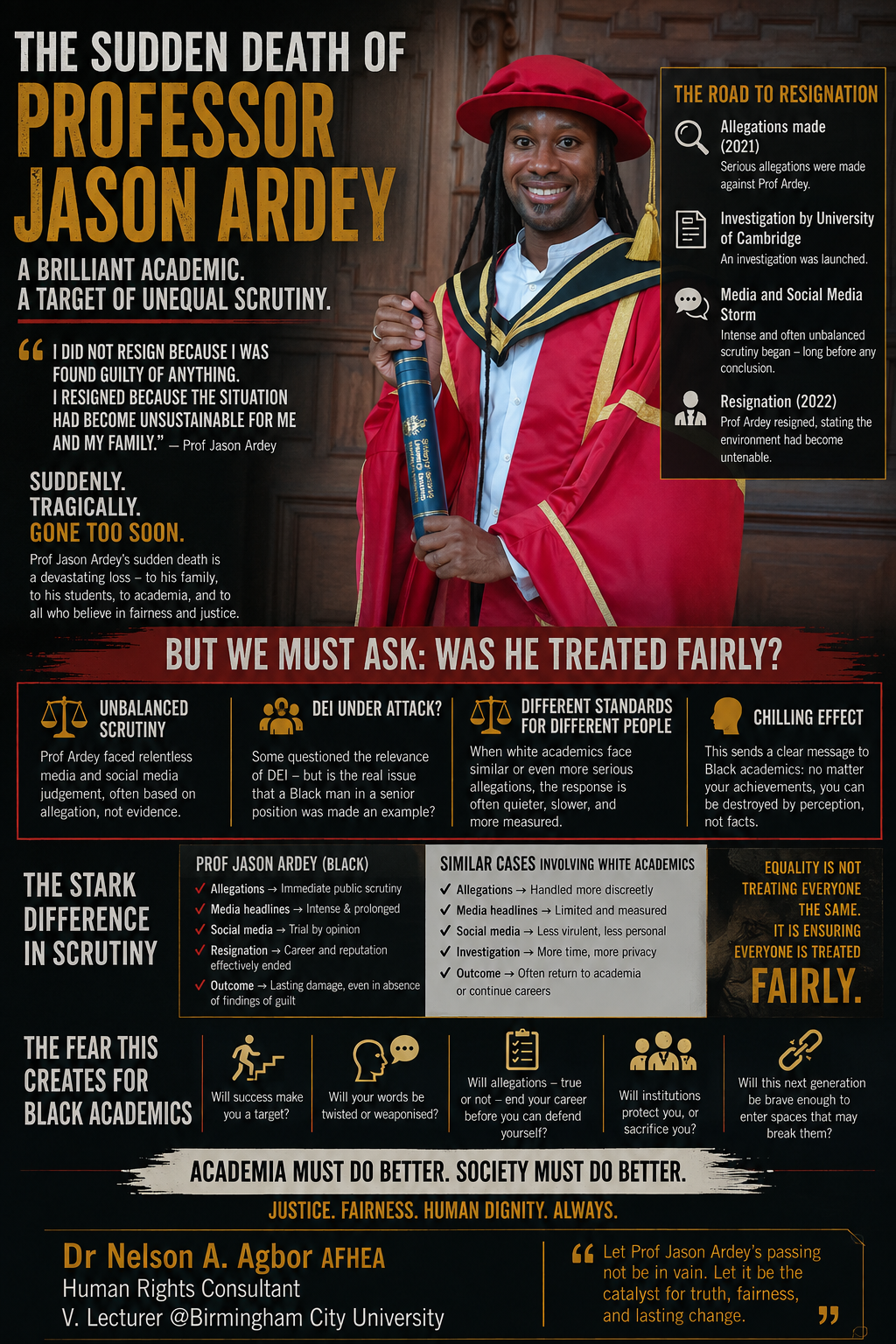
The sudden death of Professor Jason Arday at 41, shortly after his resignation from the University of Cambridge, marks a profoundly troubling moment for British higher education. Arday, a sociologist of education who became Cambridge’s youngest Black professor in 2023, was found dead in south London on 14 August 2026. Police have described his death as unexpected but not suspicious; accordingly, no responsible analysis should speculate about its medical or other cause. What can properly be examined, however, is the extraordinary public environment that preceded his death. Arday had resigned approximately a week earlier, after weeks of intense scrutiny over allegations of plagiarism, his academic qualifications, and aspects of his public biography. In his resignation statement, he denied the allegations against him and described the “relentless accusations, speculation and public commentary” as having taken a profound toll on him and those close to him. His family has subsequently referred to years of sustained abuse and misinformation. These circumstances raise questions that extend considerably beyond the conduct of one scholar: they concern proportionality, institutional responsibility, racialised public scrutiny, and the conditions under which Black academics are permitted to occupy positions of prestige.
The controversy preceding Arday’s resignation concerned matters that universities are unquestionably entitled to investigate and, where credible evidence exists, obliged to investigate. Questions were raised about textual similarities between his doctoral thesis and his publications, as well as the accuracy or presentation of claims regarding academic affiliations, fundraising, and athletic achievements. Importantly, the evidential history was not straightforward. Liverpool John Moores University, which awarded Arday his doctorate, had previously considered allegations concerning his thesis, while Cambridge initially stated publicly that he had been cleared of plagiarism allegations and described him as the target of a campaign to undermine his credibility. Retraction Watch subsequently reported that concerns about his scholarship had existed for some time, and Cambridge later announced an investigation after receiving what it described as new information concerning his qualifications. Arday resigned shortly afterwards. These facts demonstrate why two propositions must be held simultaneously: allegations of academic misconduct deserve serious examination, but an allegation, even a serious one, is not equivalent to an adjudicated finding. Universities possess procedures precisely because research-integrity disputes require evidence, procedural fairness, and proportionate conclusions rather than adjudication through newspapers or social media feeds. Cambridge itself maintains a formal procedure for investigating research misconduct.
The difficulty in Arday’s case is therefore not that scrutiny occurred, but rather its scale, character and expansion. What began as questions about academic attribution developed into a much wider public audit of his life. His charitable fundraising, sporting activities, childhood, honorary positions, institutional affiliations and personal narrative became objects of investigation and commentary. Some of this reporting identified legitimate discrepancies that deserved clarification. Yet the cumulative process increasingly resembled something broader than conventional academic accountability: Arday himself became the subject under investigation. Following his resignation, moreover, the controversy did not simply conclude with the institutional consequence of his departure. Commentary continued to interrogate his character, Cambridge’s judgment and the ideological meaning supposedly represented by his appointment. The distinction is significant. Accountability ordinarily asks whether particular professional standards were breached; personalised scrutiny asks whether the individual as a whole is authentic, deserving or fraudulent. For academics from historically underrepresented groups, the latter form of scrutiny carries a particular danger because individual imperfection can rapidly be interpreted as evidence about the legitimacy of the group to which the individual belongs.
This danger became especially evident in attempts to recast the Arday controversy as an indictment of diversity, equity and inclusion. Critics argued that his appointment showed Cambridge had subordinated merit to diversity, while some commentary portrayed him as symptomatic of institutional capture by DEI ideology. Yet this conclusion does not follow from the allegations. Even if every professional allegation against Arday were ultimately established, that would demonstrate failures concerning one scholar and perhaps failures in institutional due diligence; it would not establish that racial diversity and academic excellence are incompatible. The demographic evidence makes the sweeping DEI narrative particularly questionable. Recent reporting notes that Black professors constitute approximately one per cent of UK professors, while Cambridge’s Black academic representation remains exceptionally small. Arday was prominent precisely because Black professors at Cambridge were unusual, not because Black academics had become institutionally dominant. To use one controversial appointment as evidence against diversity therefore commits an elementary generalisation: the conduct of an individual Black professor becomes evidence against a policy category and, implicitly, against the legitimacy of efforts to address racial underrepresentation.
Race becomes particularly important at this point because white academics accused of misconduct are ordinarily permitted, in principle, to remain individuals. Their alleged failures may damage their reputations and institutions, sometimes severely, but those failures are less readily treated as evidence that white academics, as a category, were appointed because of their race. The relevant comparison should not be overstated: white academics have unquestionably experienced severe media scrutiny following allegations of professional misconduct, and therefore it would be unsustainable to claim that white scholars are generally spared public criticism. The more defensible distinction concerns representational burden. When a white professor is accused of plagiarism or dishonesty, the controversy does not normally spark a national debate about whether the employment of white professors has compromised academic standards. When a prominent Black professor encounters such allegations, however, the controversy can become attached to debates about affirmative action, DEI, “wokeness”, and whether minority scholars have been promoted beyond their merits. The Arday affair exhibited precisely this discursive expansion. Thus the racial asymmetry requiring examination lies not simply in the quantity of coverage but in what one individual’s alleged shortcomings are made to signify.
A revealing comparison can be drawn with Cambridge’s handling of other serious academic controversies, though such comparisons must account for differences in facts and allegations. In June 2026, Cambridge professor Simon Goldhill resigned after an external investigation reportedly upheld complaints of sexual and professional misconduct against him. That case concerned serious alleged interpersonal behaviour and attracted press coverage, yet it did not become a referendum on the racial legitimacy of white appointments to Cambridge, nor did commentators plausibly ask whether Goldhill’s conduct demonstrated the failure of institutional attempts to employ white men. The point is not to equate substantively different allegations or to minimise misconduct in either case. Instead, it is to expose the asymmetry in the capacity of minority academics to become representatives of an entire category. White academics generally enjoy what might be called the privilege of individualisation: their misconduct can remain their own. Black academics can encounter the opposite process, in which individual controversy is collectivised into claims about diversity, standards and racial preference. That distinction deserves far greater attention than simplistic assertions that Arday’s case either proves or disproves the existence of racial bias.
The media’s own role also warrants scrutiny, as it helped construct both phases of Arday’s public identity. His 2023 appointment generated extensive positive coverage emphasising an extraordinary biography: a Black, autistic academic who had reportedly been non-verbal until childhood, learned to read and write unusually late, and nevertheless reached a Cambridge chair at 37. The subsequent collapse of that heroic narrative inevitably possessed considerable news value. Yet media institutions should reflect on the relationship between constructing individuals as inspirational symbols and then subjecting those same individuals to spectacular forms of deconstruction. Arday was first made exceptionally visible, in part, because his biography appeared to represent social mobility, disability inclusion and racial progress. Once questions emerged, the symbolic logic reversed: the former exemplar of inclusion could become evidence of inclusion’s supposed failure. Both narratives risk denying the subject ordinary human complexity. Minority scholars should neither have to be inspirational embodiments of diversity nor become ideological exhibits when they fall short of the narratives constructed around them.
Social media intensified this problem by collapsing distinctions that institutional processes seek to preserve: allegation and finding, error and fraud, criticism and humiliation, public interest and personal attack. Arday’s supporters argued that he had experienced racist abuse and threats, while his critics maintained that legitimate questions about academic integrity were being improperly characterised as racism. Both propositions require careful consideration. Invoking racism cannot exempt scholarship from scrutiny; likewise, identifying legitimate grounds for scrutiny does not establish that every subsequent criticism directed at an individual is legitimate. A scholar may be answerable for professional errors and subjected to racialised abuse. These are not mutually exclusive possibilities. The ethical failure occurs when social media encourages observers to choose between total exoneration and total condemnation. Universities therefore require procedures capable of separating evidential investigation from online punishment, particularly where controversy becomes entangled with race, disability or other characteristics that can generate discriminatory hostility.
The implications for Black academics are potentially severe. Black scholars already occupy a strikingly small share of professorial positions in Britain, and highly visible controversies can have consequences far beyond the individuals concerned. Early-career Black researchers observing the Arday affair may reasonably ask whether entering public academic life entails accepting a degree of scrutiny qualitatively different from that experienced by colleagues who are not treated as representatives of a racial group. They may become more reluctant to discuss disadvantaged backgrounds, disability, racism or unconventional routes into higher education, fearing that autobiographical claims will be subjected to exceptional forensic scrutiny. More troublingly, appointment panels themselves may become excessively risk-averse, consciously or unconsciously imposing additional scrutiny on Black candidates for fear that another appointment will provoke accusations of “DEI hiring.” This would create a pernicious feedback loop: an exceptional case is racialised, the racialisation produces heightened suspicion of minority candidates, and that heightened suspicion is subsequently described as neutral protection of “merit.” The likely chilling effect should concern anyone committed to both research integrity and equality of academic opportunity.
Jason Arday’s death should not be instrumentalised to foreclose legitimate questions about academic standards, just as allegations about his scholarship should not be instrumentalised to discredit Black academics or diversity initiatives. At the time of writing, the police have said that his death is unexpected but not suspicious, and it would be irresponsible to assert a causal link between public scrutiny and his death without evidence. What his final weeks unquestionably expose is the need to reconsider how universities, journalists and digital publics distinguish accountability from spectacle. Academic integrity requires rigorous investigation, but justice requires consistency, proportionality and procedural fairness. The appropriate institutional response to disputed credentials is better verification and transparent research-integrity procedures, not the racialisation of merit. The appropriate media response to alleged misconduct is careful, evidence-based reporting, not the transformation of one Black professor into a referendum on whether diversity belongs in the academy. If the lasting lesson of the Arday controversy is that prominent Black scholars must be flawless because any individual failure may be used against Black academics collectively, British higher education will have learned precisely the wrong lesson. A more defensible legacy would be an academic culture in which standards remain exacting, and scrutiny remains fearless, but neither operates on racialised presumptions about who naturally belongs in positions of intellectual authority.
Dr Nelson A. Agbor AFHEA
Certified Human Rights Consultant
V. Lecturer @Birmingham City University.




