
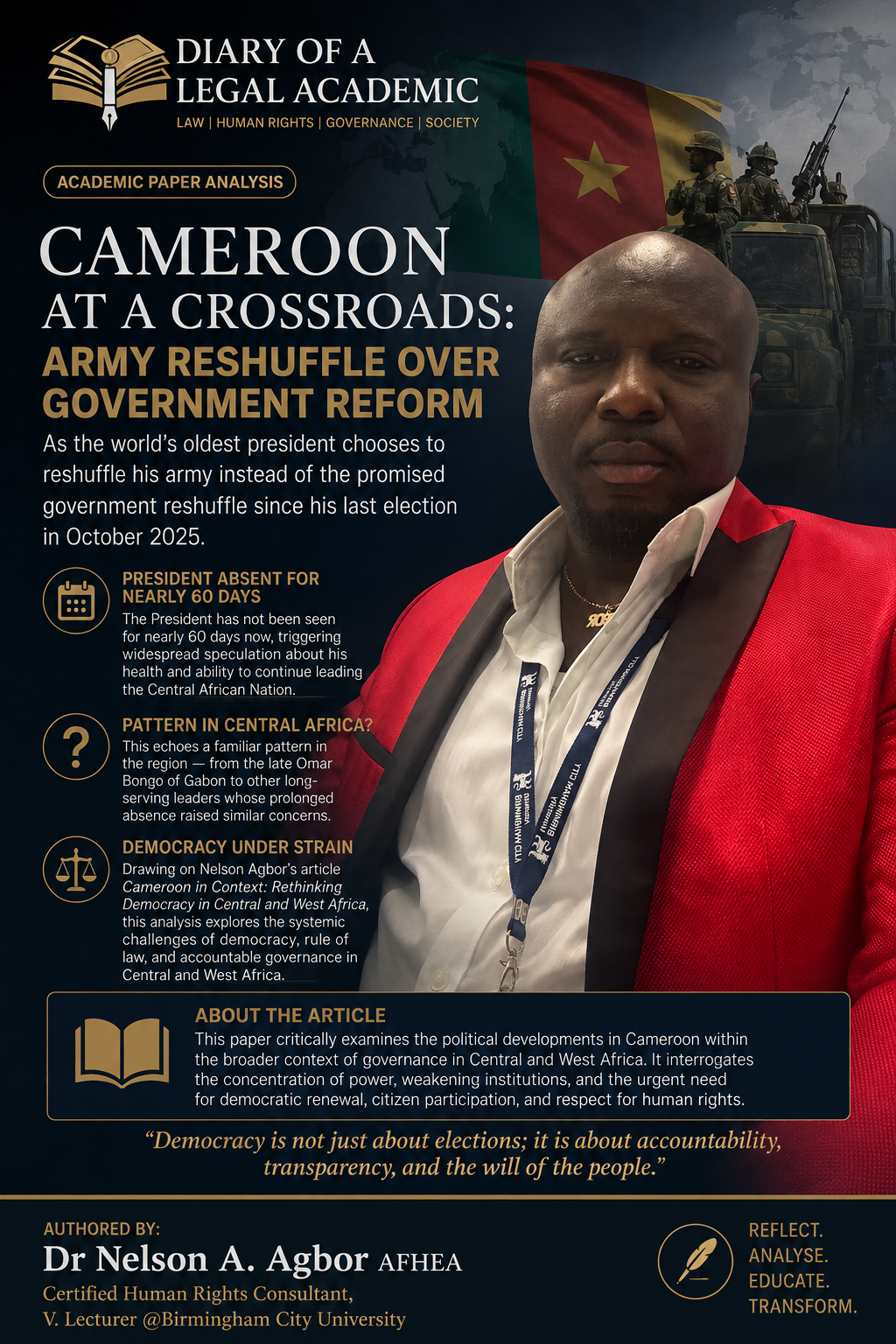
Cameroon has entered one of its most uncertain political periods since President Paul Biya assumed office in 1982. Following his controversial re-election in October 2025 for an unprecedented eighth term, expectations grew that the president would undertake a long-promised government reshuffle to address mounting concerns over governance, economic management, and political succession. Instead, the presidency has prioritised a significant restructuring of the country’s military leadership, leaving the civilian government largely unchanged. This decision has reinforced perceptions that regime security has taken precedence over institutional renewal and democratic accountability. In a political system already characterised by strong executive dominance, the emphasis on military reorganisation raises important questions about the government’s priorities and its preparedness for an uncertain political future. Recent analyses have similarly argued that Cameroon’s post-election trajectory reflects deepening concerns over succession and institutional resilience rather than democratic consolidation.
The political significance of the military reshuffle is heightened by President Biya’s prolonged absence from public view. By late July 2026, the president had not appeared publicly for more than fifty days, the longest such period of his presidency, fuelling widespread speculation about his health and capacity to continue governing. Official statements have been inconsistent, with some government officials claiming that the president continues to discharge his constitutional responsibilities while abroad, whereas others have described his absence as routine leave. The lack of transparent communication has intensified public uncertainty, encouraged rumours concerning succession, and exposed the vulnerabilities inherent in highly personalised systems of governance where state institutions remain closely tied to the authority of a single individual.
Rather than addressing these concerns through institutional reforms or a comprehensive cabinet reshuffle, the government has focused on reorganising senior military appointments. From a comparative politics perspective, this strategy is consistent with regimes where executive survival depends heavily on maintaining the loyalty of coercive institutions. In hybrid political systems, military appointments frequently serve not only security objectives but also political ones, reinforcing elite coalitions and ensuring the continued stability of the ruling order. Consequently, prioritising military restructuring over civilian political renewal may be interpreted as an effort to secure regime continuity amid growing uncertainty surrounding presidential succession.
This development reflects broader patterns of neo-patrimonial governance that continue to shape political systems across Central Africa. Although formal democratic institutions, including elections, constitutions, and legislatures, remain in place, executive authority often operates through informal patronage networks, personalised decision-making, and carefully managed elite alliances. The resulting political order combines democratic procedures with authoritarian practices, limiting genuine political competition while preserving the appearance of constitutional governance. In Cameroon, the persistence of these institutional arrangements has fuelled recurring debates about democratic legitimacy, executive accountability, and state capacity.
Nelson Agbor examines these characteristics comprehensively in his article, Cameroon in Context: Rethinking Democracy in Central and West Africa, published in the International Journal of Law and Society. Agbor argues that Cameroon cannot be adequately understood through conventional liberal democratic frameworks that assume a linear progression towards democratic consolidation. Instead, democratic governance in Cameroon reflects the interplay of colonial legacies, security challenges, neo-patrimonial political structures, and regional geopolitical dynamics. According to Agbor, these interconnected factors have produced a hybrid political order in which formal democratic institutions coexist with entrenched executive dominance and constrained civic participation. This context-sensitive interpretation offers a more nuanced explanation of why political continuity often prevails despite recurring domestic and international demands for democratic reform. (See Science Publishing Group)
The current situation also fits a broader historical pattern across Central Africa, where long-serving presidents frequently postpone or avoid meaningful succession planning while simultaneously reinforcing the institutions responsible for regime preservation. The late President Omar Bongo Ondimba of Gabon governed for more than four decades before he died in office in 2009, leaving succession to be managed within an established political elite rather than through a genuinely competitive democratic process. Similar tendencies have been observed elsewhere in the region, where extended incumbencies, personalised presidential authority, and delayed institutional reforms have often produced political uncertainty whenever questions about presidential health or succession arise. Cameroon increasingly appears to fit this regional pattern rather than to represent an exception to it.
The consequences extend beyond questions of leadership alone. Cameroon continues to confront multiple governance challenges, including the protracted Anglophone conflict, persistent insecurity linked to Boko Haram in the Far North, youth unemployment, economic inequality, and declining public confidence in state institutions. In such circumstances, prolonged uncertainty over executive leadership risks weakening governmental responsiveness and undermining domestic and international confidence in state institutions. The absence of visible presidential leadership may also complicate policy implementation, particularly where executive authority remains centralised within the presidency.
From the standpoint of democratic theory, prioritising military restructuring over civilian governmental renewal illustrates the limits of electoral legitimacy in the absence of institutional accountability. Elections alone do not necessarily produce democratic governance if executive authority remains insulated from effective legislative oversight, judicial independence, media scrutiny, and transparent succession mechanisms. Cameroon’s political trajectory therefore reflects broader debates about democratic backsliding, competitive authoritarianism, and the resilience of hybrid regimes across Africa. Rather than representing democratic consolidation, the current political moment shows that formal constitutional processes may coexist with significant constraints on democratic governance.
Comparative political analysis further suggests that uncertainty over succession is often one of the greatest risks facing highly personalised political systems. When political authority becomes concentrated in a single leader over several decades, institutions frequently struggle to function independently of presidential influence. Consequently, periods of presidential absence inevitably prompt speculation about informal decision-making structures, elite competition, and potential succession scenarios. The lack of institutional transparency surrounding President Biya’s prolonged absence illustrates precisely these structural weaknesses and reinforces concerns about the long-term stability of Cameroon’s governance model.
In conclusion, Cameroon stands at a critical political juncture. President Biya’s decision to prioritise a military reshuffle over the anticipated government reshuffle, combined with his prolonged absence from public view, has intensified longstanding concerns about succession, institutional resilience, and democratic governance. As Agbor argues, understanding Cameroon requires moving beyond simplistic democratic benchmarks towards a contextual appreciation of the historical, institutional, and geopolitical forces shaping governance across Central and West Africa. Nevertheless, while context explains the persistence of hybrid political arrangements, it does not diminish the growing importance of institutional reform, transparent succession planning, and strengthened democratic accountability. Without meaningful political renewal, Cameroon risks reinforcing the very governance patterns that have historically complicated democratic development throughout Central Africa, while increasing uncertainty about the country’s political future. (See Science Publishing Group)
Dr Nelson A. Agbor AFHEA
Certified Human Rights Consultant
V. Lecturer @Birmingham City University.




