
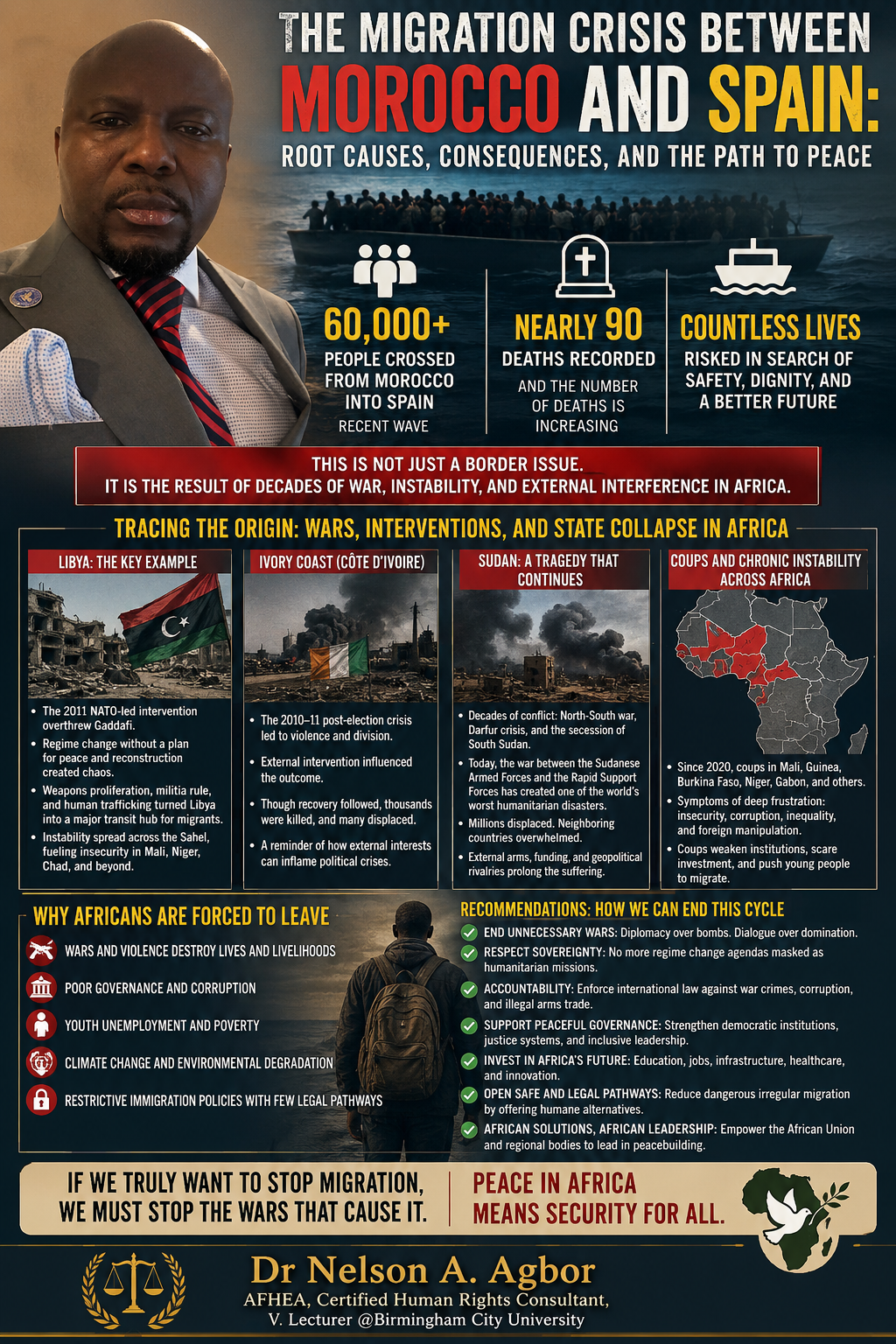
The recent rise in irregular migration from Morocco to Spain has once again highlighted the complex humanitarian and geopolitical challenges facing Europe. Reports of tens of thousands of migrants attempting to reach Spanish territory, alongside a rising death toll approaching ninety fatalities in some recent incidents, underscore the extraordinary human cost of irregular migration across the western Mediterranean and Atlantic routes. These tragedies are not isolated events but manifestations of broader structural conditions, including armed conflict, economic inequality, demographic pressures, environmental degradation, weak governance, and restrictive migration policies. Understanding the contemporary migration crisis therefore requires moving beyond immediate border events to examine the historical and political forces that have destabilised large parts of Africa over several decades.
Although migration to Europe has multiple drivers, conflict remains one of the most significant. Armed violence destroys livelihoods, weakens state institutions, and creates prolonged insecurity that compels millions to seek safety and opportunity elsewhere. Many migrants arriving in Morocco do not originate there but come from across West, Central, and East Africa after undertaking long and dangerous journeys. The cumulative effect of numerous regional conflicts has produced extensive displacement networks, many of which ultimately converge on North Africa before attempting to enter Europe. Consequently, the migration crisis cannot be understood solely as a border management issue but must also be viewed as the downstream consequence of prolonged instability across the African continent.
One of the most debated examples is the 2011 intervention in Libya. Following the uprising against Muammar Gaddafi, a NATO-led military intervention contributed to the collapse of the Libyan regime. While supporters of the intervention argued that it was undertaken to prevent mass civilian casualties, many scholars contend that insufficient planning for Libya’s post-conflict reconstruction created a severe governance vacuum. Competing militias, fragmented political authority, widespread proliferation of weapons, and the emergence of sophisticated human-trafficking networks transformed Libya into one of the principal transit hubs for migrants seeking to reach Europe. The Libyan case illustrates how regime change without sustainable institution-building can generate long-term regional instability with consequences extending far beyond national borders.
The destabilisation of Libya also had significant spillover effects across the Sahel. Weapons from Libyan stockpiles spread into neighbouring countries, strengthening armed groups in Mali, Niger, Chad, and Burkina Faso. The resulting deterioration in regional security contributed to new displacement crises and undermined already fragile governments. These developments coincided with the rise of terrorist insurgencies affiliated with extremist organisations, further complicating humanitarian conditions. Although local political dynamics played an important role, the unintended regional consequences of the Libyan intervention continue to feature prominently in academic analyses of African security and migration.
Other African conflicts similarly illustrate the interplay between domestic political crises and international involvement. In Côte d’Ivoire, the disputed 2010 presidential election escalated into violent conflict before international intervention helped secure internationally recognised electoral outcomes. Although the country subsequently experienced economic recovery, the conflict displaced large populations and exposed the fragility of political institutions. Sudan presents an even more severe example. Decades of civil war, the Darfur conflict, South Sudan’s secession, and, more recently, the devastating war between the Sudanese Armed Forces and the Rapid Support Forces have generated one of the world’s largest displacement crises. Although these conflicts have deep domestic roots, external military assistance, regional rivalries, and international geopolitical competition have often intensified or prolonged the violence.
The recent wave of military coups across West and Central Africa further underscores the erosion of state legitimacy in several countries. Since 2020, coups have occurred in Mali, Guinea, Burkina Faso, Niger, and Gabon, among others. Each case has distinct domestic causes, including dissatisfaction with governance, insecurity, corruption, and economic hardship. Nevertheless, the broader regional pattern suggests widespread public frustration with political institutions that have struggled to deliver security and development. Persistent instability discourages investment, weakens public services, and contributes to migration by reducing opportunities for young populations. The recurrence of unconstitutional changes of government also complicates international cooperation aimed at promoting sustainable development and conflict resolution.
It would, however, be overly simplistic to attribute Africa’s migration challenges solely to Western intervention. Domestic political competition, ethnic tensions, weak institutions, corruption, environmental stress, rapid population growth, and competition over natural resources drive many conflicts. Likewise, regional actors have frequently shaped the trajectory of these conflicts through military interventions, financial support for armed groups, or geopolitical rivalry. A comprehensive explanation therefore requires recognising the interplay between external interventions and internal governance failures. Such an approach avoids reducing complex historical processes to a single explanatory factor while acknowledging that international policies have often produced unintended and enduring consequences.
Europe’s response has largely emphasised border security, enhanced surveillance, agreements with transit countries, and cooperation with North African governments to reduce irregular migration. While these measures may temporarily reduce crossings, they do little to address the structural drivers of displacement. Long-term migration management requires sustained investment in conflict prevention, economic development, institutional strengthening, education, and legal migration pathways. Without meaningful improvements in governance and security across countries of origin and transit, migration pressures are likely to persist despite increasingly restrictive border policies.
Reducing forced migration ultimately depends on preventing unnecessary wars and strengthening international commitments to peaceful conflict resolution. Greater diplomatic engagement, consistent support for United Nations mediation, stricter enforcement of international humanitarian law, and more rigorous oversight of international arms transfers could reduce the intensity and duration of many conflicts. External powers should place greater emphasis on post-conflict reconstruction, institution-building, and inclusive political settlements rather than on narrowly defined military objectives. At the same time, African governments and regional organisations must continue to strengthen democratic institutions, improve accountability, combat corruption, and expand economic opportunities for their citizens. Peace is unlikely to emerge through military means alone; durable stability requires legitimate governance and sustained socioeconomic development.
In conclusion, migration flows from Morocco to Spain mark only the visible endpoint of a much broader geopolitical and humanitarian crisis. The contemporary migration challenge reflects decades of conflict, state fragility, governance failures, and unequal development across parts of Africa. The Libyan intervention remains one of the clearest examples of how the collapse of state institutions can generate regional instability with lasting consequences for migration. By contrast, conflicts in Sudan and political instability elsewhere illustrate the multiplicity of pathways to displacement. Nevertheless, responsibility for these crises is shared among domestic actors, regional powers, and international stakeholders. A durable solution will require moving beyond reactive border enforcement towards a comprehensive strategy centred on conflict prevention, accountable governance, economic development, and international cooperation. By reducing the frequency of armed conflict and investing in sustainable peace, both Africa and Europe would be better placed to address the root causes of forced migration rather than merely its consequences.
Dr Nelson A. Agbor AFHEA
Certified Human Rights Consultant
V. Lecturer @Birmingham City University




