
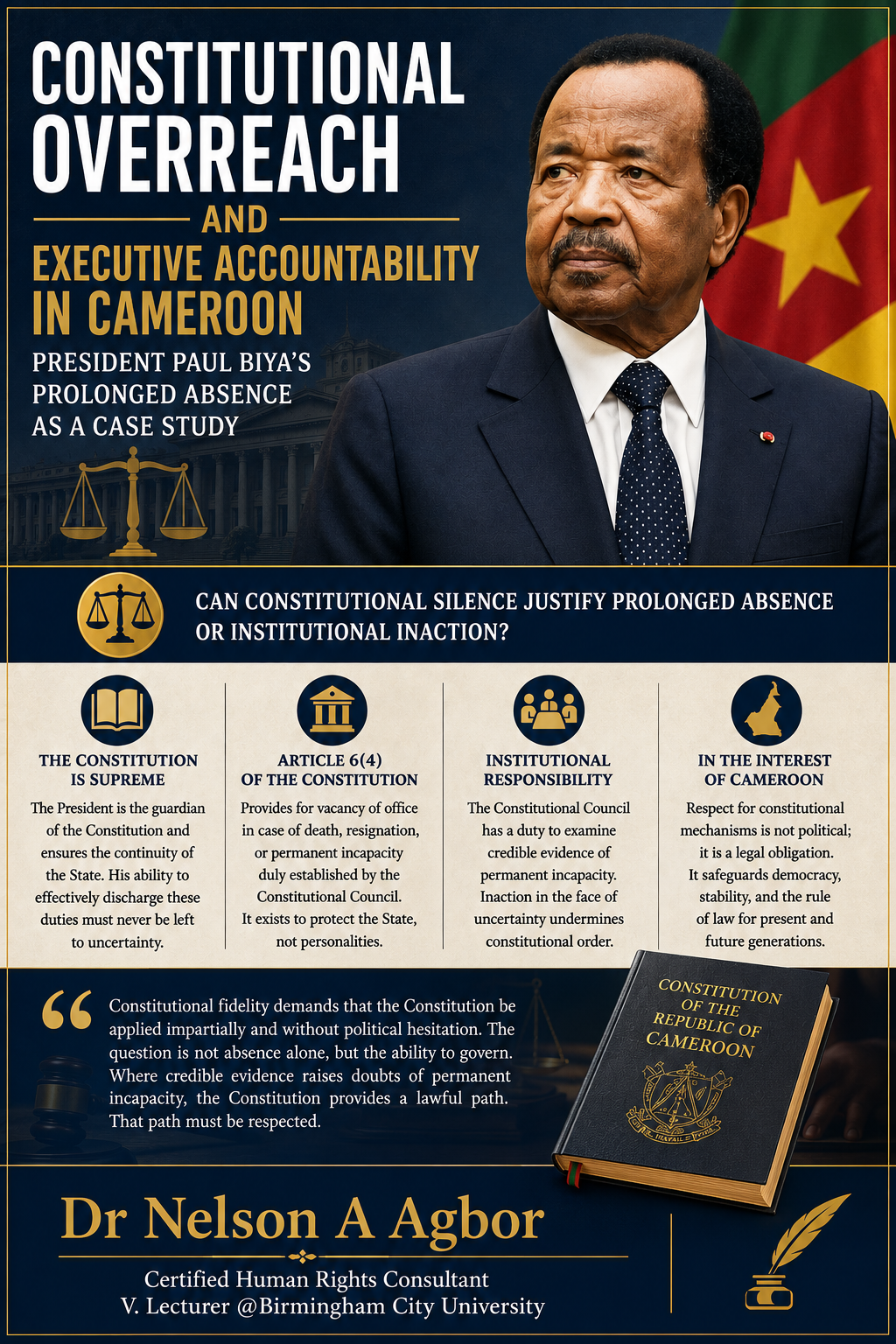
Constitutionalism requires that public power be exercised within the limits set by the Constitution, with every state institution remaining accountable to the supreme law of the land. Constitutional overreach occurs not only when public officials exceed powers expressly granted to them but also when constitutional institutions fail to fulfil their obligations in circumstances that threaten constitutional order. In Cameroon, the prolonged absence of President Paul Biya from the country has reignited debate about executive accountability, constitutional continuity, and the responsibilities of institutions entrusted with safeguarding constitutional governance. Although the Constitution does not prescribe a maximum duration for a presidential absence, an extended and unexplained absence raises legitimate constitutional concerns about transparency, effective governance, and institutional responsibility.
The Constitution of Cameroon establishes the Presidency as the central institution of executive authority. Under Article 5, the President is the Head of State, symbolises national unity, guarantees national independence and territorial integrity, ensures the regular functioning of public authorities, and safeguards the continuity of the State. These constitutional responsibilities presuppose that the President remains capable of effectively exercising the powers entrusted to the office. While modern communication technologies may permit certain governmental functions to be performed remotely, the constitutional expectation remains that the Head of State can discharge presidential duties continuously and effectively, in a manner that inspires public confidence.
President Paul Biya’s reported absence from Cameroon for more than fifty days has sparked widespread public debate about the practical exercise of presidential authority. The constitutional issue is not the length of the absence in itself, since no provision of the Constitution sets a numerical limit on time spent outside the national territory. Rather, the constitutional concern arises when prolonged absence creates uncertainty about the President’s effective exercise of constitutional functions or raises credible questions about the capacity to govern. Constitutional legitimacy depends not merely on the formal existence of executive authority but on its effective and accountable exercise.
The principal constitutional provision governing presidential incapacity is Article 6(4) of the Constitution, which provides that, in the event of a vacancy in the Presidency arising from death, resignation, or duly established permanent incapacity, the President of the Senate shall act as Interim President pending the election of a new President. The determination of permanent incapacity falls within the Constitutional Council’s constitutional competence. Consequently, the Constitution provides a lawful mechanism for preserving constitutional continuity when a President is no longer able to exercise the functions of office. The provision is designed to prevent institutional paralysis while ensuring that constitutional succession occurs within a legal framework rather than through political improvisation.
The central constitutional question is therefore not whether President Biya has violated the Constitution merely by remaining outside Cameroon for more than fifty days. No constitutional provision expressly prohibits such an absence. Instead, the issue is whether the factual circumstances surrounding the prolonged absence provide sufficient grounds for constitutional scrutiny of possible permanent incapacity or inability to perform presidential functions. Where credible evidence raises such concerns, constitutional institutions cannot ignore them without risking the erosion of constitutional accountability and the rule of law.
In constitutional democracies, institutions entrusted with constitutional oversight have an independent obligation to uphold the Constitution without fear or favour. The Constitutional Council is not merely an adjudicative body but also a constitutional guardian charged with preserving constitutional order. If circumstances objectively suggest that the constitutional conditions contemplated by Article 6(4) may exist, the Council should exercise its constitutional mandate by examining the relevant facts in accordance with the law. Such action would not constitute judicial activism or political interference; rather, it would represent faithful adherence to constitutional duty.
The failure of competent constitutional institutions to assess credible questions about presidential capacity may itself constitute a form of institutional constitutional failure. Constitutional supremacy requires that no office, including the Presidency, be beyond constitutional scrutiny. The rule of law demands that constitutional procedures be applied consistently, regardless of the political status or longevity of the officeholder. When constitutional mechanisms remain dormant despite circumstances warranting consideration, the resulting institutional inaction risks weakening public confidence in constitutional governance.
Comparative constitutional practice shows that many constitutional systems provide mechanisms for determining presidential incapacity to preserve governmental continuity and constitutional stability. Such procedures are not designed to undermine elected leaders but to protect constitutional government during periods of uncertainty. Their legitimacy depends on impartial application, procedural fairness, and objective assessment of relevant evidence. Cameroon has such a constitutional mechanism under Article 6(4), and its effectiveness depends on the willingness of competent institutions to use it whenever constitutionally justified.
The broader lesson from President Biya’s prolonged absence is that constitutional government requires more than a constitutional text; it requires institutions prepared to enforce constitutional norms faithfully and independently. Constitutional silence on the duration of presidential travel should not be read as permitting indefinite uncertainty about the effective exercise of executive authority. Equally, constitutional succession mechanisms should neither be invoked lightly nor ignored when their application may legitimately arise. Constitutional fidelity demands careful, objective, and lawful assessment of the relevant constitutional conditions.
In conclusion, President Biya’s prolonged absence does not, by itself, constitute a constitutional violation, as the Constitution prescribes no maximum period for the President to remain in Cameroon. Nevertheless, the circumstances may legitimately raise constitutional questions about the effective exercise of presidential authority and, where supported by credible evidence, whether the constitutional conditions for permanent incapacity under Article 6(4) require formal examination. Respect for constitutionalism demands that the Constitutional Council and all competent state institutions faithfully discharge their constitutional responsibilities by applying the Constitution impartially and without political hesitation. Only through such institutional fidelity can Cameroon preserve the rule of law, reinforce constitutional legitimacy, and ensure that the Constitution remains the supreme and effective law governing the exercise and succession of presidential power.




