
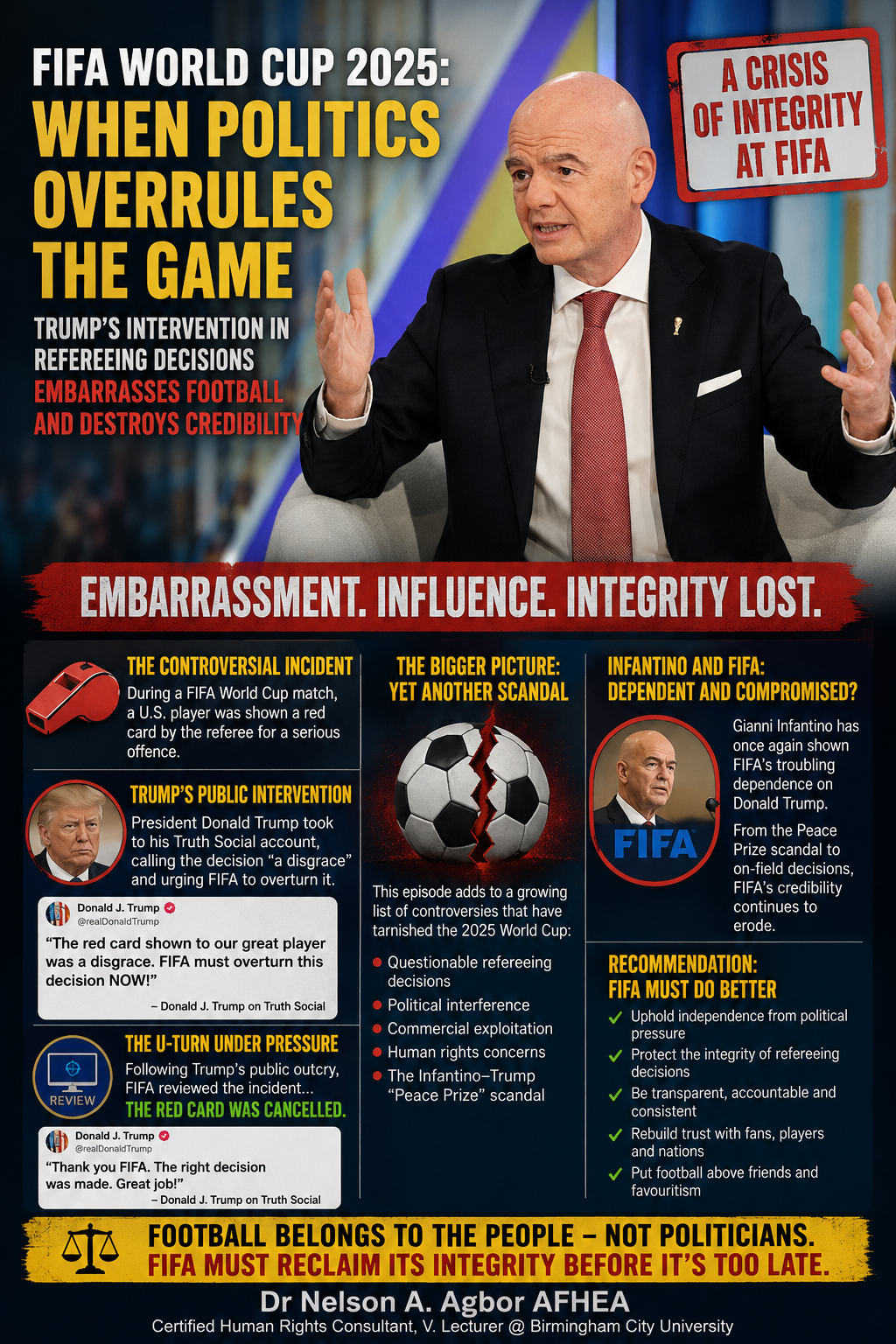
The 2026 FIFA World Cup has delivered remarkable football, record attendances and unforgettable moments. Yet, alongside the sporting spectacle, the tournament has also sparked a succession of controversies that risk overshadowing events on the pitch. Among the most significant has been the public intervention by U.S. President Donald Trump in a refereeing decision involving United States striker Folarin Balogun. The controversy has reignited longstanding concerns about FIFA’s institutional independence, transparency and vulnerability to political influence. More importantly, it raises profound questions about whether the world’s governing body for football can continue to present itself as an impartial regulator when powerful political figures appear to be able to influence disciplinary outcomes.
The controversy arose after Balogun received a red card during the United States’ World Cup victory over Bosnia and Herzegovina. Following a VAR review, the referee ruled that the challenge amounted to serious foul play, triggering an automatic suspension for the next match under standard FIFA disciplinary procedures. Although many football analysts debated whether the decision was harsh, disciplinary consistency has long been regarded as essential to maintaining fairness throughout international tournaments. At that stage, the matter appeared to be one of many contentious refereeing decisions that inevitably accompany major football competitions.
The situation changed dramatically when Donald Trump publicly condemned the decision on his Truth Social platform, calling the dismissal a disgrace and urging FIFA to reverse what he characterised as an injustice. Subsequent reports indicated that Trump had personally contacted FIFA President Gianni Infantino to seek a review of the suspension. Soon afterwards, FIFA’s Disciplinary Committee invoked a rarely used provision of its disciplinary framework to suspend enforcement of Balogun’s one-match ban, thereby making him eligible to play in the United States’ knockout fixture against Belgium.
The controversy intensified when Trump returned to Truth Social to publicly thank FIFA for “doing what was right” after the suspension was reversed. Regardless of whether FIFA’s legal reasoning may ultimately be defensible under its disciplinary code, the sequence of events created a damaging public perception that political pressure, rather than purely legal analysis, had shaped the outcome. In governance, perception often carries as much weight as reality. Sporting institutions depend on public confidence that decisions are made independently, consistently and without external interference. Where that confidence is weakened, institutional legitimacy inevitably suffers.
The episode therefore represents far more than a disagreement over a single red card. It touches on the fundamental constitutional principles on which international sport is built. FIFA has consistently required national football associations to remain free from governmental interference, often threatening suspension when governments attempt to influence football administration. The apparent willingness to accommodate intervention by one of the world’s most powerful political leaders therefore exposes an uncomfortable inconsistency. If political neutrality is a universal principle, it must apply equally, regardless of a country’s political influence or geopolitical importance.
The Balogun controversy also adds to a growing list of governance concerns surrounding this year’s tournament. Critics have already questioned FIFA’s increasingly close relationship with political leaders, commercial interests, and host governments. Earlier controversy over the award of a FIFA Peace Prize to Donald Trump raised concerns about transparency, institutional independence, and the appropriate role of political symbolism in global football governance. Against that background, the reversal of a disciplinary sanction following high-profile political intervention inevitably reinforces concerns that football administration has become increasingly intertwined with political calculations rather than remaining exclusively focused on sporting justice.
Central to this debate is the leadership of Gianni Infantino. Throughout his presidency, Infantino has sought to expand FIFA’s commercial reach and political influence while positioning football as a global diplomatic instrument. Critics argue, however, that these ambitions have increasingly blurred the line between sporting governance and political relationships. The latest controversy is likely to reinforce perceptions that FIFA has become excessively dependent on maintaining favourable relationships with powerful political actors, particularly in the United States, as co-host of the 2026 World Cup. Even where no improper influence can be conclusively established, the appearance of preferential access is itself a governance problem.
Institutional credibility depends not only on compliance with written regulations but also on adherence to universally applied principles of fairness, equality, and procedural consistency. Elite sporting competitions derive legitimacy from the belief that identical rules apply equally to every participant, irrespective of nationality, political influence, or commercial significance. When disciplinary outcomes appear susceptible to extraordinary intervention, confidence among players, supporters, referees, and national associations inevitably declines. Such developments risk encouraging future attempts by governments and influential individuals to seek similar interventions whenever controversial refereeing decisions arise.
From a governance perspective, FIFA should treat this episode as an opportunity for institutional reform rather than merely defending the legality of the disciplinary outcome. Greater transparency in disciplinary appeals, the publication of detailed legal reasoning, stronger safeguards to insulate disciplinary committees from political pressure, and clearer procedural rules for exceptional reviews would all help to rebuild confidence. Equally important is reaffirming FIFA’s long-standing commitment to political neutrality. The governing body cannot credibly insist on non-interference by smaller football associations while appearing receptive to interventions from powerful political leaders.
Ultimately, the enduring legacy of the 2026 FIFA World Cup should be defined by excellence on the football pitch rather than by controversy within football governance. The Balogun affair illustrates how quickly institutional credibility can be undermined when political intervention intertwines with sporting decision-making. Regardless of individual views on the correctness of the original red card, the perception that presidential influence coincided with a favourable disciplinary outcome has caused avoidable reputational damage to FIFA. If the organisation wishes to preserve its authority as the independent guardian of world football, it must demonstrate, through consistent action rather than mere public statements, that its disciplinary processes remain impartial, transparent and immune to political influence. Only by reaffirming these principles can FIFA restore confidence in its governance and protect the integrity of the world’s most popular sport.
Dr Nelson A. Agbor AFHEA
Certified Human Rights Consultant
V. Lecturer @Birmingham City University




