
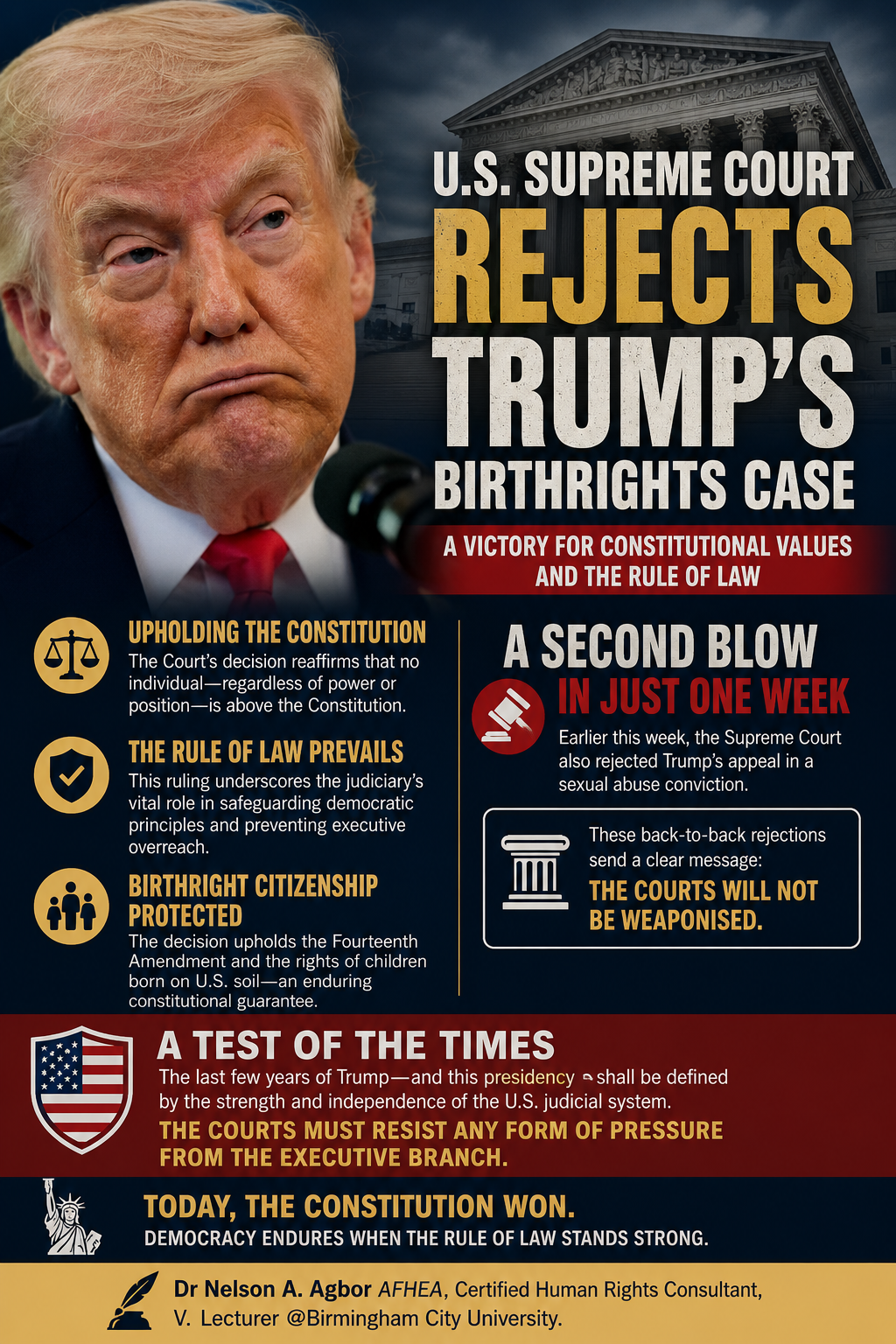
The United States Supreme Court’s decision to reject President Donald Trump’s attempt to restrict birthright citizenship is among the most constitutionally significant rulings in recent years. By reaffirming the constitutional guarantee of citizenship to those born within the United States, the Court reinforced the enduring authority of the Fourteenth Amendment over executive preference. Beyond immigration policy, the ruling underscores a fundamental constitutional principle: no President has the authority to alter constitutional rights through executive action alone. The decision therefore reaffirms constitutional supremacy and the rule of law.
The importance of this case extends well beyond the immediate question of birthright citizenship. At its core lies the enduring tension between executive ambition and constitutional limits. Modern constitutional democracies are sustained not by the popularity of elected leaders but by institutions that ensure governmental power remains subject to legal constraints. The Supreme Court’s judgment demonstrates that constitutional guarantees cannot be displaced merely because they conflict with the political priorities of a sitting administration.
Equally significant is the Court’s reaffirmation that constitutional interpretation must remain grounded in the Constitution’s text, history, and established jurisprudence. The Citizenship Clause of the Fourteenth Amendment has, for generations, provided the legal foundation for birthright citizenship in the United States. By preserving this long-established constitutional understanding, the Court reinforced the principle that constitutional change must occur through the amendment process or legitimate legislative action rather than by executive decree.
This judgment also illustrates the central role of judicial independence within the American constitutional order. Courts exist not to validate political programmes but to determine whether governmental actions comply with constitutional requirements. The legitimacy of the judiciary depends on its willingness to decide cases according to law, irrespective of the political consequences. Decisions of constitutional importance inevitably generate political controversy, yet their value lies precisely in their capacity to preserve legal stability during periods of intense political disagreement.
The ruling marks the second significant legal setback for President Trump this week. Earlier, the Supreme Court declined to hear his appeal against the civil judgment arising from the sexual abuse and defamation litigation involving E. Jean Carroll, leaving the lower court’s verdict undisturbed. Although the two cases address entirely different legal questions, together they demonstrate the Court’s continued willingness to allow established legal processes to operate independently of political office or influence.
Taken together, these developments reinforce a broader constitutional lesson: public office does not place any individual beyond the reach of the law. Democratic governance requires that constitutional rights, judicial procedures, and legal accountability remain applicable regardless of political status. The durability of constitutional systems is measured not by periods of political consensus but by the moment when institutions are required to adjudicate disputes involving the nation’s most powerful officeholders.
Indeed, the defining constitutional legacy of President Trump’s second administration may ultimately be measured less by its policy initiatives than by the resilience of the American judicial system. Courts have increasingly found themselves at the centre of disputes over executive authority, immigration, civil liberties, and constitutional interpretation. Their continued ability to exercise independent judicial review will remain essential to maintaining the constitutional equilibrium envisioned by the framers of the American constitutional order.
Nevertheless, judicial independence should never be construed as judicial supremacy over democratic institutions. Rather, it reflects the constitutional doctrine of separation of powers, under which each branch of government performs distinct functions and serves as a safeguard against institutional overreach by the others. When courts invalidate executive actions that conflict with constitutional guarantees, they are not engaging in political opposition; they are fulfilling their constitutional duty to preserve the integrity of the constitutional framework.
The broader significance of these rulings extends beyond the United States. Constitutional democracies around the world frequently confront tensions between executive power and constitutional limits. The American experience demonstrates that stable democratic governance depends on institutions capable of resisting unconstitutional encroachments, irrespective of the political identity of those exercising executive authority. Independent courts therefore remain indispensable guardians of constitutionalism, legal certainty, and democratic legitimacy.
Ultimately, the Supreme Court’s rejection of restrictions on birthright citizenship is a powerful reminder that constitutions derive their authority not from transient political majorities but from enduring legal principles. Whether politically welcomed or criticised, the decision reinforces the foundational proposition that constitutional rights cannot be overridden by executive preference alone. Coupled with the Court’s refusal earlier in the week to disturb the separate civil judgment against President Trump, these decisions collectively underscore a defining feature of constitutional democracy: the Constitution remains supreme, the rule of law endures, and no individual stands above the legal order it establishes.
Dr Nelson A. Agbor AFHEA
Certified Human Rights Consultant
V. Lecturer @Birmingham City University.




