
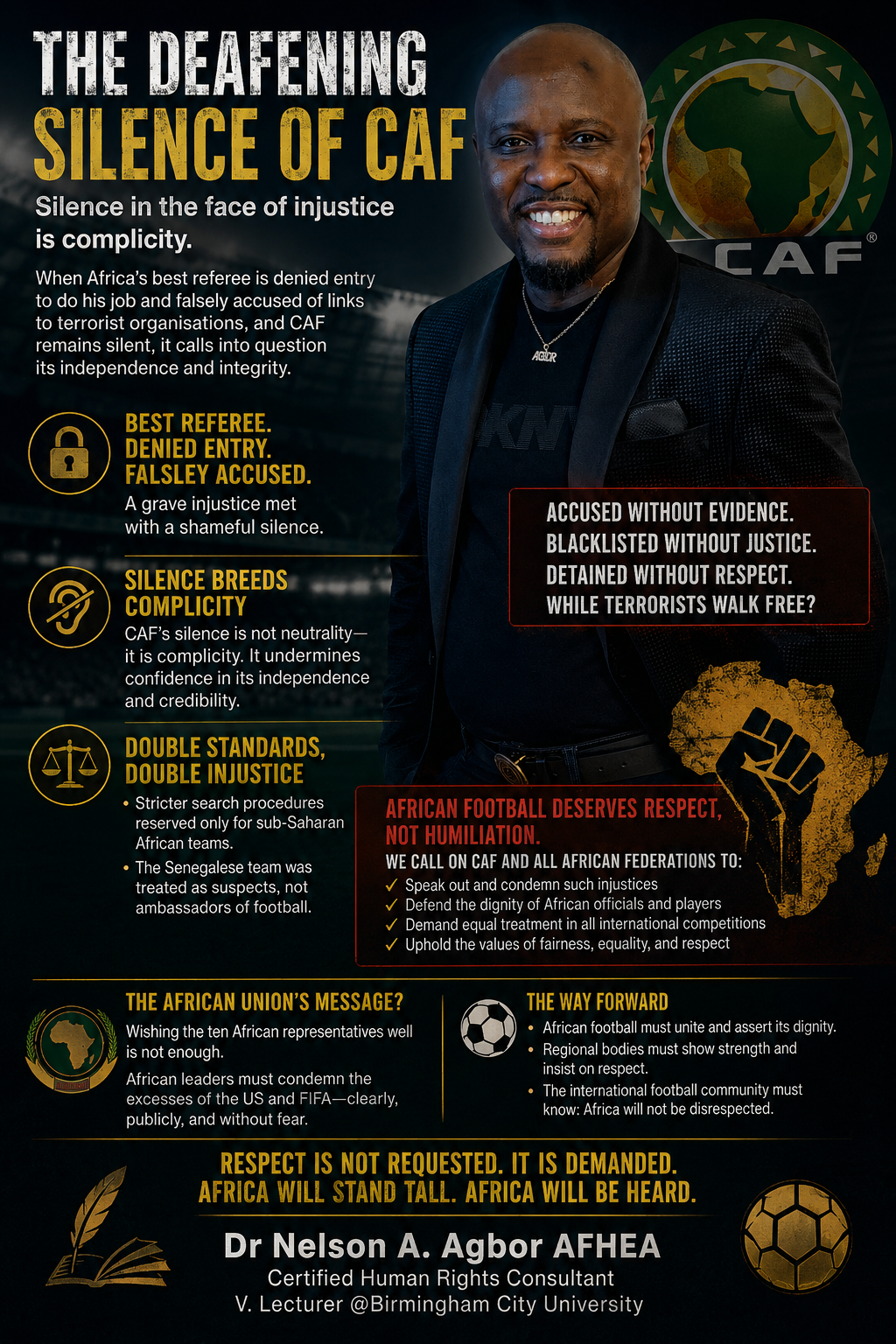
The controversy surrounding the reported refusal of entry to a leading African referee and the allegations linking him to terrorist organisations raise profound questions about justice, due process, and institutional responsibility within international football governance. Beyond the individual circumstances of the case, the Confederation of African Football’s (CAF) reaction—or lack thereof—has become a matter of significant concern. When an organisation entrusted with representing the interests of African football remains silent in the face of allegations that directly affect one of its most distinguished officials, that silence inevitably acquires political and institutional meaning. In governance studies, silence is rarely neutral; it often serves as tacit acceptance or accommodation.
CAF’s apparent reluctance to publicly challenge what many regard as a grave injustice invites scrutiny of its independence and capacity to defend African stakeholders. Sports governing bodies are expected not only to organise competitions but also to safeguard the dignity and professional integrity of their members. When a referee of continental standing is prevented from carrying out his professional duties and subjected to allegations of an exceptionally serious nature, the expectation is that the continental federation would demand transparency, evidence, and procedural fairness. The absence of such a response risks creating the impression that African officials can be marginalised without meaningful institutional resistance.
From an organisational perspective, silence in moments of controversy can have damaging consequences. Institutions derive legitimacy from their willingness to protect the rights and interests of those they represent. If CAF is perceived as unwilling to challenge decisions by more powerful actors in global football governance, questions naturally arise about the balance of power between African football institutions and international authorities. Such perceptions weaken confidence among referees, players, coaches, and supporters, who expect continental leadership to act as a defender rather than a passive observer.
The issue extends beyond a single referee. It raises broader concerns about the treatment of African football personnel within international sporting structures. African football has contributed enormously to the global game through talent, investment, fan engagement, and competitive excellence. Yet incidents suggesting unequal treatment continue to fuel frustration across the continent. When institutions fail to respond to these incidents, they reinforce the perception that African voices remain subordinate within global football governance, despite the continent’s growing importance to the sport.
Equally concerning is the broader pattern of differential treatment reportedly experienced by some African delegations. Reports of stricter search procedures applied to certain sub-Saharan African teams, including the Senegalese delegation, have intensified debates about fairness, dignity, and equality. Even when security considerations are invoked, the legitimacy of such measures depends on their consistent and non-discriminatory application. If specific groups appear to be subjected to heightened scrutiny without clear justification, concerns inevitably arise about unequal treatment and the persistence of structural biases within international sporting environments.
These developments place responsibility not only on CAF but also on national football federations across Africa. Continental and national institutions must cultivate a stronger culture of principled advocacy. Condemning perceived injustices need not entail hostility towards international partners; rather, it reflects a commitment to fairness and equal treatment. Mature institutions demonstrate credibility by defending their members when due process appears threatened. African federations should therefore recognise that public silence can be read as acquiescence, whereas measured yet firm advocacy can strengthen both institutional legitimacy and international respect.
The African Union’s response also warrants critical examination. While expressions of support and encouragement for Africa’s representatives at major tournaments are important symbols of continental solidarity, they may be insufficient when serious concerns arise about the treatment of African participants. Symbolic messages of goodwill to African teams carry limited value if they are not accompanied by a willingness to address issues of fairness, dignity, and equal treatment. Continental representation requires more than celebration; it also requires protection and advocacy when challenges arise.
The broader relationship between African institutions and global governing bodies such as FIFA must likewise be considered. FIFA frequently promotes inclusion, equality, and non-discrimination as foundational values of world football. However, these principles carry little practical meaning if concerns about differential treatment are not addressed transparently and consistently. When allegations of unequal treatment arise, institutions have a responsibility to investigate, explain, and reassure affected stakeholders. Failure to do so risks undermining confidence in the universality of the values that international football claims to uphold.
At a deeper level, this controversy highlights the ongoing struggle of African institutions to assert themselves within global governance frameworks. Respect in international relations is seldom granted automatically; it is often earned through consistent defence of institutional interests and principled engagement with partners. African football organisations have the collective influence, legitimacy, and moral authority to advocate effectively for their members. Doing so requires confidence, coordination, and a willingness to challenge decisions perceived as unjust, even when they originate with powerful international actors.
In conclusion, the silence surrounding CAF in the face of allegations affecting one of Africa’s leading referees has raised legitimate concerns about institutional independence, accountability, and representation. Taken together with wider concerns about the treatment of African teams and officials, the episode underscores the need for stronger advocacy from African football bodies and continental institutions. Respect within the international football community depends not only on sporting success but also on institutions’ willingness to defend the dignity and rights of those they represent. If African football is to command the respect it deserves, its governing bodies must demonstrate that silence will no longer be their response to perceived injustice.
Dr Nelson A. Agbor AFHEA
Certified Human Rights Consultant
V. Lecturer @Birmingham City University.




