
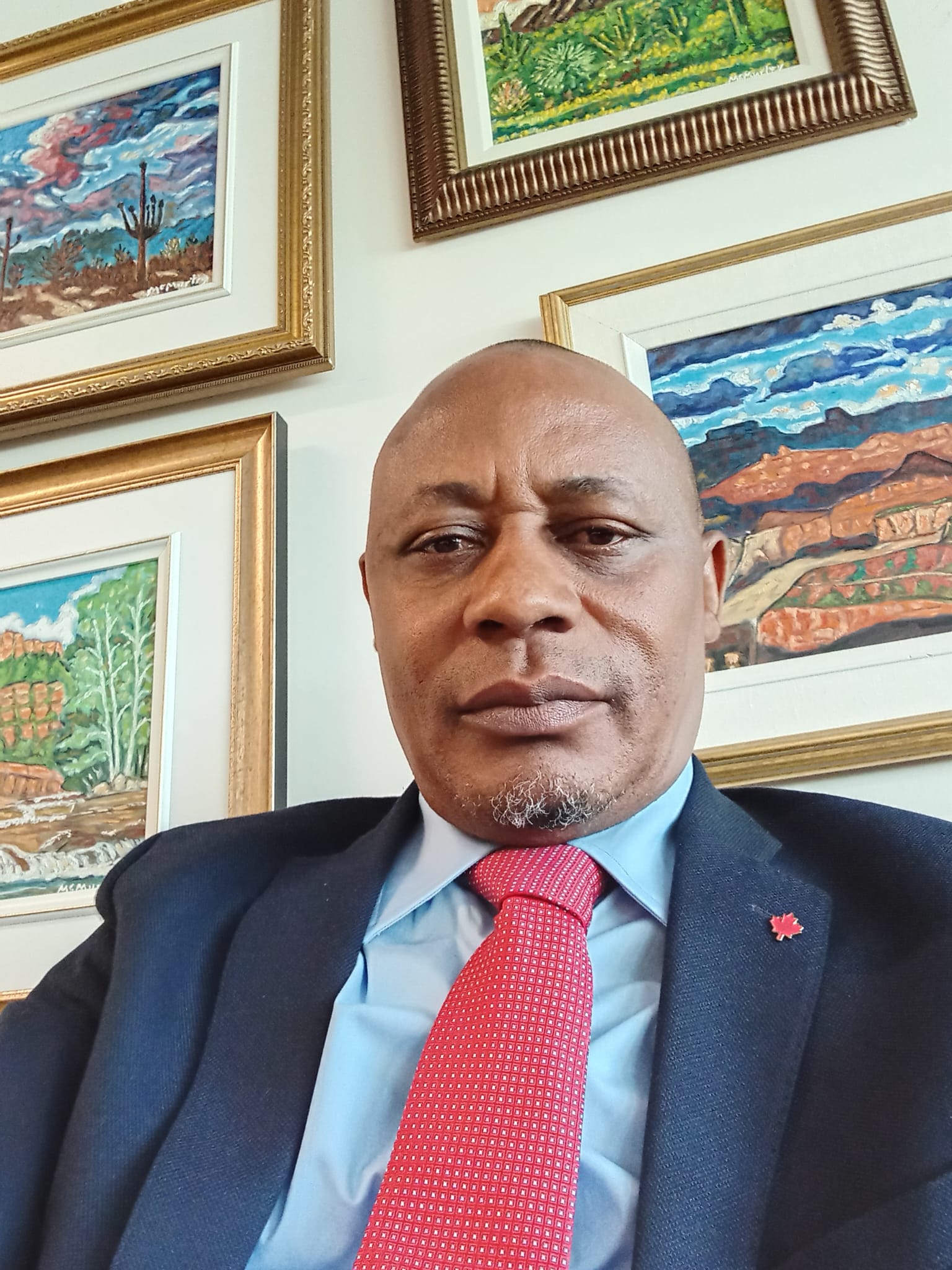
By Prof Tarh Ntantang
Since independence and reunification, the Republic of Cameroon has projected itself under the nationalist slogan “One Nation, One Flag”, a symbolic expression aimed at promoting unity, territorial integrity, and collective identity among its culturally and linguistically diverse populations. This was one of the messages displayed during the 54th edition of the National Day celebration on 20 May 2026. Over the decades, the Cameroonian state under President Paul Biya has further reinforced this ideology through centralised governance, patriotic rhetoric, and the cultivation of state nationalism built around the narrative of peaceful coexistence between Francophone and Anglophone Cameroonians.
Yet beneath this carefully constructed image of national cohesion lies a deeply fractured state grappling with one of Africa’s most protracted and underreported conflicts: the Anglophone crisis. What began in 2016 as peaceful protests by lawyers and teachers in Cameroon’s English-speaking North West and South West regions has evolved into a devastating armed conflict marked by separatist insurgency, militarisation, humanitarian catastrophe, economic collapse, mass displacement, and profound social fragmentation.
Nearly ten years into the conflict, the contradiction between the state’s nationalist rhetoric and the realities on the ground has become increasingly evident. The slogan, “One nation, One Flag, One heartbeat,” now appears less a reflection of national reality and more an illusion masking unresolved historical grievances, governance failures, identity crises, and institutional exclusion. The persistence of violence in the Anglophone regions raises fundamental questions about the meaning of nationhood, citizenship, and unity in Cameroon.
HISTORICAL FOUNDATION OF A DIVIDED STATE
The roots of Cameroon’s contemporary crisis are deeply embedded in its colonial history. Following Germany’s defeat in World War I, Cameroon was partitioned between Britain and France under the mandates of the League of Nations. France administered the larger eastern territory, while Britain governed two narrow strips adjoining Nigeria: Northern and Southern Cameroons. This colonial division produced two distinct political, legal, educational, and administrative structures. French Cameroons adopted civil law, a centralised administration, and Francophone political traditions, whereas British Southern Cameroons developed under the Anglo-Saxon system, characterised by common law, decentralised governance, and English-language education.
The reunification of British Southern Cameroons with French Cameroons in 1961 was intended to create a federal, bilingual state based on equality between the two entities. However, many Anglophones later argued that the federal arrangement was gradually dismantled in favour of excessive centralisation dominated by the Francophone political elite. The abolition of federalism in 1972 under President Ahmadou Ahidjo was a major point of contention. To many Anglophones, the unitary state weakened constitutional protections designed to preserve their linguistic and cultural identity. Over subsequent decades, grievances intensified over perceived political marginalisation, unequal resource allocation, the erosion of the common law system, and the increasing dominance of French in public administration and education. Thus, long before the outbreak of armed conflict in 2016, the foundations of national unity had already become fragile and contested.
THE ILLUSION OF NATIONAL UNITY
For decades, the Cameroonian state invested heavily in the symbolism of unity. National celebrations, such as the 20th May Day, reinforced narratives of national integration and collective patriotism. Official discourse consistently portrayed Cameroon as “Africa in miniature”, emphasising coexistence among more than 250 ethnic groups and two colonial linguistic heritages. However, state nationalism often concealed deeper structural inequalities and unresolved tensions. The highly centralised political system concentrated power in Yaounde while limiting meaningful regional autonomy. Political dissent is frequently suppressed in the name of preserving national unity and territorial integrity. The slogan “One Nation, One Flag” became increasingly problematic, as it demanded symbolic conformity without adequately addressing underlying grievances. National unity was presented not as a negotiated democratic project but as a fixed state doctrine beyond criticism. Consequently, many Anglophones came to perceive official nationalism as performative rather than substantive. The state emphasised unity rhetorically while many citizens experienced exclusion politically, economically, and culturally. This contradiction would eventually erupt into open confrontation.
FROM PEACEFUL PROTEST TO ARMED CONFLICT
The immediate origins of the current Cameroonian Anglophone conflict trace back to the 2016 protests led by Anglophone lawyers and teachers. Lawyers protested the appointment of Francophone magistrates unfamiliar with common-law traditions, while teachers opposed the deployment of French-speaking teachers to English-speaking schools. These protests initially focused on sectoral and constitutional grievances rather than secession. However, the government’s heavy-handed response transformed the situation dramatically. Security crackdowns, the arrest of activists, internet shutdowns, and violent repression radicalised many protesters and fuelled separatist sentiments. What began as demands for reform evolved into calls for federalism and, eventually, for outright independence under the name “Ambazonia.” By late 2017, separatist groups had emerged across the North West and South West regions. The Cameroonian government responded with militarisation, and the conflict rapidly escalated into a full-scale insurgency. Today, the conflict has claimed thousands of lives, displaced hundreds of thousands of civilians, and devastated local economies and institutions. According to multiple humanitarian reports, more than 700,000 people have been internally displaced, while thousands have sought refuge in neighbouring Nigeria.
HUMANITARIAN CATASTROPHE AND SOCIAL COLLAPSE
One of the greatest tragedies of the Anglophone conflict is its devastating humanitarian impact on civilians. Entire communities have been displaced, villages burned, schools destroyed, and economic activity disrupted. Education has become one of the primary casualties of the conflict. School boycotts enforced by separatist groups, attacks on educational institutions, the kidnapping of teachers and students, and military insecurity have severely disrupted learning in the affected regions. UNICEF and humanitarian organisations have warned of the emergence of a “lost generation” deprived of formal education. Healthcare systems have also deteriorated as hospitals face insecurity, staffing shortages, and limited access for vulnerable communities. Agricultural production, once central to the economies of the North West and South West regions, has sharply declined due to displacement and insecurity. The conflict has also produced deep psychological trauma. Families have been separated, communities fragmented, and social trust eroded. Civilians frequently find themselves trapped between state security forces and separatist fighters, both accused of human rights abuses. Under such circumstances, the national rhetoric of “One Heartbeat” appears increasingly detached from the lived realities of citizens enduring violence, fear, and displacement..
CRISIS OF GOVERNANCE AND STATE LEGITIMACY
The prolonged nature of the conflict exposes a broader crisis of governance in Cameroon. Rather than merely a security issue, the Anglophone crisis reflects deeper structural failures related to political inclusion, decentralisation, democratic participation, and state legitimacy. Critics argue that successive governments failed to meaningfully address Anglophone grievances for decades. Instead, state responses frequently emphasised security measures over political dialogue. This reliance on coercive state power further weakened trust between citizens and national institutions. The concentration of political authority around the presidency has also contributed to changes in governance. Cameroon’s centralised political structure often limits local participation in decision-making and reduces opportunities for genuine regional autonomy.
Furthermore, the persistence of corruption, patronage politics, electoral distrust, and restrictions on political freedoms has compounded citizens’ frustrations. Consequently, the Anglophone conflict can not be understood solely as an ethnic or separatist issue; it is also a manifestation of broader governance deficits within the Cameroonian state.
NATIONAL IDENTITY IN CRISIS
The conflict has profoundly reshaped debates about national unity in Cameroon. The idea of a unified bilingual nation has come under increasing strain as mutual distrust deepens across sections of the population. For Anglophones, the crisis has reinforced perceptions of exclusion and second-class citizenship within a Francophone-dominated state. Conversely, many Francophone Cameroonians fear that separatism threatens national unity and territorial integrity. The result is a fragmented national consciousness, in which competing identities increasingly overshadow collective citizenship. Instead of “One heartbeat” Cameroon, today appears characterised by divided historical memories, competing political narratives, and polarised visions of the future. This identity crisis demonstrates that national unity requires justice, inclusion, constitutional trust, and democratic dialogue.
INTERNATIONAL SILENCE AND THE FORGOTTEN CONFLICT
Despite its severity, Cameroon’s Anglophone crisis has attracted relatively little international attention compared with other African conflicts. Political analysts often describe it as a “forgotten conflict”, overshadowed by geopolitical priorities and competing humanitarian emergencies. Although organisations such as Human Rights Watch, Amnesty International, and the UN have documented abuses and called for dialogue, international diplomatic engagement has remained limited and inconsistent. This relative silence has prolonged the conflict. Without sustained international pressure and meaningful mediation efforts, both the government and separatist factions have continued to pursue military approaches, with limited incentives for compromise.
PATHWAYS TOWARDS NATIONAL RECONCILIATION
Resolving Cameroon’s Anglophone crisis requires moving beyond symbolic nationalism towards substantive nation-building based on justice, inclusion, and democratic reform. Military solutions alone are unlikely to end a conflict rooted in historical grievances and identity politics. A sustained resolution would require:
- INCLUSIVE POLITICAL DIALOGUE
Meaningful negotiations involving the government, separatists, representatives, civil society, religious leaders, women, and youths are essential for rebuilding trust. - CONSTITUTIONAL AND INSTITUTIONAL REFORMS
Many political analysts advocate decentralization or federal restructuring as mechanisms for addressing longstanding grievances related to governance and autonomy. - HUMAN RIGHTS AND TRANSITIONAL JUSTICE
Investigations into abuses committed by all parties are necessary for accountability and reconciliation. - RECONSTRUCTION AND HUMANITARIAN RECOVERY
The affected regions require substantial investment in education, healthcare, infrastructure, and economic recovery. - NATIONAL REIMAGINING
Cameroon government must redefine national unity not as imposed conformity but as democratic coexistence built upon mutual respect and constitutional equality.
CONCLUSION
All in all, the slogan “Cameroon: One Nation, One Flag, One Heartbeat ” once represented an aspirational vision of unity within diversity. Yet, after nearly ten years of violent conflict in the Anglophone regions, the gap between official rhetoric and political reality has become painfully apparent. The Anglophone crisis has exposed the fragility of Cameroon’s post-colonial nation-building project and revealed the dangers of ignoring historical grievances, suppressing dissent, and prioritising centralised control over inclusive governance. Thousands of lives have been lost, communities shattered, and generations traumatised in a conflict that continues to challenge the legitimacy of the state and the meaning of national identity itself. Ultimately, true national unity can not be sustained through slogans alone. A genuine “heartbeat” of nationhood must emerge from justice, equality, democratic participation, and the recognition of the country’s diverse identities and histories. Until such conditions are realised, Cameroon risks remaining not fully united, but an illusion of unity overshadowed by unresolved conflict and fractured citizenship.
Prof. TARH NTANTANG IS FOUNDER/CEO OF NTANTANG RESEARCH AND CONSULTING CENTER(NRCC) YAOUNDE-CAMEROON. He is a global policy expert and practitioner in democracy support, peacebuilding, and governance, with over a decade of experience across Africa. He holds a doctorate in political economy and international affairs from the University of Yaounde 1. He is also a certified climate migration scholar at York University, Toronto, Canada.




