
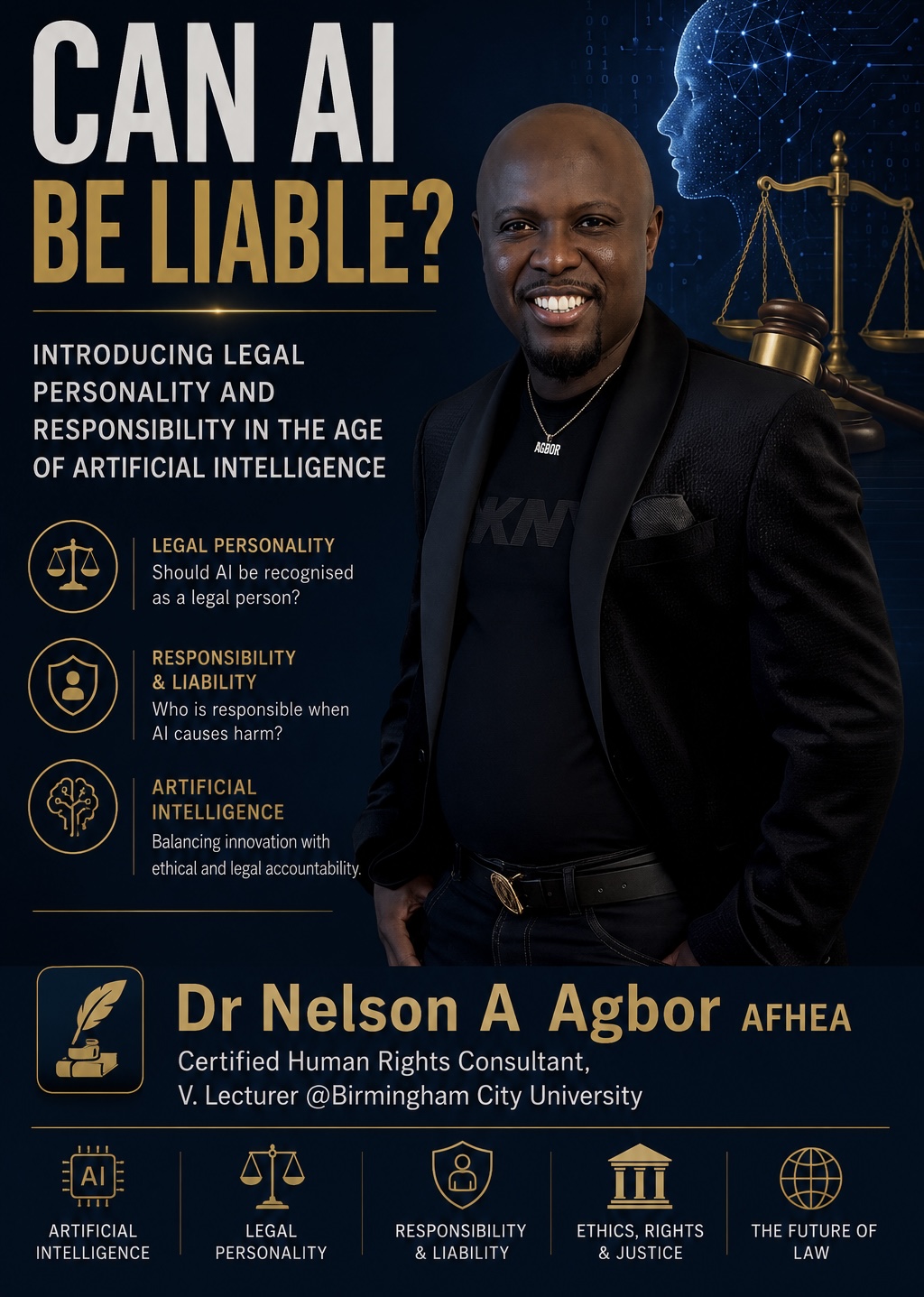
Artificial intelligence has rapidly evolved from a speculative technological concept into a transformative force shaping governance, commerce, healthcare, transport, and judicial administration. As AI systems become increasingly autonomous and capable of making decisions without immediate human intervention, legal scholars and policymakers confront a profound jurisprudential question: can artificial intelligence itself bear legal liability? Traditionally, liability has been attached to natural persons and juridical entities such as corporations. However, highly sophisticated AI systems now perform functions once reserved exclusively for human reasoning, including predictive analysis, contractual negotiation, medical diagnosis, and autonomous driving. The emergence of these technologies has exposed limitations in conventional legal doctrines of fault, causation, and responsibility. Consequently, debates surrounding AI liability increasingly focus on whether AI should be granted legal personality, thereby attracting rights, duties, and accountability.
The concept of legal personality is neither novel nor confined to human beings. Legal systems have long extended juridical status to artificial entities to serve practical, economic, or social objectives. Corporations, partnerships, states, and charitable organisations possess legal personality despite lacking human consciousness. Recognition enables them to sue and be sued, own property, enter into contracts, and bear liabilities independently of their members. This legal fiction emerged primarily to facilitate accountability and economic efficiency. Supporters of AI legal personality argue that autonomous systems may similarly require independent recognition to resolve attribution problems arising from machine decision-making. When an autonomous AI system causes harm through actions not directly foreseeable by programmers or operators, assigning liability solely to human actors may appear doctrinally strained. Thus, proponents contend that extending limited legal personality to AI could provide conceptual coherence and regulatory clarity.d regulatory clarity.
Nevertheless, granting AI legal personality raises significant philosophical and doctrinal concerns. Legal personality has traditionally rested on notions of rational agency, moral consciousness, and intentionality. Although corporations lack biological consciousness, they remain ultimately governed by human decision-makers and collective human interests. Artificial intelligence, by contrast, operates through algorithmic processing without subjective awareness or moral understanding. Current AI systems do not possess consciousness, emotions, or independent volition in the human sense. Critics therefore argue that legal personality should not be entirely detached from moral agency. Imposing liability on AI systems themselves may create the dangerous illusion that machines are morally accountable actors rather than tools created and controlled by humans. This could allow developers, manufacturers, and corporations to evade responsibility by shifting blame onto autonomous systems incapable of genuine punishment or moral culpability.
The issue is particularly acute in tort law, where liability generally depends on negligence, foreseeability, and causation. Autonomous AI systems complicate these principles because their outputs may evolve unpredictably through machine learning. For example, an autonomous vehicle may cause an accident due to decisions generated by self-learning algorithms that developers did not explicitly programme. Determining whether liability should attach to the manufacturer, software developer, owner, operator, or the AI system itself becomes exceedingly difficult. Existing tort doctrines often rely on identifying a human actor who breached a standard of care. Yet AI systems may produce harmful outcomes without any obvious human negligence. Some scholars therefore advocate strict liability frameworks, under which developers or operators are held responsible regardless of fault. Others suggest establishing AI compensation funds or mandatory insurance schemes to ensure victims receive remedies without requiring courts to resolve complex attribution problems.
Contract law poses additional challenges regarding AI autonomy and responsibility. AI systems are increasingly negotiating contracts, executing transactions, and making commercial decisions independently. Algorithmic trading systems, for instance, can conclude financial transactions within milliseconds without direct human supervision. Questions therefore arise about contractual intent, consent, and enforceability. Traditional contract doctrine presumes parties capable of understanding legal obligations and expressing genuine assent. AI systems currently lack conscious intent and cannot comprehend legal duties. Consequently, most legal systems continue to treat AI actions as extensions of human or corporate principals. However, as AI systems become more sophisticated, distinguishing between human authorisation and machine-generated decision-making may become increasingly difficult. Limited legal personality for AI could, in theory, simplify these relationships by recognising AI systems as separate transactional agents, though such recognition would require substantial revision of established legal principles.
Criminal liability is perhaps the most controversial dimension of AI accountability. Criminal law fundamentally depends on the concepts of mens rea and moral blameworthiness. Punishment serves purposes including deterrence, rehabilitation, retribution, and incapacitation, all of which presuppose conscious agency. Since AI lacks subjective awareness, imposing criminal responsibility directly on machines appears conceptually incoherent under existing legal theory. An AI system cannot form criminal intent, experience guilt, or undergo rehabilitation. Nonetheless, autonomous weapons systems and AI-assisted criminal conduct raise pressing accountability concerns. If an autonomous military drone unlawfully targets civilians or an AI system facilitates financial fraud, identifying the appropriate human actor responsible may prove challenging. Most scholars therefore reject direct criminal liability for AI while emphasising expanded accountability for developers, deployers, and corporate entities that exercise control over such systems.
Comparative legal developments reveal divergent approaches to AI liability across jurisdictions. The European Union has emerged as a leading regulatory actor through initiatives such as the EU Artificial Intelligence Act, which emphasises risk-based regulation and human oversight. Earlier European Parliament proposals even contemplated “electronic personhood” for highly autonomous AI systems, though this idea faced substantial criticism and was ultimately not adopted. In the United States, regulatory approaches remain fragmented and heavily reliant on existing tort and consumer protection frameworks. China, meanwhile, has emphasised state-centred governance and algorithmic accountability mechanisms. These varying approaches demonstrate that the global legal community has yet to reach consensus on the juridical status of AI. Nonetheless, all jurisdictions recognise that traditional legal doctrines are under increasing pressure from technological autonomy.
From a policy perspective, introducing a limited AI legal personality may offer pragmatic advantages. It could create clearer mechanisms for allocating liability, facilitate the adoption of mandatory insurance schemes, and support regulatory oversight of autonomous systems. Similar to corporate personhood, AI legal personality need not imply moral equality with humans but could instead serve as a legal instrument to address practical governance challenges. Limited personality could allow AI systems to maintain separate liability funds, enter into contractual relationships, and become identifiable legal units within regulatory systems. However, such recognition should remain narrowly confined and carefully supervised to prevent misuse. Importantly, granting AI legal personality must not weaken human accountability or permit corporations to externalise risks onto algorithmic entities that lack meaningful assets or moral agency.
Despite these potential advantages, the dangers associated with AI legal personhood remain substantial. Extending juridical status to AI may unintentionally anthropomorphise machines and obscure the fundamentally human choices embedded in algorithmic systems. AI technologies reflect the objectives, biases, and commercial incentives of their creators. Treating AI as an independent legal actor risks disguising structural inequalities and reducing transparency in corporate governance. Moreover, because AI systems cannot experience punishment, sanctions directed at them may lack a meaningful deterrent effect. Financial penalties imposed on AI entities would ultimately burden human owners or operators. Accordingly, many scholars argue that existing legal doctrines should instead be adapted to strengthen human and corporate accountability rather than inventing entirely new forms of electronic personhood.
In conclusion, the question of whether AI can be legally liable is one of the most important jurisprudential challenges of the twenty-first century. As artificial intelligence increasingly performs autonomous functions capable of causing significant social and economic harm, current legal systems remain grounded in assumptions centred on human agency and corporate control. Granting AI legal personality may offer practical benefits for addressing attribution and compensation issues, particularly in tort and commercial law. However, profound philosophical and doctrinal objections remain, especially regarding moral agency and criminal responsibility. At present, the stronger legal position appears to favour maintaining human-centred accountability while developing specialised regulatory frameworks for AI governance. Rather than treating AI as a truly independent legal subject, the law should focus on ensuring that developers, corporations, operators, and states remain responsible for the design, deployment, and consequences of autonomous technologies. The future of AI liability will therefore likely involve a hybrid framework combining strict regulation, enhanced oversight, insurance mechanisms, and carefully calibrated legal reforms, rather than the full recognition of artificial intelligence as an autonomous legal person.
Dr Nelson A. Agbor AFHEA,
Certified Human Rights Consultant, V. Lecturer @Birmingham City University.




