
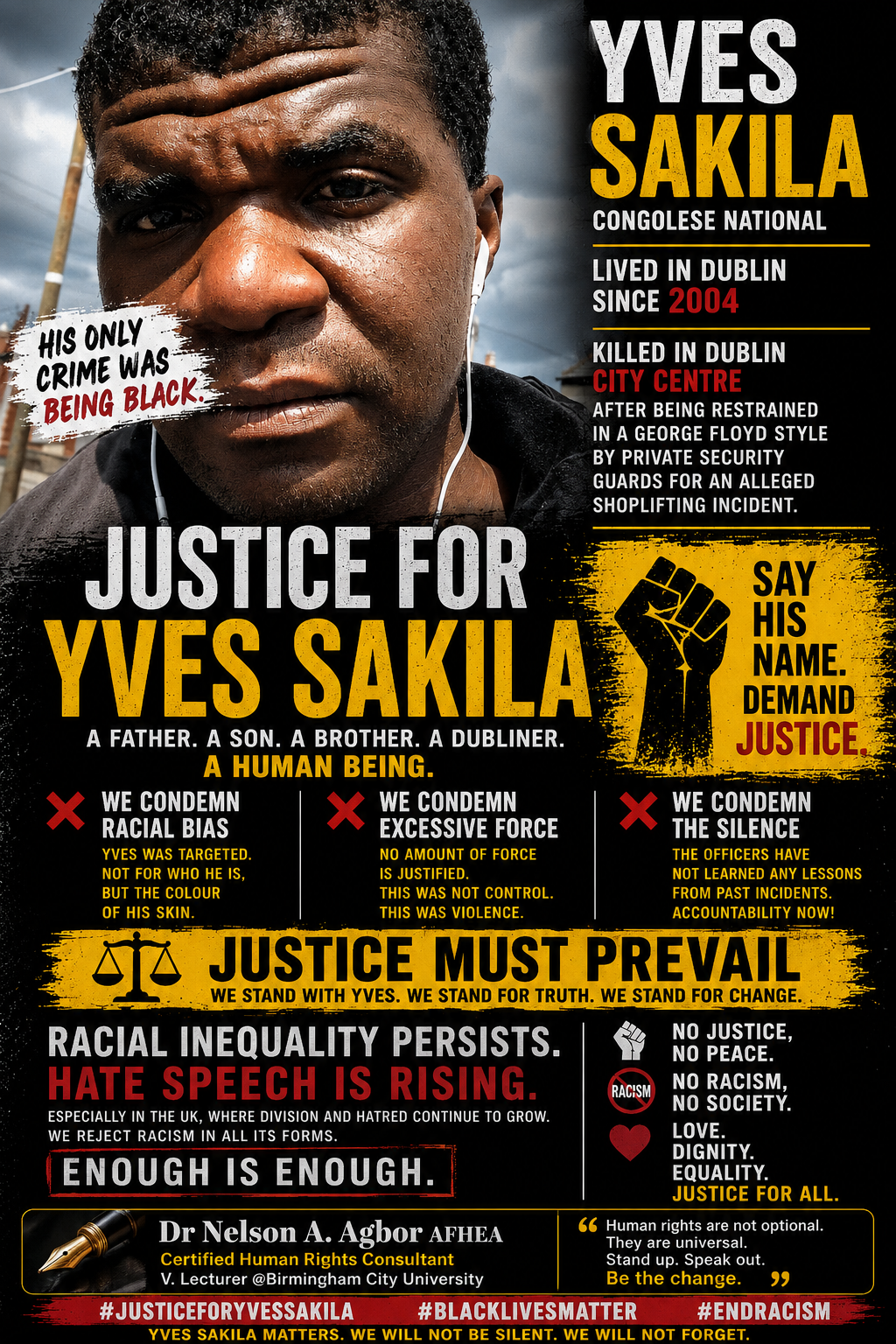
The death of Yves Sakila in Dublin City Centre, following a violent restraint by private security guards, raises profound legal, moral, and societal concerns about racial profiling, excessive force, and the devaluation of Black lives in contemporary Europe. Sakila, a Congolese national who reportedly lived in Dublin since 2004, was allegedly restrained in a manner disturbingly reminiscent of the killing of George Floyd in 2020. The incident reportedly stemmed from an allegation of shoplifting, yet the response by private security personnel appears grossly disproportionate to the circumstances. The imagery and testimonies associated with the event evoke painful memories of a global moment that forced societies to confront systemic racism and institutional violence. That such an incident could occur years after worldwide condemnation of Floyd’s killing demonstrates a disturbing failure to internalise the lessons of accountability, restraint, and respect for human dignity.
The deployment of extreme physical force against Black individuals in alleged petty crime situations reflects enduring racial bias embedded in security cultures across many Western societies. Although private security guards are not sworn police officers, they frequently operate within systems shaped by similar assumptions about race, criminality, and public threat. Black men continue to be disproportionately perceived as dangerous, aggressive, or resistant, often leading to escalated confrontations that would likely not occur in similar circumstances involving white individuals. In the case of Yves Sakila, the apparent willingness to subdue him by force rather than de-escalate illustrates how racialised suspicion can transform a minor allegation into a fatal encounter. Such actions are incompatible with the principles of proportionality and necessity that should govern all security interventions in democratic societies governed by the rule of law.
Equally troubling is the broader institutional failure evident in this tragedy. The killing of George Floyd prompted international protests, corporate pledges, diversity initiatives, and promises of structural reform. Governments, law enforcement agencies, and private institutions publicly acknowledged systemic racism and vowed to prevent similar occurrences. Yet the death of Yves Sakila suggests that many of these commitments have remained superficial or symbolic rather than transformative. The persistence of violent restraint techniques, particularly those targeting vulnerable racial minorities, indicates that meaningful lessons have not been learned. Training programmes emphasising de-escalation, cultural competence, and anti-racist practice appear insufficient when individuals continue to die during interactions over low-level allegations. Justice systems must therefore move beyond rhetorical condemnation and ensure that accountability mechanisms are both independent and effective.
The incident also highlights the precarious position of African migrants and Black communities within European urban spaces. Despite years of residence and social contribution, many immigrants continue to face exclusion, surveillance, and discriminatory treatment. Dublin, like many European capitals, has become increasingly multicultural, yet racial equality has not kept pace with demographic change. Structural inequalities in employment, housing, policing, and social representation continue to marginalise Black communities and expose them to heightened scrutiny. The death of Yves Sakila, therefore, cannot be understood merely as an isolated incident of individual misconduct; rather, it reflects wider social patterns in which Black bodies are disproportionately subjected to coercion, suspicion, and violence.
These concerns resonate strongly in the United Kingdom, where racial hostility and hate speech have intensified in recent years. Political polarisation, anti-immigrant rhetoric, and the amplification of extremist narratives on social media have contributed to a climate in which racial minorities increasingly face intimidation and exclusion. Hate crimes against Black people, migrants, Muslims, and other minority groups remain a persistent challenge despite legislative efforts to combat discrimination. The normalisation of inflammatory discourse within parts of the political and media establishment risks legitimising prejudice and reinforcing discriminatory attitudes within institutions responsible for public safety. When societies tolerate racist rhetoric or fail to confront systemic inequality decisively, they create conditions in which violence against marginalised communities becomes easier to rationalise or ignore.
Ultimately, justice for Yves Sakila requires more than expressions of sympathy or temporary public outrage. It demands a transparent, independent investigation capable of establishing full accountability for the actions that led to his death. It also requires a broader societal reckoning with the persistence of racial inequality in Ireland, the United Kingdom, and across Europe. Democratic societies cannot credibly defend human rights while Black individuals continue to die after being subjected to violent restraint over minor allegations. The sanctity of human life must take precedence over aggressive enforcement practices rooted in fear and racial bias. Yves Sakila’s death should catalyse substantive reform, renewed anti-racist commitment, and institutional accountability. Without such action, promises of equality and justice will remain hollow ideals rather than lived realities for racial minorities across Europe.
Dr Nelson A. Agbor AFHEA,
Certified Human Rights Consultant, V. Lecturer @Birmingham City University.




