
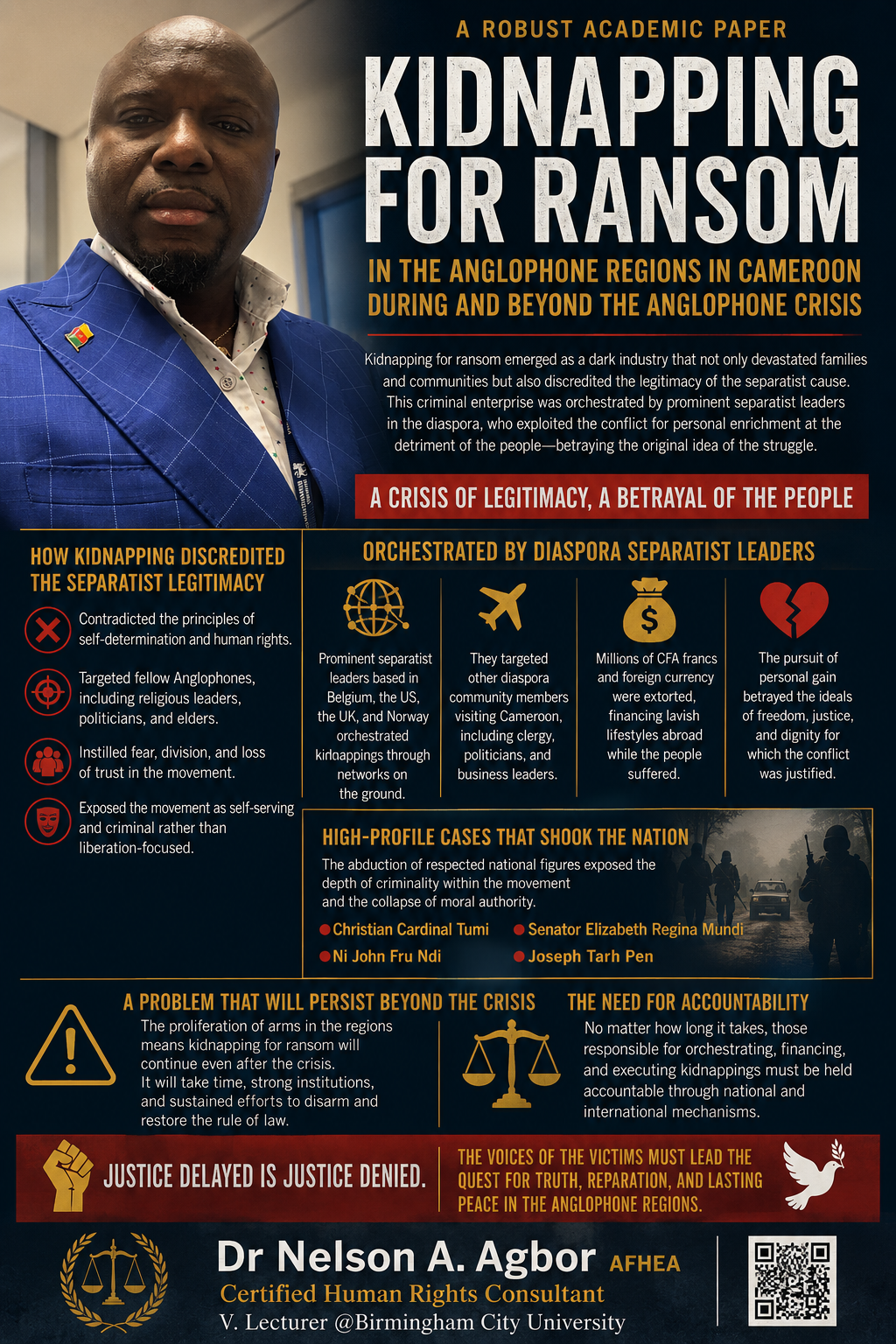
The Anglophone Crisis in Cameroon, which began in 2016 as a political protest against the perceived marginalisation of the English-speaking regions, gradually escalated into a violent armed conflict marked by widespread abuses against civilians. Although the conflict initially stemmed from legitimate grievances rooted in the historical “Anglophone problem,” the evolution of separatist violence, particularly kidnapping for ransom, severely undermined the moral legitimacy of the separatist struggle. What was initially presented as a liberation movement increasingly became associated with organised crime, extortion, and terror against the very populations the separatists claimed to defend. The normalisation of abductions, arbitrary detention, and ransom demands transformed many armed factions into predatory networks operating for financial gain rather than political emancipation.
Kidnapping for ransom became one of the most notorious features of the conflict in the North West and South West Regions. Armed separatist groups targeted politicians, clergy, traditional rulers, teachers, students, businesspeople, and ordinary civilians. The phenomenon evolved into a parallel war economy sustained by fear and coercion. Numerous roadblocks established by armed groups became centres of extortion, where civilians were abducted until families paid significant sums for their release. Human Rights Watch documented how kidnappings became endemic in the Anglophone regions, affecting both high-profile figures and ordinary citizens. The widespread nature of these acts fundamentally contradicted the separatists’ claims to protect the Anglophone population from state oppression.
One of the most symbolic cases was the abduction of Christian Cardinal Tumi in November 2020. Cardinal Tumi, widely respected nationally and internationally as a moral authority and advocate for peace, had consistently called for dialogue and reconciliation. His kidnapping by alleged separatist fighters shocked both domestic and international observers. Reports indicated that armed men intercepted his convoy in the North West Region as he accompanied the Fon of Nso back to his palace. The abduction of a 90-year-old cleric who had openly defended the suffering population exposed the extent to which extremist factions had abandoned ethical and political restraint. Rather than strengthening the separatist cause, the incident generated widespread outrage and further alienated many Anglophones who had initially sympathised with demands for justice and federal reform.
Similarly, the repeated kidnapping of Ni John Fru Ndi marked a major turning point in public perceptions of the separatist movement. Fru Ndi, founder of the Social Democratic Front (SDF), had long embodied Anglophone political resistance within democratic structures. Yet separatist fighters abducted him twice in 2019, subjecting him to humiliation, intimidation, and physical abuse. Reports indicated that the kidnappers sought to pressure him into withdrawing SDF representatives from state institutions. The symbolism was devastating: a movement claiming to defend Anglophone dignity had turned violently against one of the foremost Anglophone political figures in Cameroon’s modern history. This exposed deep internal contradictions within separatist ideology and underscored the increasingly coercive nature of armed groups operating in the region.
The abduction of Elizabeth Regina Mundi further reinforced perceptions that separatist violence had devolved into indiscriminate criminality. Senator Regina Mundi was kidnapped in 2022 alongside other civilians and held for months under harsh conditions. Her case showed that political office-holders, regardless of their actual influence on government policy, became targets for armed groups seeking publicity, leverage, or financial gain. Likewise, the kidnapping and killing of Joseph Tarh Pen reflected the growing vulnerability of journalists, traditional elites, and mediators caught between the government and separatist factions. Such incidents deepened civilian fear and undermined any residual perception of the separatist struggle as a disciplined liberation movement grounded in international norms of self-determination.
An important dimension of the kidnapping economy was the role of influential separatist leaders in the diaspora. Several prominent activists based in countries such as Belgium, the United States, the United Kingdom, and Norway allegedly exerted ideological and operational influence over armed groups on the ground. Through social media broadcasts, fundraising campaigns, and transnational communication networks, diaspora leaders mobilised financial support while encouraging radicalisation and the use of violent enforcement mechanisms. Evidence from multiple incidents suggested that rival diaspora factions also used local militias to intimidate or target members of competing diaspora communities visiting Cameroon. In many instances, kidnappings were not merely politically motivated but were tied to ransom extraction and the consolidation of financial influence within separatist circles.
The emergence of kidnapping as a lucrative industry fundamentally betrayed the original aspirations of the Anglophone protests. The early demands of lawyers, teachers, students, and civil society actors centred on constitutional reform, linguistic equality, decentralisation, and respect for the historical identity of the former British Southern Cameroons. However, as armed conflict intensified, some separatist commanders and diaspora financiers transformed the struggle into a commercial enterprise sustained by extortion, illegal taxation, contraband activities, and ransom payments. Civilians became commodities within a war economy. The moral distinction between political insurgency and organised criminal violence progressively eroded, causing many local populations to lose confidence in separatist rhetoric and leadership.
The long-term consequences of this criminalisation are likely to persist even after the formal end of armed hostilities. One of the greatest dangers facing post-conflict Anglophone Cameroon will be the proliferation of weapons and the entrenchment of armed networks accustomed to violent profiteering. Experience from other African conflicts shows that once kidnapping economies become institutionalised, they rarely disappear immediately after ceasefires or peace agreements. Armed actors who have benefited financially from instability often resist demobilisation because conflict has become economically rewarding. The continued circulation of small arms in rural communities across the North West and South West Regions could therefore sustain post-war banditry, localised insurgency, and kidnapping for years after any political settlement.
For this reason, accountability and transitional justice will remain essential to any durable peace process. Responsibility must extend beyond fighters who physically carry out abductions to include financiers, propagandists, and coordinators operating abroad. Diaspora leaders who allegedly incited violence or benefited materially from ransom systems cannot be permanently shielded by geographic distance or foreign citizenship. International law increasingly recognises forms of transnational criminal responsibility for financing armed violence and human rights abuses. Even if prosecutions take decades, the principle of accountability remains necessary to restore public trust and deter future cycles of impunity. Failure to address these crimes risks institutionalising a culture in which political violence becomes a legitimate avenue for personal enrichment.
In conclusion, kidnapping for ransom became one of the clearest signs of the degeneration of the Anglophone armed struggle in Cameroon. High-profile abductions of figures such as Christian Cardinal Tumi, Ni John Fru Ndi, Elizabeth Regina Mundi, and Joseph Tarh Pen exposed the profound contradiction between separatist claims of liberation and the violent realities imposed on civilians. What began as a legitimate political grievance was, in many respects, hijacked by militarised actors and diaspora opportunists who turned suffering into economic opportunity. The legacy of these kidnappings will continue to shape public memory of the conflict long after the guns fall silent. Ultimately, meaningful reconciliation in Cameroon will depend not only on ending armed confrontation but also on confronting the criminal networks, ideological extremism, and culture of impunity that emerged during the crisis.
Dr Nelson A. Agbor AFHEA
Certified Human Rights Consultant
V. Lecturer @Birmingham City University.




