
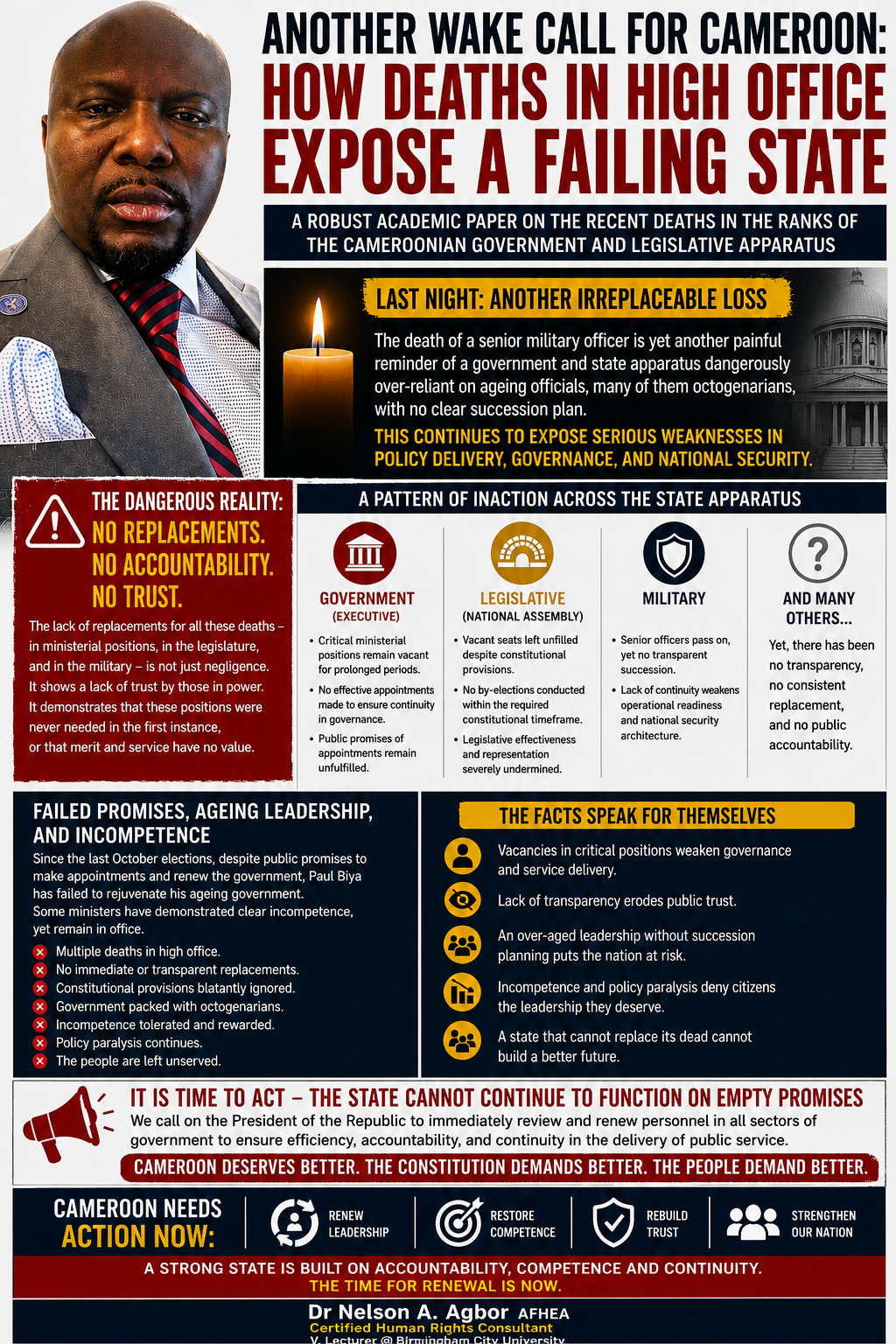
The recent wave of deaths within the Cameroonian political, administrative, and military establishment has exposed a profound structural crisis at the heart of the state. What initially appeared to be isolated incidents has become a pattern, revealing the fragility of a government overwhelmingly dominated by elderly officials who have remained in office for decades, with no credible succession planning. The death of Brigadier General Philippe Mpay on the night of 8–9 May 2026 has intensified public concern about the ageing of the state apparatus and the regime’s inability to ensure institutional continuity. The repeated disappearance of senior figures from the political scene, without timely replacement, raises serious constitutional, administrative, and governance questions.questions.
Over the past several months, Cameroon has seen the deaths of several prominent figures in strategic positions within the state hierarchy. Among them are Marcel Niat Njifenji, former President of the Senate and Vice Nforh Ndiepnso Tabetando; Cavayé Yéguié Djibril, long-serving President of the National Assembly; Alexis Dipanda Mouelle, former President of the Supreme Court; Jean Pierre Biyiti bi Essam, former minister and diplomat; and now Brigadier General Philippe Mpay. These deaths are not merely symbolic. They concern individuals who held pivotal institutional positions, and their absence directly affects the state’s functioning. The accumulation of vacancies at the summit of the republic illustrates the dangers inherent in concentrating power within an ageing political elite that has failed to prepare a younger administrative generation capable of ensuring continuity.
The Cameroonian Constitution is explicit about the need to maintain institutional continuity. Constitutional principles governing the operation of the executive, legislative, and military structures require that vacancies arising from death, resignation, or incapacity be filled without delay to ensure the uninterrupted functioning of public institutions. The doctrine of continuity of the state is central to constitutional governance in Cameroon, particularly in relation to parliamentary leadership, ministerial functions, and strategic military command structures. Yet, despite this constitutional imperative, numerous positions left vacant by deceased officials remain unfilled or are occupied on an interim, ineffective basis. This persistent delay reflects a dangerous culture of political inertia within the regime.
The death of Brigadier General Philippe Mpay is particularly significant because it highlights how deeply Cameroon’s security establishment is trapped in gerontocratic governance. At a time when the country faces multiple security threats, including instability in the Far North, separatist conflict in the Anglophone regions, and growing transnational insecurity in Central Africa, the persistence of octogenarians in sensitive military positions undermines operational effectiveness. A modern military institution requires dynamic leadership, rapid adaptation, and strategic innovation. The continued reliance on ageing officers who often remain in office beyond retirement age weakens institutional responsiveness and creates dangerous command vacuums when officers die.
The legislative branch has also suffered from this paralysis. The deaths of Cavayé Yéguié Djibril and Marcel Niat Njifenji followed decades in which both men personified institutional stagnation in Cameroon’s parliament. Their extraordinarily long tenures reflected a political system resistant to renewal and excessively dependent on personalities rather than on institutions. While formal replacements may eventually emerge, the broader issue remains unresolved: the absence of a systematic process for generational transition within the political elite. Parliamentary institutions cannot function effectively when leadership succession depends entirely on presidential discretion rather than on constitutional norms and democratic institutionalisation.
This failure to appoint replacements promptly also reveals a deeper political problem: a profound lack of trust within the ruling establishment. The reluctance to renew personnel suggests that power remains concentrated within an extremely narrow circle around President Paul Biya, where loyalty is valued above competence or institutional necessity. If strategic positions can remain vacant for extended periods without apparent urgency from the presidency, it inevitably raises questions about whether many of these offices were genuinely necessary in the first place. The situation exposes the highly personalised nature of governance in Cameroon, where institutions function less as autonomous organs of state and more as extensions of presidential authority.
The crisis becomes even more glaring when viewed against the backdrop of promises made after the October elections. President Paul Biya reportedly said that a government reshuffle and administrative renewal would be carried out to inject new energy into the state apparatus. Yet months later, no substantial renewal has taken place. Ageing ministers remain in office despite mounting evidence of administrative exhaustion and public dissatisfaction. Some ministers have repeatedly shown serious shortcomings in handling public policy challenges, including infrastructure development, security management, and economic governance. The absence of decisive action reinforces the perception that the regime is increasingly disconnected from the country’s operational realities.
The consequences of this stagnation are already evident in policy implementation. Administrative inefficiency, delayed public projects, weak crisis-response mechanisms, and declining public confidence stem in part from leadership fatigue at the highest levels of government. A state apparatus dominated by elderly officials with limited dynamism struggles to adapt to rapidly evolving political, technological, and socio-economic realities. Cameroon’s youthful population increasingly views its governing institutions as outdated and incapable of responding effectively to contemporary national challenges. The deaths of senior officials merely expose what has long been an underlying structural dysfunction.has long been an underlying structural dysfunction.
Furthermore, the lack of immediate replacements creates uncertainty within the bureaucracy and weakens institutional morale. In military structures, prolonged vacancies or interim command arrangements can create confusion over authority and strategic direction. In legislative institutions, leadership vacuums reduce parliamentary efficiency and weaken democratic oversight. Within ministerial departments, the absence of substantive appointments delays decision-making and paralyses policy execution. Such dysfunction undermines not only governance efficiency but also the state’s credibility among citizens and international partners.
Cameroon therefore faces an urgent need for comprehensive institutional renewal. The continued deaths of senior state officials should not be treated merely as isolated tragedies but as warnings of systemic decline within the governing structure. President Paul Biya and the ruling establishment must immediately undertake a thorough review of personnel across the executive, legislative, and military sectors to ensure continuity, efficiency, and constitutional stability. The survival and effectiveness of the Cameroonian state depend on its ability to transition from personalised gerontocratic governance towards institutional resilience grounded in competence, renewal, and accountability. Without such reforms, the repeated vacancies caused by ageing leadership will continue to weaken the republic and deepen the governance crisis facing Cameroon today.
Dr Nelson A. Agbor AFHEA
Certified Human Rights Consultant
V. Lecturer @Birmingham City University.




