
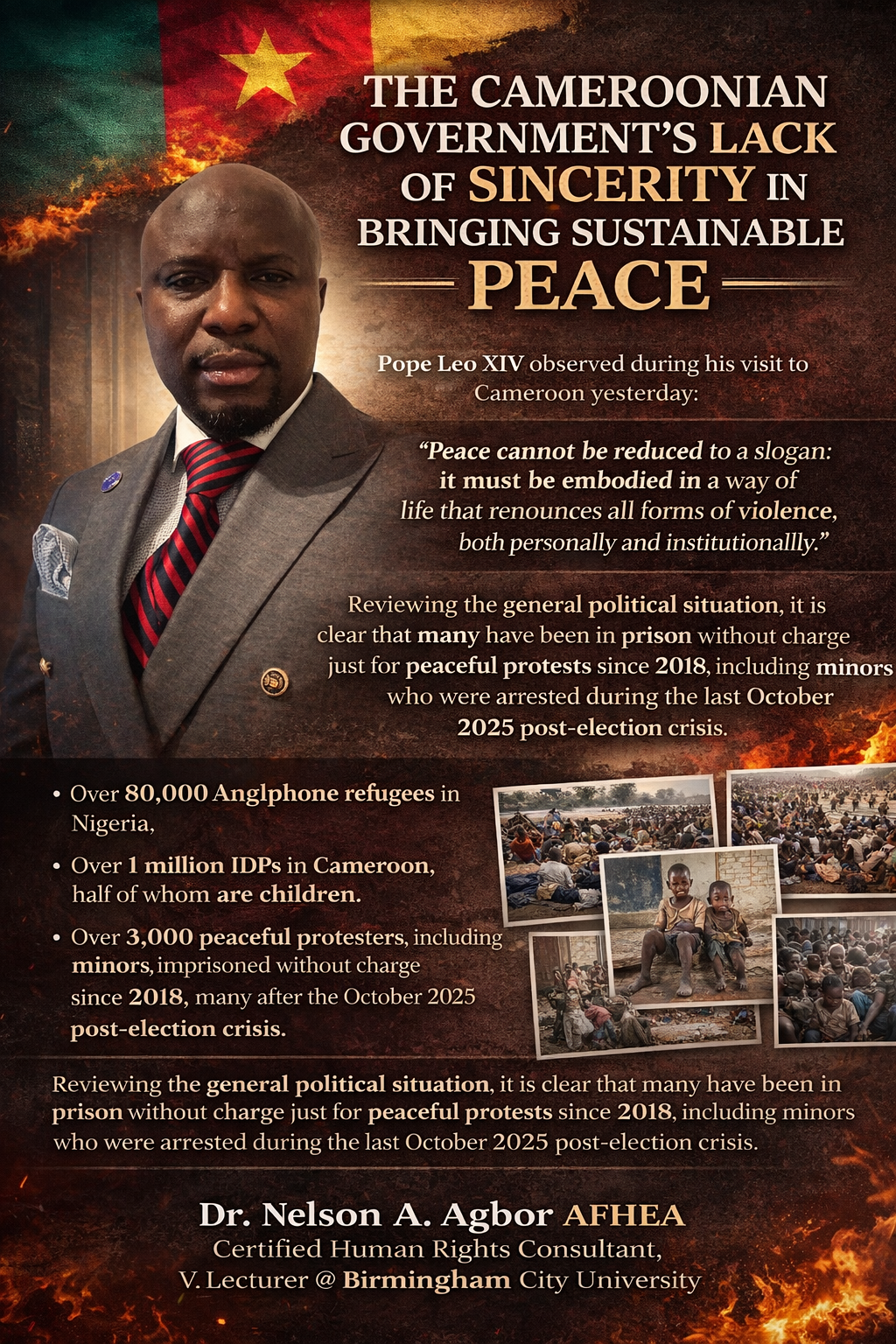
The question of sustainable peace in Cameroon remains one of the most pressing political and humanitarian crises in contemporary Africa. Despite repeated official rhetoric emphasising unity and stability, mounting evidence from humanitarian organisations, civil society actors, and international observers points to a persistent gap between state discourse and lived realities. This disjunction was starkly underscored during the recent visit of Pope Leo XIV, who cautioned that “peace cannot be reduced to a slogan,” but must instead manifest in both personal conduct and institutional practice. His remarks implicitly challenge the Cameroonian government’s longstanding narrative, raising serious questions about its sincerity in pursuing a durable resolution to the Anglophone crisis.
At the heart of this critique is the protracted conflict in Cameroon’s Anglophone Northwest and Southwest regions, which began in 2016 with a series of peaceful protests by lawyers and teachers. These demonstrations, initially grounded in demands for linguistic and legal recognition, were met with forceful repression. Over time, the crisis escalated into an armed conflict between state forces and separatist groups. The government has consistently framed its actions as necessary for national security; however, the persistence and escalation of violence suggest that coercive measures have failed to address underlying grievances.
Humanitarian indicators starkly contradict official claims of progress. According to reports from organisations such as the United Nations High Commissioner for Refugees and the Norwegian Refugee Council, more than 700,000 people are internally displaced in Cameroon. At the same time, more than 100,000 have fled across the border into Nigeria. These figures reflect not only the scale of the crisis but also its enduring nature. The continued outflow of refugees contradicts any assertion that stability has been restored and underscores the absence of conditions conducive to voluntary return.
Particularly troubling is the disproportionate impact of the conflict on children. UNICEF and other child-focused organisations have documented widespread school closures, leaving hundreds of thousands of children deprived of formal education for years. In some cases, schools have been directly targeted, either burned or forcibly shut down. The resulting educational vacuum has heightened children’s risk of exploitation, recruitment by armed groups, and psychological trauma. Pope Leo XIV’s emphasis on renouncing violence “both personally and institutionally” resonates strongly here, as the institutional failure to safeguard children constitutes a profound moral and political indictment.ound moral and political indictment.
The situation of internally displaced persons (IDPs) further illustrates systemic shortcomings. Many IDPs live in precarious conditions, lacking adequate shelter, healthcare, and access to basic services. Humanitarian agencies have repeatedly highlighted funding shortfalls and restricted access to affected areas, often due to insecurity or administrative constraints imposed by authorities. These conditions are not merely incidental but reflect structural deficiencies in governance and crisis management.
Another critical dimension is the erosion of civil liberties. Since 2018, numerous reports from groups such as Amnesty International and Human Rights Watch have documented arbitrary arrests, prolonged detention without trial, and the suppression of peaceful protests. Individuals advocating dialogue or expressing dissent have frequently been charged under anti-terrorism laws, raising concerns about the proportionality and legality of state responses. This pattern suggests an institutional reliance on repression rather than engagement.
The October 2025 post-election crisis was a particularly alarming episode. Following contested electoral results, protests erupted in several regions, including Anglophone areas. Security forces responded with mass arrests, reportedly detaining hundreds, including minors. Detaining children in political contexts constitutes a severe violation of international human rights standards, including the Convention on the Rights of the Child, to which Cameroon is a party. Such actions further undermine the credibility of the government’s claims to uphold the rule of law.
In this context, Pope Leo XIV’s intervention takes on heightened significance. His statement can be read not merely as a general moral exhortation but as a pointed critique of performative peacebuilding. By emphasising the need for peace to be “embodied,” he implicitly calls for concrete policy shifts—beyond symbolic gestures towards substantive reforms. This includes addressing the root causes of conflict, such as political marginalisation, economic inequality, and cultural exclusion.
The Cameroonian government has, on occasion, initiated dialogue processes, most notably the 2019 Major National Dialogue. However, these efforts have been widely criticised for their limited inclusivity and lack of follow-through. Key stakeholders, including prominent separatist leaders and civil society representatives, were either excluded or under-represented. Consequently, the dialogue failed to produce a consensus framework capable of de-escalating the conflict.
A genuine commitment to sustainable peace would require a fundamentally different approach. First, there must be an unequivocal end to arbitrary detentions and the immediate release of individuals held without charge, particularly those arrested for peaceful political expression. This step would signal a willingness to restore trust and uphold the rule of law. Second, the government must engage in inclusive, good-faith dialogue with all relevant actors, including those with dissenting views. Without such engagement, any peace initiative risks being perceived as unilateral and insincere.
Furthermore, institutional reforms are essential to address longstanding grievances. These may include decentralisation measures that grant greater autonomy to Anglophone regions, judicial reforms to ensure linguistic parity, and accountability mechanisms for human rights violations. Importantly, these reforms must be implemented transparently and monitored by independent bodies to ensure credibility.
In conclusion, the current trajectory of the Cameroonian state raises serious doubts about its sincerity in pursuing sustainable peace. The humanitarian crisis, characterised by mass displacement, refugee flows, and the suffering of children, is empirical evidence of policy failure. The continued repression of dissent further compounds this failure. Pope Leo XIV’s remarks serve as both a moral compass and a political challenge: peace must be lived, not proclaimed. For Cameroon, this means moving from rhetoric to action, beginning with the release of detainees and the initiation of a genuinely inclusive dialogue. Only through such measures can the foundations of lasting peace be meaningfully laid.
Dr Nelson A. Agbor AFHEA
Certified Human Rights Consultant
V. Lecturer @Birmingham City University.




