
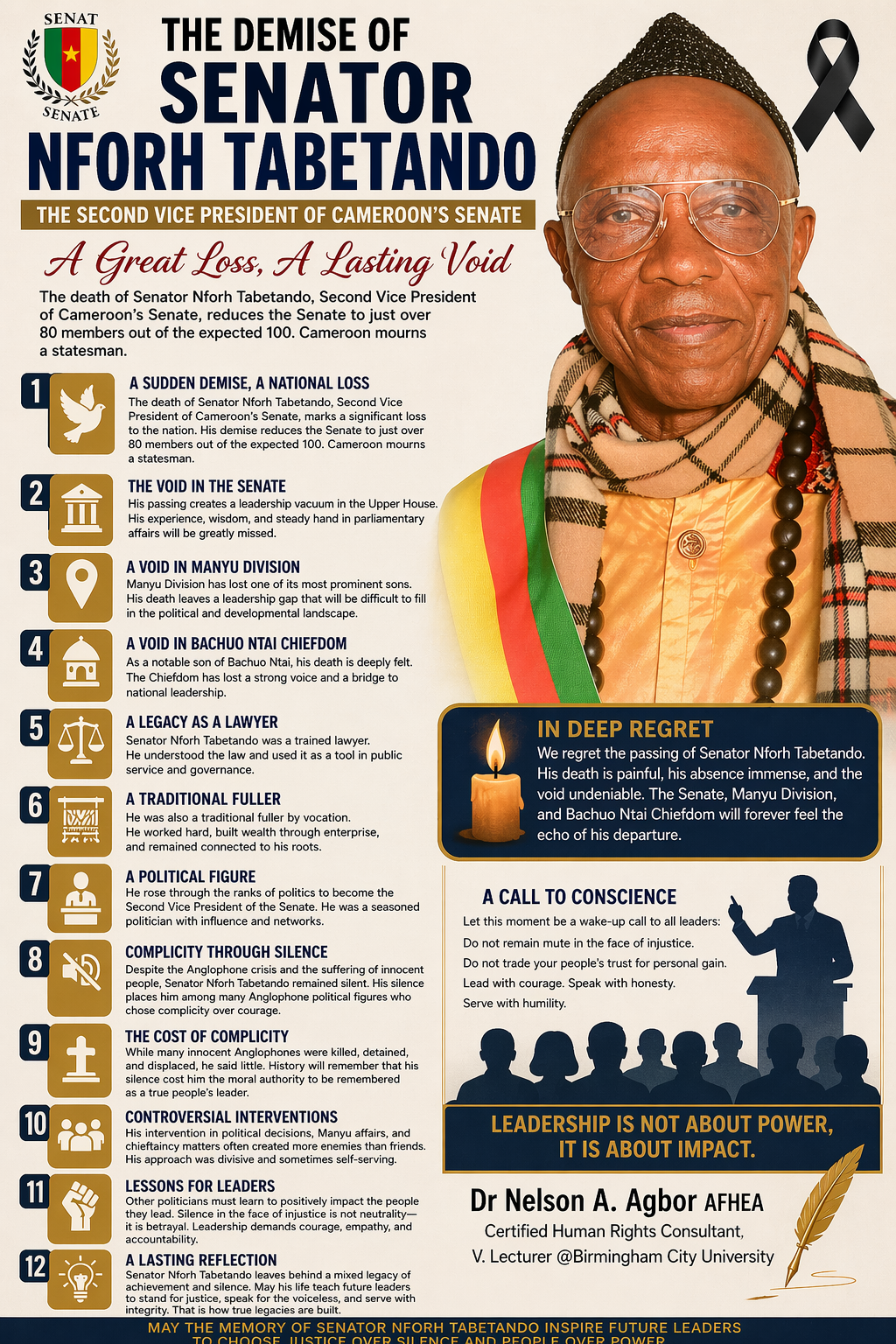
The passing of Nfor Ndiepnso Tabetando on April 21, 2026, marks a significant rupture in the institutional, political, and socio-cultural fabric of Cameroon. As Second Vice President of the Senate, his death not only represents the loss of a senior statesman but also underscores the fragility of elite continuity within Cameroon’s upper chamber of the bicameral legislature. His death, occurring just days after another high-level loss, has contributed to a notable depletion of the Senate’s membership, reducing it to just over eighty active members out of the constitutionally mandated one hundred. This numerical contraction is not merely administrative; it carries implications for legislative quorum, regional representation, and elite bargaining within the state.
Beyond institutional arithmetic, the death of Tabetando reverberates profoundly across the Manyu Division, a locality whose political visibility has long been intertwined with his career. As a senator for the South West Region, he embodied a rare intersection of traditional authority and modern governance. His passing leaves a palpable vacuum in local political mediation, particularly in a division already strained by the protracted Anglophone crisis. The symbolic and practical absence of such a figure inevitably weakens channels of representation between peripheral constituencies and the central state.
At the micro-sociological level, the void is even more acute within the Bachuo Ntai Chiefdom, where Tabetando reigned as a traditional ruler for over three decades. His dual identity as both senator and chief positioned him as a cultural custodian and political broker. His death thus disrupts not only governance structures but also the continuity of customary authority, which remains central to social cohesion in rural Cameroon. Mourning in Bachuo Ntai is therefore not merely ceremonial; it signals a rupture in generational leadership and communal identity.
An examination of his professional trajectory reveals a layered legacy. Trained in law, Tabetando practised for over forty years, established a legal chamber in Douala, and positioned himself within Cameroon’s elite legal class. His legal career provided the epistemic foundation for his later political engagements, enabling him to navigate legislative processes with technical competence. Within the Senate, he rose to positions of influence, including leadership of the ruling party’s parliamentary group, thereby consolidating his standing within the Cameroon People’s Democratic Movement.
Equally significant was his role as a traditional “fuller”, a custodian of customs and moral order within his chiefdom. This aspect of his identity complicates simplistic readings of his career. Unlike technocratic politicians detached from local realities, Tabetando embodied a hybrid authority, rooted in both indigenous legitimacy and modern state structures. His contributions to religious and cultural institutions, including patronage of the Catholic Church, further reinforced his standing as a moral figure within his community.
Yet any comprehensive academic assessment must move beyond hagiography. Tabetando’s political career unfolded during one of Cameroon’s most turbulent periods: the Anglophone crisis. Beginning in 2016, the conflict exposed deep structural grievances in the Anglophone regions, including marginalisation, linguistic discrimination, and uneven development. At the height of the crisis, numerous reports documented the killing of civilians and widespread human rights abuses. In this context, the silence or perceived silence of Anglophone elites in national institutions came under intense scrutiny.
Tabetando stands as an emblem of this contested elite comportment. Despite his proximity to power and his symbolic status as a representative of Anglophone constituencies, he did not emerge as a vocal critic of state violence or a robust advocate for systemic reform. This perceived complicity aligns him with a broader cohort of Anglophone political figures whose strategic silence has been interpreted as acquiescence. The ethical implications of such silence are profound: it raises questions about the responsibilities of representation, particularly in crisis contexts.
The critique sharpens when set against his otherwise successful career. Here was a man who had accumulated significant legal expertise, political capital, and traditional authority. Yet these resources were not decisively mobilised to challenge the structural injustices affecting his own constituency. In this sense, his legacy is marked by a paradox: institutional success coexisting with moral ambivalence. This duality complicates attempts to canonise his contributions without acknowledging their limitations.
Moreover, his political interventions at the local level were not without controversy. His involvement in Manyu’s political and chieftaincy affairs often generated friction, producing more adversaries than allies. These dynamics underscore the inherently contentious nature of hybrid authority figures, whose overlapping roles can blur the line between public service and personal influence. In Manyu, these tensions occasionally undermined the cohesion that his leadership ostensibly sought to promote.
Another dimension of critique concerns the geographic and political centralisation of power. Like many Cameroonian elites, Tabetando’s career was centred on the capital, Yaoundé, the epicentre of political decision-making. His continued alignment with central authority structures arguably distanced him from grassroots realities, reinforcing perceptions of elite detachment. The notion that such alignment precluded principled dissent further complicates his historical evaluation.
Nevertheless, it would be analytically reductive to dismiss his contributions outright. Tabetando’s role in sustaining traditional institutions, fostering religious patronage, and participating in national governance constitutes a substantive legacy. His career illustrates the complexities of leadership in postcolonial African states, where actors must navigate competing demands of tradition, modernity, and political survival. The tragedy lies not in his achievements but in the opportunities foregone, particularly the chance to leverage his position for transformative advocacy.
The lessons from his demise are therefore instructive. Contemporary and future politicians must recognise that leadership entails not only the accumulation of power but also its ethical use. Silence in the face of injustice is not neutrality; it is a form of participation. The Anglophone crisis, with its attendant human cost, underscores the need for courageous representation. Political actors must move beyond performative allegiance to actively defend the rights and dignity of their constituents.
In conclusion, the death of Nfor Ndiepnso Tabetando encapsulates both the grandeur and the contradictions of elite politics in Cameroon. His passing leaves a tangible void in the Senate, in Manyu Division, and within the Bachuo Ntai Chiefdom. Yet his legacy is neither wholly celebratory nor entirely condemnatory. Rather, it is a composite of achievement and omission, authority and silence. As Cameroon reflects on his life, the imperative is clear: future leaders must aspire not only to occupy positions of influence but also to wield them in the service of justice, accountability, and genuine representation.n the service of justice, accountability, and genuine representation.
Dr Nelson A. Agbor AFHEA
Certified Human Rights Consultant
V. Lecturer @Birmingham City University.




