
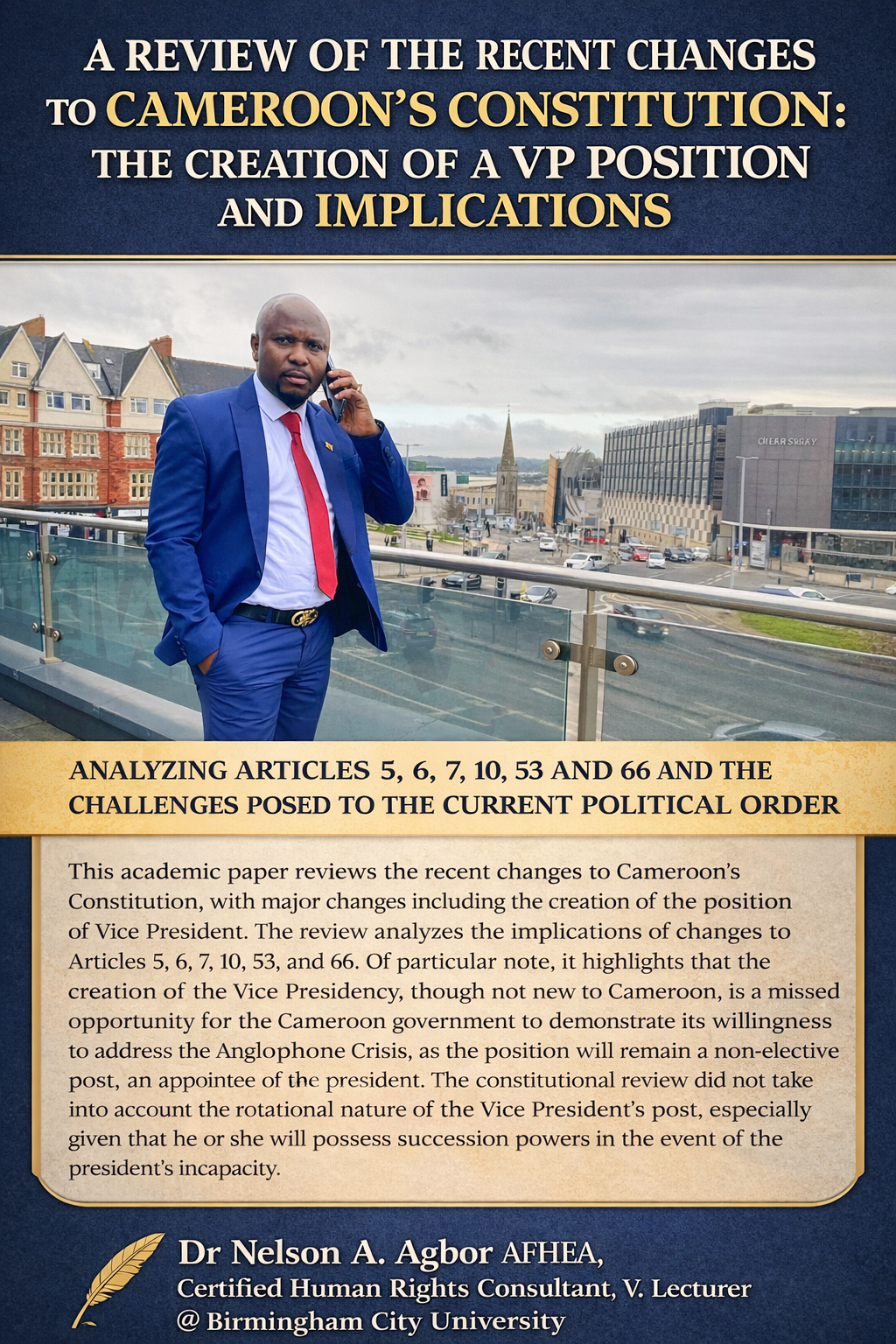
The ongoing constitutional reform process in Cameroon, especially the proposed amendments to Articles 5, 6, 7, 10, 53, and 66, marks a pivotal moment in the development of the country’s constitutional framework. These reforms, most notably the reintroduction of the Vice Presidency, must be viewed within a broader historical and political context characterised by strong presidential power, prolonged incumbency, and unresolved structural tensions such as the Anglophone Crisis. While the reform is framed as an effort at institutional modernisation, its deeper implications indicate continuity rather than change in Cameroon’s governance structure.
Article 5, which traditionally defines the powers and role of the President, appears to be further entrenched by the proposed reforms. Cameroon’s constitutional tradition already concentrates executive authority in the presidency, with the President acting as both Head of State and central arbiter of national policy. Paul Biya’s extended tenure over four decades has reinforced this model, particularly following the removal of presidential term limits in 2008. Any amendment that introduces a Vice President without diluting presidential authority risks reinforcing a hierarchical executive rather than creating a genuinely balanced one. Thus, Article 5’s evolution indicates a continuity of hyper-presidentialism rather than a move towards executive pluralism.
Article 6, which governs the presidential election and tenure, is indirectly affected by the introduction of a Vice President with succession powers. The reform seems motivated by the need to clarify succession mechanisms, especially given the advanced age of the current president and the lack of a stable transitional framework. However, by not democratising the selection of the Vice President, who remains a presidential appointee, the reform creates a paradox: succession is formalised, but legitimacy is not. This results in a structurally weak link in the constitutional chain of democratic accountability.
Article 7, which explicitly addresses presidential succession, undergoes one of the most significant transformations. Previously, interim authority was entrusted to the President of the Senate; the proposed reform replaces this with the Vice President. While this may streamline the continuity of the executive, it also centralises succession within the executive branch itself. The change removes a crucial inter-institutional check by excluding the legislature from the succession process. In terms of constitutional design, this represents a vertical consolidation of power rather than a horizontal distribution.
Article 10, which outlines presidential powers, including appointments, gains renewed significance through the reform. The Vice President’s status as a presidential appointee directly stems from this provision. This reinforces a patronage-based executive structure, where the Vice President’s political survival depends entirely on presidential confidence. Consequently, the office lacks autonomy and cannot function as an independent constitutional counterweight. The reform thus institutionalises executive subordination within the highest levels of government.
Article 53, which establishes the High Court of Justice (or Court of Impeachment) must be interpreted in light of the new executive configuration. The introduction of a Vice President raises questions regarding accountability mechanisms: would the Vice President be subject to the same impeachment procedures as the President? If so, the concentration of executive power within a tightly controlled hierarchy could complicate enforcement. Given Cameroon’s historical pattern of limited judicial independence and strong executive influence, the reform risks rendering Article 53 procedurally intact but substantively weakened.
Article 66, which mandates asset declaration by public officials, ostensibly promoting transparency and anti-corruption norms. However, its effectiveness depends on enforcement mechanisms that have historically been weak. The inclusion of a Vice President within this framework does not, in itself, strengthen compliance. Instead, it broadens the circle of high-ranking officials subject to a provision that has been inconsistently implemented. Thus, while Article 66 remains normatively progressive, its practical impact under the new constitutional arrangement is likely to remain limited.the new constitutional arrangement is likely to remain limited.
The most politically significant aspect of the reform is the reintroduction of the Vice Presidency itself. Historically, Cameroon had a Vice President during the federal era (1961–1972), a position notably held by Anglophone leaders as part of a delicate regional balance. The current reform, however, abandons this rotational or representational approach. By appointing the Vice President rather than electing them, the government loses an opportunity to address long-standing grievances in the Anglophone regions, where perceptions of marginalisation remain a key driver of conflict.
This omission is especially significant in the context of the Anglophone Crisis, which is rooted in historical, legal, and linguistic inequalities. A constitutionally mandated rotational Vice Presidency, alternating between Anglophone and Francophone regions, could have served as a symbolic and institutional means of inclusion. Instead, the proposed model strengthens central control and sidesteps participatory legitimacy. The reform thus embodies a technocratic approach to succession rather than a reconciliatory one to nation-building.
Furthermore, the decision to keep the Vice Presidency as a non-elective position creates a democratic deficit. In comparative constitutional practice, vice presidents who hold succession powers are generally elected on a joint ticket with the president, sharing a mandate. Cameroon’s approach diverges from this tradition, resulting in a situation where an unelected official can assume the presidency. This prompts serious questions about constitutional legitimacy, especially in a political system already criticised for limited electoral competitiveness.
In conclusion, the constitutional amendments to Articles 5, 6, 7, 10, 53, and 66, along with the creation of the Vice Presidency, constitute an incremental rather than transformative reform. While they address the technical issue of succession, they do not engage with deeper structural challenges, including executive over-centralisation, weak accountability mechanisms, and the unresolved Anglophone Crisis. The reintroduction of the Vice Presidency, although historically grounded, appears as a missed opportunity that prioritises regime stability over constitutional inclusivity and democratic renewal.
Dr Nelson A. Agbor AFHEA
Certified Human Rights Consultant
V. Lecturer @Birmingham City University.




