
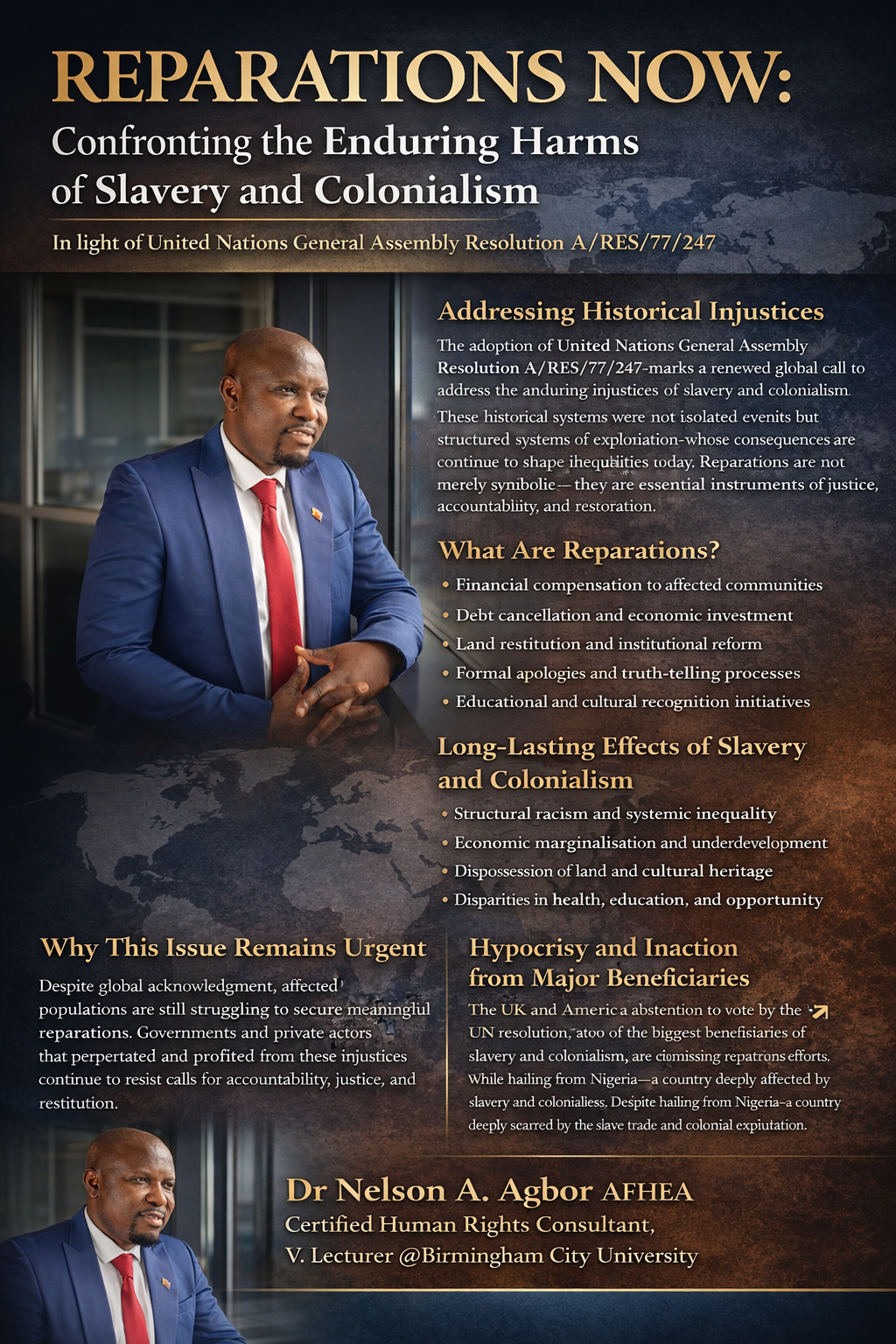
The issue of reparations for the historical injustices of slavery and colonialism has re-emerged as a key topic in international human rights discussions, especially following United Nations General Assembly Resolution A/RES/78/234, which urges renewed global focus on reparatory justice. This resolution indicates a growing awareness that the legacies of transatlantic slavery and imperial rule are not merely historical but continue to influence current inequalities. In this context, reparations are more than symbolic acts; they involve tangible, political, and moral efforts to address systemic damage caused over centuries. The ongoing existence of global racial and economic inequalities highlights the need to adopt such measures.
Reparations include a wide range of measures, such as financial compensation, debt cancellation, institutional reform, land restitution, and public recognition of wrongdoing. They also involve investments in education, healthcare, and infrastructure in communities most affected by slavery and colonial exploitation. Significantly, reparations are based on principles of restorative justice, aiming to mend relationships between perpetrators and victims while tackling structural inequalities. The call for reparations is therefore not merely retrospective but seeks to change current and future conditions shaped by historical injustices.
The enduring impacts of slavery and colonialism are visible across many aspects of contemporary life. Economically, formerly colonised nations and diasporic communities often remain embroiled in poverty, underdevelopment, and exclusion from global markets. Socially, racial hierarchies established during colonial rule still exist in forms of discrimination and marginalisation. Politically, many countries continue to struggle with unstable governance structures imposed or influenced by colonial powers. These lasting consequences show that slavery and colonialism were not just isolated historical events but fundamental processes that shaped the modern world system.
Despite these realities, efforts to secure reparations have faced resistance from powerful nations, including the UK and the US, both of which abstained from voting on the aforementioned UN resolution. This abstention is particularly notable given the central roles these countries played in the transatlantic slave trade and colonial expansion. Their reluctance to support reparatory frameworks raises important questions about accountability and the willingness of former imperial powers to confront their historical responsibilities—positions that could undermine global commitments to justice and equality.
The debate over reparations is further muddled by politicians’ comments that seem dismissive or contradictory. For example, Kemi Badenoch, leader of the UK Conservative Party, has faced criticism for remarks that trivialise the importance of reparations. This position is seen as hypocritical, especially considering her Nigerian roots, as Nigeria itself bears deep scars from the transatlantic slave trade and British colonialism. Such language not only undermines the lived experiences of affected communities but also fuels a wider hesitation to engage seriously with historical accountability.
In conclusion, the demand for reparations remains a crucial and unresolved issue in global justice. The lasting effects of slavery and colonialism continue to influence inequalities, making reparatory actions both essential and urgent. International efforts, such as UN Resolution A/RES/78/234, are important steps toward recognising these injustices, but real progress depends on the active participation and commitment of the nations that benefited most. Without such involvement, the promise of justice may stay unfulfilled, and the structural legacies of oppression will endure for generations.
Dr Nelson A. Agbor AFHEA
Certified Human Rights Consultant
V. Lecturer @Birmingham City University.




