
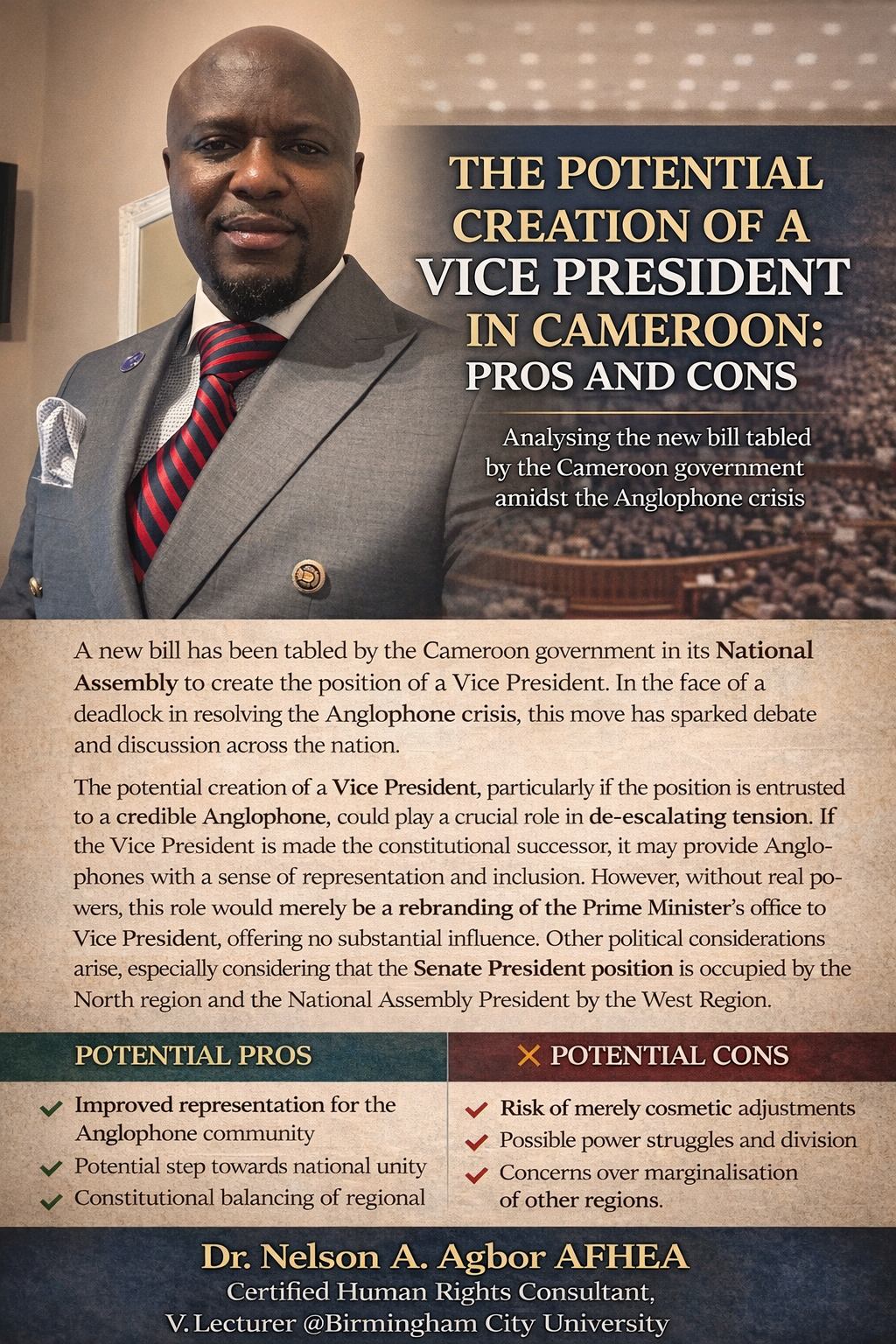
The tabling of a constitutional reform bill to establish the position of Vice President in Cameroon’s National Assembly signifies a potentially important institutional change within the country’s semi-presidential system. Although the details of the bill are still being debated in parliament, early signs suggest it could be part of a wider rebalancing of executive authority and political representation in a context characterised by long-standing governance under President Paul Biya and growing political instability. The proposal comes at a time when Cameroon’s National Assembly, controlled by the ruling party, remains the primary legislative forum for constitutional reform, and when discussions about succession, inclusion, and national unity have intensified. Therefore, the creation of a vice presidency should be seen not only as an administrative change but also as a calculated political move to address internal pressures.
A key aspect of this reform is its potential importance to the Anglophone crisis, an ongoing armed and political conflict rooted in historical grievances of marginalisation among English-speaking Cameroonians. Since 2017, the crisis has intensified into violent clashes between separatist groups and state forces, leading to thousands of deaths and widespread displacement. The crisis originates from long-standing tensions over linguistic inequality, governance structures, and perceived exclusion from national decision-making. In this context, the introduction of a vice presidency, especially if reserved for or politically assigned to an Anglophone, could symbolically and institutionally recognise the state’s bilingual foundations. Such a move might indicate the central government’s willingness to reconfigure power-sharing arrangements and address demands for greater inclusion.
However, the effectiveness of this reform as a conflict-mitigation tool largely depends on the constitutional powers assigned to the office. If the vice president is granted significant executive authority and clearly identified as the constitutional successor to the presidency, the position could offer Anglophone elites a credible stake in national governance. This could, in theory, encourage elite buy-in and lessen perceptions of systemic exclusion. Conversely, if the role remains mostly ceremonial or subordinate, merely replacing the existing Anglophone-held post of prime minister without real authority, it risks being seen as superficial reform. Such a situation would likely increase scepticism among Anglophone communities, for whom previous measures, including the 2019 “special status” arrangement, have been criticised as insufficient or symbolic.
Beyond the Anglophone question, creating a vice presidency has broader political implications for Cameroon’s already limited political space. On one side, it could bring clarity to presidential succession, especially in a system where the Senate president currently acts as the interim successor. Reassigning this role to a vice president might reduce uncertainty and help stabilise elite competition. On the other hand, the reform could further strengthen executive dominance if the appointment process remains centralised within the presidency, thereby limiting democratic accountability. In a context where opposition parties already face structural disadvantages and electoral reforms are still debated, introducing a vice presidency could either open up or further restrict opportunities for political participation, depending on its design.
Regional balancing is another crucial factor shaping the implications of this proposal. Cameroon’s political system has long depended on informal mechanisms of regional and ethnic representation to sustain equilibrium among diverse constituencies. The recent allocation of key institutional roles, such as the Senate presidency to the North and the National Assembly presidency to the West, reflects this approach of geopolitical balancing. In this context, assigning the vice presidency to an Anglophone could be seen as an extension of this strategy, strengthening national unity through symbolic inclusivity. However, such balancing can also entrench identity-based politics, potentially increasing fragmentation if not paired with substantial policy reforms that address root grievances.
In conclusion, the proposed creation of a vice presidency in Cameroon presents both an opportunity and a risk within the country’s evolving political landscape. Its potential to resolve the Anglophone crisis depends on whether it truly entails meaningful power-sharing or is simply a rebranding of existing structures. While it might improve clarity on succession and provide a platform for regional inclusion, it could also reinforce executive centralisation and become a symbolic gesture if not implemented thoughtfully. Ultimately, the success of this reform will rely less on the existence of the office itself and more on the political will to endow it with real authority, ensure fair representation, and incorporate it into a broader framework of democratic and institutional reform.
Dr Nelson A. Agbor AFHEA
Certified Human Rights Consultant
V. Lecturer @Birmingham City University.




