
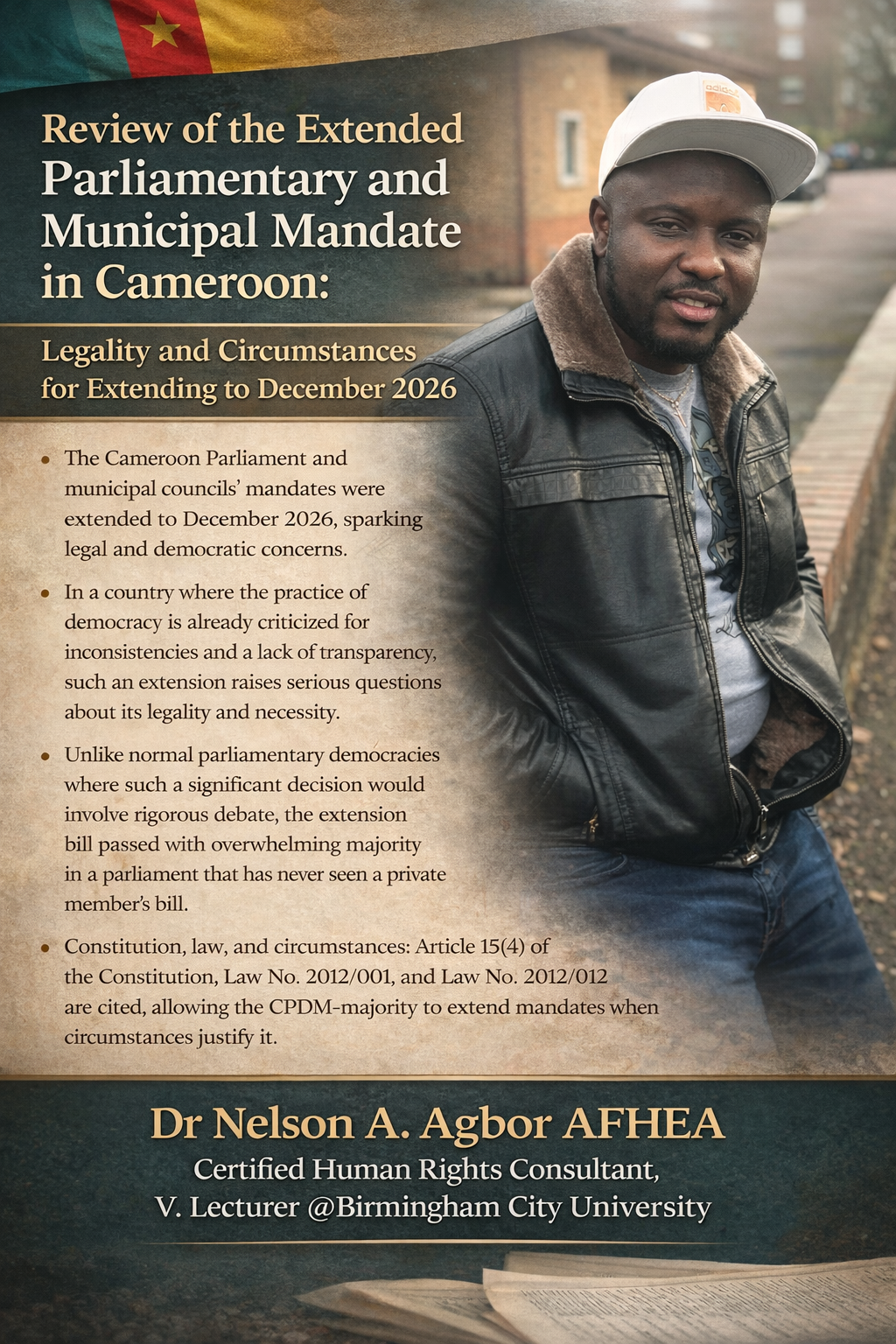
The proposed extension of parliamentary and municipal mandates in Cameroon to December 2026 should be viewed within a broader pattern of electoral delays and constitutional manoeuvring that have increasingly shaped the country’s political path. Originally, legislative and municipal elections scheduled for 2025 were postponed through a series of legal measures, including Law No. 2024/011 of 24 July 2024, which extended the mandate of Members of Parliament to 30 March 2026. Municipal councillors also benefited from an executive decree extending their term to at least May 2026. Current discussions suggest a possible further extension to as late as December 2026, justified by what the executive calls “compelling constraints” affecting the electoral timetable. This developing situation raises important questions about constitutional legality, democratic legitimacy, and the balance of institutional power.
From a strictly legal perspective, the Constitution of Cameroon provides a framework for such extensions. Article 15(4) of the Constitution allows the President of the Republic, “where circumstances so warrant,” to request Parliament to extend or abridge its term of office by law, following consultation with the Constitutional Council and parliamentary bureaux. This provision serves as the main legal basis for extending legislative mandates. In parallel, the Electoral Code, particularly Article 170(2), permits the postponement of municipal elections by presidential decree, reflecting a distinction between legislative and local electoral processes. Thus, procedurally, the extension of mandates is not inherently unconstitutional; rather, its legality depends on the existence of exceptional circumstances and adherence to the prescribed consultative mechanisms.nces and adherence to the prescribed consultative mechanisms.
However, the constitutionality of such extensions cannot be assessed solely on procedural grounds. The phrase “where circumstances so warrant” suggests the presence of objective, compelling, and exceptional conditions, such as war, a national emergency, or a severe institutional crisis, that make elections infeasible. While the government has cited logistical and political constraints, including the overlap of multiple elections, critics argue that these do not reach the level of constitutional necessity. Furthermore, the repeated use of this mechanism to first extend mandates to 2026 and, now, possibly beyond, risks turning an exceptional constitutional provision into a routine political tool. This undermines the principle of constitutionalism, which mandates that extraordinary powers remain limited, justified, and temporary.
The political context in which these extensions take place further complicates their legitimacy. Cameroon’s democratic system has long been criticised for structural imbalances, including the dominance of the ruling Cameroon People’s Democratic Movement (CPDM) and the marginalisation of opposition parties. The National Assembly, overwhelmingly controlled by the CPDM, approved the initial extension with little resistance, effectively ensuring the passage of the executive’s proposal. In a legislature where private members’ bills are virtually non-existent and party discipline is strict, the likelihood that a new government-sponsored bill extending mandates to December 2026 would face meaningful opposition is minimal. Consequently, the legislative process risks becoming a mere formality, rather than a genuine forum for deliberation and accountability.
In a functioning parliamentary democracy, a proposal to extend elected mandates, especially for a second term, would typically spark rigorous debate, scrutiny, and possible rejection. Legislators would be expected to balance the necessity of the extension against the democratic principle of regular elections, which is central to representative governance. The lack of such debate in Cameroon highlights deeper institutional weaknesses, including limited legislative independence and the concentration of power in the executive branch. The extension, therefore, seems less a response to unavoidable circumstances and more a politically motivated move that unfairly advantages the incumbent regime by delaying electoral competition.
In conclusion, while extending parliamentary and municipal mandates in Cameroon to December 2026 might be justifiable under a narrow interpretation of constitutional and statutory provisions, its broader legality and legitimacy remain highly debatable. Repeatedly invoking exceptional powers without clearly demonstrated necessity risks undermining constitutional norms and eroding public confidence in democratic institutions. Coupled with a political climate characterised by executive dominance and limited parliamentary oversight, these extensions reinforce perceptions of democratic regression. For such measures to be justified, they must be accompanied by transparent reasoning, genuine institutional consultation, and a clear commitment to restoring the normal electoral cycle conditions, which currently seem only partially met.
Dr Nelson A. Agbor AFHEA
Certified Human Rights Consultant
V. Lecturer @Birmingham City University.




