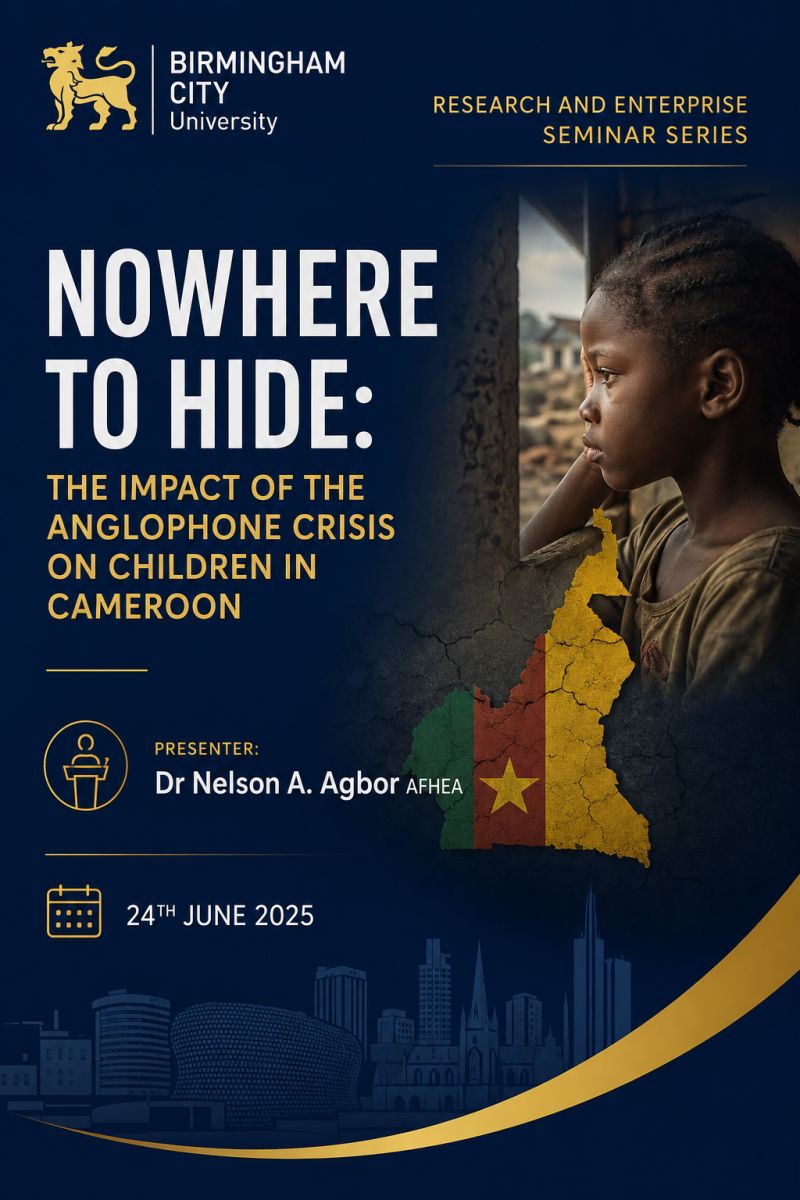
Research and Enterprise Seminar Series
Birmingham City University
24 June 2026
Dr Nelson Agbor presented this research seminar examining the consequences of the continuing Anglophone crisis for children living in Cameroon’s conflict-affected regions.
The presentation considered how prolonged insecurity has affected children’s rights, access to education, physical safety and psychological wellbeing. It also examined the wider responsibilities of state institutions, armed actors and the international community in protecting children during periods of internal conflict.
View the original announcement: https://www.linkedin.com/posts/dr-nelson-agbor-phd-afhea-551bb117b_research-humanrights-childrenrights-activity-7473300261785018368-cdEX/
Presentation overview
The Anglophone crisis in Cameroon has developed from political and legal grievances into a prolonged conflict with serious consequences for civilian communities.
Children have been particularly exposed to the effects of violence, displacement, school closures, insecurity and the deterioration of essential public services. These conditions affect not only their immediate safety, but also their longer-term development, education and ability to participate fully in society.
The presentation examined these consequences through a human rights and legal perspective. It considered the protections owed to children under domestic, regional and international law, while recognising the practical difficulties of enforcing those protections within areas affected by conflict and institutional instability.
Rather than treating children solely as incidental victims of a wider political crisis, the seminar placed their experiences at the centre of the analysis. It asked how prolonged conflict alters childhood itself and how failures of protection may produce consequences extending far beyond the immediate period of violence.
Event details
Presentation: Nowhere to Hide: The Impact of the Anglophone Crisis on Children in Cameroon
Speaker: Dr Nelson Agbor
Event: Research and Enterprise Seminar Series
Institution: Birmingham City University
Date: 24 June 2026
Format: Academic research seminar
Status: Past event
Primary themes: Children’s rights, human rights, conflict, education and Cameroon
Areas of examination
The presentation focused on four interconnected areas.
Children’s rights
The conflict raises serious questions concerning the protection of children’s fundamental rights.
These include the right to life, personal security, education, family life, health and protection from violence, exploitation and degrading treatment. Where state institutions cannot or do not provide effective protection, these guarantees risk becoming formal commitments without practical enforcement.
Education
Education has been one of the most visible areas affected by the crisis.
School closures, insecurity, attacks on educational institutions and fear among families have disrupted learning across parts of Cameroon’s Anglophone regions. Prolonged exclusion from education can deepen inequality and limit children’s future social and economic opportunities.
The interruption of schooling also has broader consequences for community stability, social development and the transmission of knowledge between generations.
Safety and displacement
Children living in conflict-affected communities may face direct violence, forced displacement, family separation and exposure to military or armed activity.
Displacement can place children in unfamiliar and insecure environments, often with limited access to education, healthcare and social support. It can also increase their vulnerability to exploitation, trafficking and other forms of abuse.
Psychological wellbeing
The effects of conflict are not confined to physical harm.
Exposure to violence, insecurity, bereavement and displacement can have lasting psychological consequences. These effects may remain insufficiently recognised where humanitarian and legal responses concentrate primarily on immediate physical protection.
A meaningful response to the crisis must therefore consider mental health, trauma and the longer-term social reintegration of affected children.
Legal and human rights significance
The experience of children during the Anglophone crisis raises questions extending beyond humanitarian concern. It engages legal duties relating to human rights protection, the conduct of hostilities, access to education and the treatment of civilians during internal conflict.
Cameroon is subject to domestic, regional and international obligations concerning the protection of children. These obligations do not cease during periods of political instability or armed violence.
The central difficulty lies in the gap between legal recognition and practical implementation. Rights may be formally guaranteed while institutional weakness, insecurity and limited accountability prevent their effective enforcement.
The crisis therefore illustrates a broader problem within human rights law: the existence of legal protection does not necessarily ensure protection in practice.
The consequences of conflict for children must be assessed not only through immediate casualties, but through the lasting effects on education, security, development and social belonging.
The presentation also raised questions concerning accountability. Where children suffer harm, it is necessary to examine which actors bear legal and institutional responsibility and what remedies are realistically available.
This requires consideration of the conduct of state security forces, non-state armed groups, political authorities and institutions responsible for education, welfare and public protection.
Children within the wider Anglophone crisis
The Anglophone crisis has its origins in longstanding disputes concerning language, legal identity, political representation and the position of Cameroon’s English-speaking regions within the state.
Protests involving lawyers and teachers developed into a wider political confrontation and subsequently into armed conflict. As violence expanded, civilian populations became increasingly exposed to displacement, insecurity and the disruption of public services.
Children occupy a particularly vulnerable position within this environment. They generally have limited influence over the political circumstances that create conflict, yet may endure its consequences throughout their formative years.
The presentation therefore situated children’s experiences within wider questions of governance, political legitimacy and state responsibility. It considered how failures to resolve political and institutional grievances can produce forms of harm that extend into family life, education and childhood development.
Academic context
The presentation formed part of the Birmingham City University Research and Enterprise Seminar Series.
The seminar provided an opportunity for engagement among colleagues, researchers and practitioners working across law, human rights, governance and related disciplines.
By bringing the experiences of children into analysis of the Anglophone crisis, the presentation contributed to a broader understanding of how political conflict affects those who possess the least power to shape its course.
It also reinforced the importance of interdisciplinary research. The consequences of the crisis cannot be understood exclusively through constitutional law, conflict studies, education policy or humanitarian analysis. Each provides only part of the wider picture.
A comprehensive response requires attention to legal protection, institutional accountability, education, health, community resilience and the political conditions necessary for sustainable peace.
External reference
The original event announcement is available through Dr Nelson Agbor’s LinkedIn profile.
Button: View the LinkedIn announcement
Link: https://www.linkedin.com/posts/dr-nelson-agbor-phd-afhea-551bb117b_research-humanrights-childrenrights-activity-7473300261785018368-cdEX/